
Business Observations
Everyone Knew About It at the Time

Nearly a Million Dollars, and It Still Wasn't Over
Many years ago, a property developer had a project that caused damage to a neighbouring home.
When it happened, his first instinct was not to shift blame. It was to fix the problem as quickly as possible. What could be repaired, he repaired. What could be restored, he restored. Some parts had gone beyond a simple repair, so he had them pulled down and rebuilt. By the time it was all done, he had spent close to a million New Zealand dollars dealing with the consequences.
From his point of view, the logic was straightforward. It was his project. The problem had come from the project. So you dealt with it. The neighbour had already been affected; whatever could be done on site, you did it, rather than letting things drag on.
A lot of small-business owners build their companies in exactly this way. There is not always someone to ask, and there is rarely much time to wait. Customers need answers. Staff need answers. Banks, suppliers, building sites and cash flow keep producing new problems. The skill owners develop is simple: when something lands on the desk, however difficult it is, find a way to get it sorted.
The real difficulty only emerged later, when the insurance matter had to be dealt with.

Insurance asked a different set of questions: When did the damage occur? When was it notified? What did the site look like at the time? What work had already been carried out? Why was it done that way? Who made each decision? Where were the photographs, reports, quotes, invoices and emails?
Only then did it become clear that, for a long time, everyone had been focused on fixing the site. Much less effort had gone into preserving a complete record of how those decisions were made. Some material sat in email threads. Some was with different people. Money had genuinely been spent and work had genuinely been done, but once enough time had passed, even basic questions - why this cost arose, which work it related to, who decided what - meant going back through the record.
Later, I became involved in organising the material. Emails, photographs, invoices, reports and correspondence that had been scattered across different places were gathered again and sorted by time and subject. Slowly, what had happened began to form a timeline that someone else could actually follow.
The more I worked through it, the more strongly I felt that we were not creating any new facts. The work had already been done. The money had already been spent. The house had already been repaired. We were simply putting what had happened back into its original order, so that someone who had never been there could understand how the matter had reached that point.
The same event can look very different when its evidence is scattered across hundreds of emails and a pile of invoices, compared with when the same material is laid out by date, event and document. That, I think, is a problem many small businesses eventually encounter: "I did everything I could to sort it out" is not the same thing as allowing someone who arrives later to establish, from the record, what actually happened.
"But He Clearly Did It"
Another owner discovered that one of the company's sales managers was suspected of taking company stock and selling it privately for personal gain.
The owner was furious. To him, the issue seemed fairly simple: if an employee had taken the company's goods and sold them on the side, the business had been harmed. Why would that person remain employed?
He dismissed the manager on the spot.
Later, the matter entered a formal employment relations process. The owner had assumed the central question would be only one thing: "Did the employee actually do it?"
But once the matter moved into a formal process, that was not the only question on the table. How had the company looked into the allegation? Did the employee know exactly what they were suspected of? Were they given a proper opportunity to respond? What process had the owner followed before making the final decision? What records had been kept?
The owner struggled with that.
"But he clearly did it."
I can understand the reaction. Small-business owners deal first with practical consequences. Is stock missing? Has the company lost money? Does the problem need to be dealt with now? It is their company, and every extra day tends to land back on them.
But once a matter enters a formal process, an outsider does not look only at the outcome. They also look back at how you got there.
Why Does This Invoice Belong to My Project?
The third story is less dramatic than the first two. It is just accounts.
A small developer was running several projects at once. Several sites were moving quickly. A load of timber would arrive, some would go to one job, some to two others. Workers might be on Project A today and Project B a few days later. Some costs were paid centrally by the company, with the intention of allocating them back to each project when there was time.
When business is busy, that can feel perfectly natural. The owner knows where the materials went. The project manager probably knows. The accountant may remember. If someone had asked at the time, "Which site did this batch go to?" there was probably an immediate answer.
But projects run for years. People change. Emails multiply. Files thicken. Things that felt impossible to forget at the time become surprisingly hard to reconstruct.
Later, costs on one project changed, and the developer needed to explain additional charges to the client. The client asked a very simple question: "How do you prove that this money was spent on my project?"
The owner said, I did spend it. The invoice is real. The company really paid it. The materials really were bought.
But that was not what the client was asking. The question was: "Why does this invoice belong to my project?"
If materials, labour and payments for several projects have been mixed together for years, proving later that a particular cost belongs to one specific job can become extraordinarily difficult. Eventually, the disputed amount ran into hundreds of thousands of dollars.
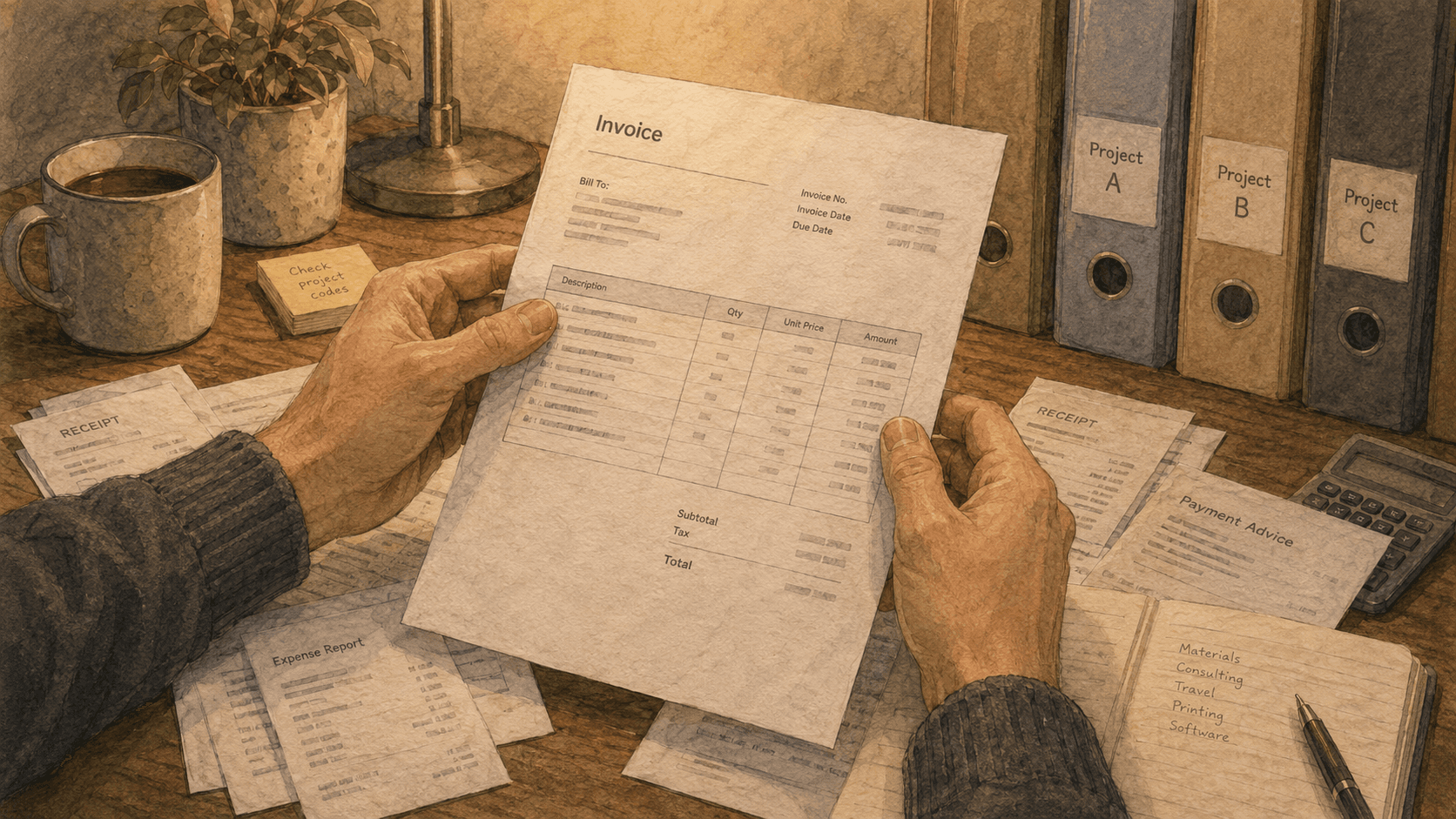
Sometimes, when I was working through records like these, I would sit with a completely ordinary invoice in my hand for a long time.
The supplier's name is there.
The date is there.
The amount is there.
The GST is there.
The paper is real. The money is real.
What is missing is the smallest detail from back then:
where it went.
No Legal Department. No HR.
When I put these stories together, I increasingly think it is unfair to dismiss the problem with a simple line: "The owner didn't understand the process."
A large company may have an in-house legal team, HR, finance, and people responsible specifically for insurance, compliance, contracts and document management. Many small businesses have none of that. The owner is several departments at once.
Today it is a customer. Tomorrow it is debt collection. In the morning it is a staff issue; in the afternoon, a building site. The bank's email needs an answer. So does the lawyer's. The accountant needs something. A supplier's invoice lands directly on the owner's phone. Business problems do not stop arriving at six o'clock. In a small company, most roads eventually lead back to the owner's desk.
That is also why many of the owners I have met are highly capable people. Building a business from very little usually means becoming very good at solving problems: reacting quickly, getting things done, refusing to sit still when something goes wrong. That ability may be exactly what got them this far. But sometimes the same strength becomes a blind spot.
A customer is upset, so calm them down. Something has gone wrong on site, so fix it. There is a staff problem, so deal with it. The site needs materials, so get them there. The owner's most natural question is: Has the problem been solved?
A formal process may ask several more. What was the situation at the time? What did you rely on? Who was notified? Was the other person given a chance to respond? Why was that course chosen? Can the steps still be reconstructed later?
One thing I have come to feel more strongly is that once a commercial dispute enters a formal process, the process can matter just as much as the underlying event. That is not because a person's intentions have no value. It is because intentions stay in people's heads, while process leaves things behind in the world.
Nor is this something unique to any one community. It is closer to a structural condition of small business. Resources are limited. One person plays several roles. It is simply unrealistic to expect a small owner to have a perfect system, a specialist and a complete record for every issue in the way a large organisation might.
Over time, that has also changed how I think about "capability" in business. Capability is not only how much you can carry when a problem lands on you. It is also knowing when the experience that normally helps you solve problems is no longer enough.
Anyone who stays in business long enough is likely to meet a problem that sits outside the experience they use every day. The hard part is not necessarily admitting that you do not know the answer. It is noticing early enough that this particular problem can no longer be pushed forward in the way you are used to. Knowing what you are missing at that moment is also a form of capability.
A Row of Folders
When the records from that insurance matter were finally organised, a row of new folders appeared in the online workspace.
Emails.
Photos.
Quotes.
Invoices.
Reports.
Legal correspondence.
Timeline.
More than six hundred related records and more than two hundred invoices and receipts gradually found their way back to their places.
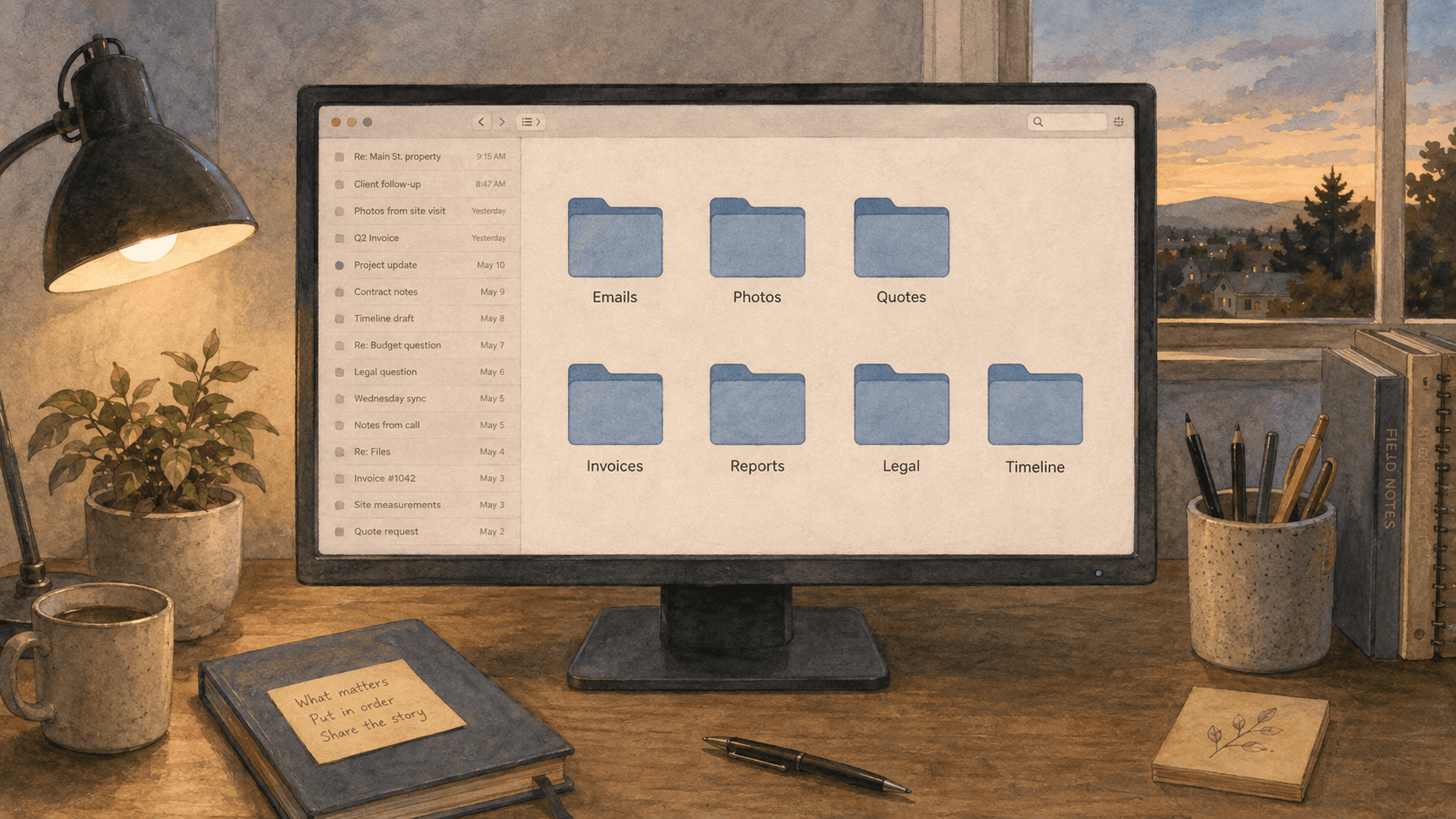
Some files were easy to place as soon as they were opened. Others only made sense after three or four emails around them were read together. When everything was still scattered across an inbox, each email looked like an ordinary exchange. Put back on a timeline, some of the relationships between them began to appear.
Once the material was organised, I passed it to the lawyer. The folders on the screen were ordinary. No single document was dramatic. Reorganising them had not produced a piece of evidence that had never existed before. The only difference was that something that had once been tangled now had dates, sequence and places where it could be found.
I thought again of something business owners often say when a dispute arises:
"Everyone knew about it at the time."
Usually, that is true.
At the time, quite a few people probably did know.
It is just that the person who later sits down at a computer and opens those files was not there when it happened.




READER NOTES