
Market changes · New Zealand Property Cycle II
When Vineyards Start Pulling Up Vines
When the tide goes out, some leave, some liquidate, and some bend down and finish what is still in front of them.
The excavators moved in while the vines were still green.
The hardest part was that the vines were not dead.
The vines were still fine. The numbers were not.
The excavators moved into the vineyard while the vines were still green.
Steel arms came down. Soil rolled over. Posts tilted and roots that had been in the ground for years came up with the vines. The machines kept moving, row after row. Ground that had been neatly planted was soon bare and brown.
The hardest part was that the vines were not dead.
Many could still bud and bear fruit. They had been pruned, irrigated and fed year after year. Once, ripe grapes meant a harvest. Now the grower had to pay again - this time to pull the same vines out of the ground.
This has been happening in Australia.
In 2024, ABC reported from the Riverina region of New South Wales that so many growers were removing vines that excavators could be booked out for months. Some red-wine grapes were fetching around A$150 a tonne, and an industry estimate put losses for some varieties at roughly A$2,000 per hectare. The grapes could still be sold. The problem was that selling them no longer covered the cost of growing them.
By the end of 2025, Wine Australia’s numbers made the imbalance clearer. In 2024-25, Australia produced about 1.13 billion litres of wine and sold about 1.08 billion litres - production exceeded sales by roughly 52 million litres. At the end of June 2025, national wine inventory stood at 2.06 billion litres. At the prevailing rate of sales, Wine Australia estimated that around 262 million litres sat above the long-term normal level of inventory.
The industry was already cutting back. In 2026, Australia’s winegrape crush fell to 1.27 million tonnes, down 19 per cent from the previous year and 25 per cent below the ten-year average - the smallest crush since 2000. Yet even after that reduction, the weighted average purchase price still fell another 6 per cent, to A$570 a tonne.
The vines were still fine.
The numbers were not.
Watching them being pulled out, I thought of Charlie.
Wine Australia · Three numbers behind the contraction
Charlie finally got his Bentley
Charlie had been in construction for years.
When the property market was strong, his company employed somewhere between a dozen and twenty people. Someone looked after the sites, someone managed the projects, several jobs could move at the same time, and he mostly did what the owner of the business needed to do.
Developers were making money then.
Charlie built their houses. He watched homes rise from the ground, and he watched developers buy land, sell houses, change cars and move on to the next project.
One day he said to me, “I build the houses. So why is he the one driving the Bentley?”
We all laughed.
Later, Charlie became a developer himself.
And eventually, he got his Bentley.
The company had staff, there were projects in the pipeline, and he could still take two overseas holidays a year. If the story had stopped there, it would have been a familiar one from the last New Zealand property boom: a builder saw where the larger margins were, stepped into development, caught the market and made money.
Then the market changed.
The projects in Charlie’s hands did not disappear with it.
“If the market is this bad, why are they still building?”
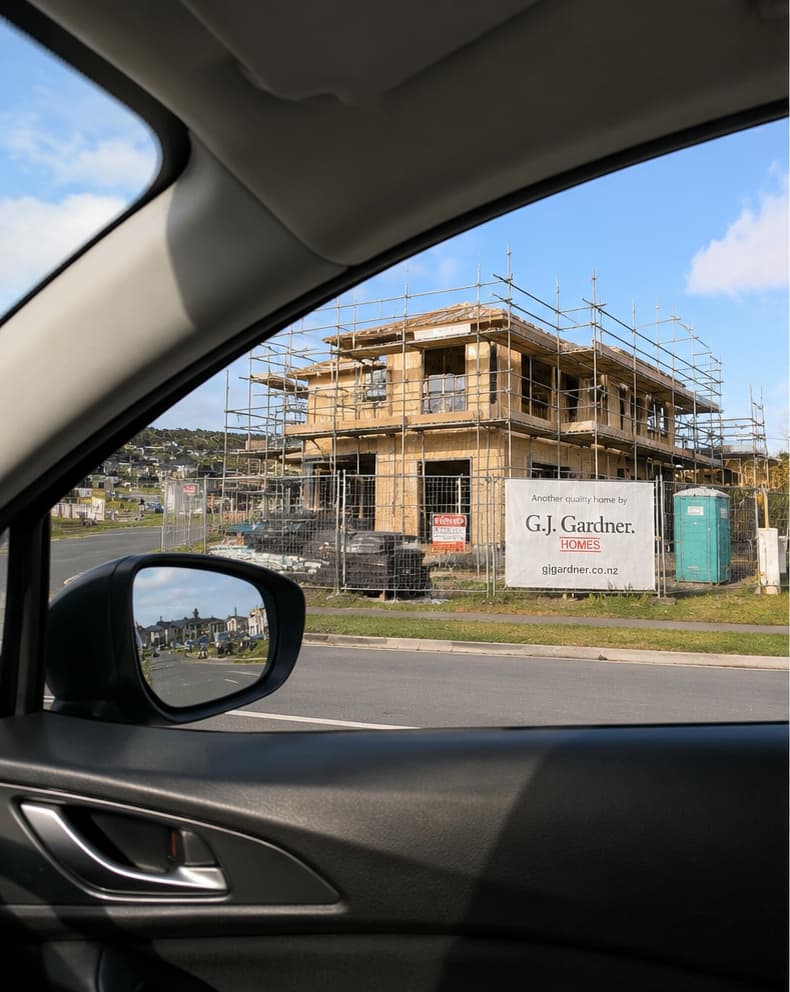
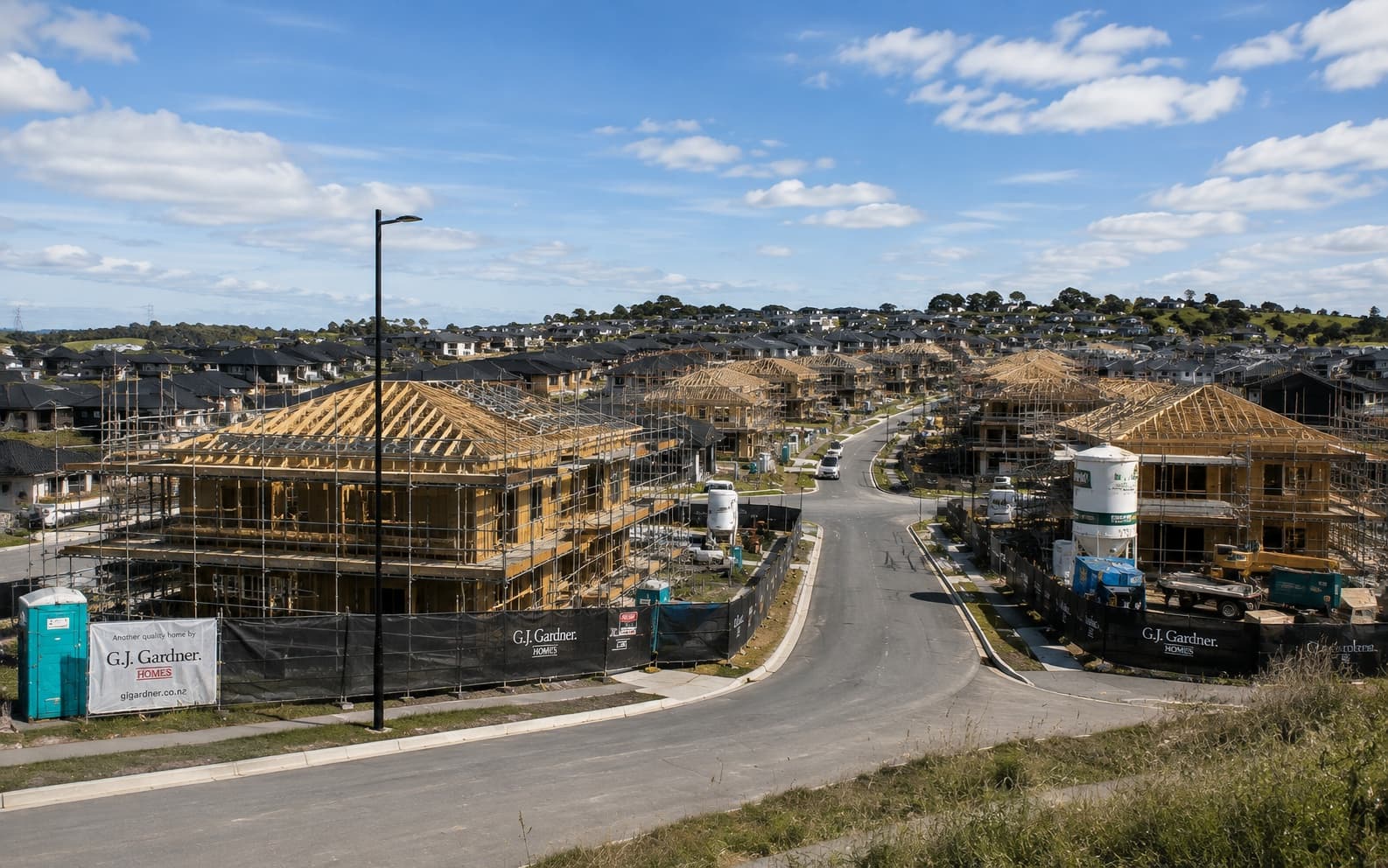
One day, Katherine and I were driving past a new development in Auckland.
The housing market had already cooled, but there were still fences and scaffolding along the road, and rows of houses were still going up.
Katherine watched for a while and asked, “If the market is this bad, why are they still building?”
If Australia had too much wine, growers could pull out vines. Why couldn’t housing supply simply be cut back?
For projects that had not started, it could.
But once a development was halfway down the road, it was different. The land had been bought, the design work done, the building consent approved and the money borrowed. Some sites had already been excavated; some frames were already standing. Stopping did not bring the money already spent back, and interest on land and debt did not stop simply because work on site did.
Property has an awkward characteristic: demand can turn quickly, but supply takes much longer to turn.
A buyer can decide this month that a house is too expensive and simply not buy it next month. A developer may still be completing homes today that began with land purchases, designs and decisions made two or three years ago.
In the year to June 2026, 40,581 new homes were consented in New Zealand, up 19 per cent on the previous year. A building consent does not mean every one of those homes will be built immediately, but it does show that the supply pipeline created in earlier years did not suddenly close when the market cooled.
Charlie’s projects were decisions made in the previous cycle.
The market had moved into the next one. He was still finishing the last one.
The economy is growing again. Why are home buyers still waiting?
If you look only at the macro numbers, New Zealand’s economy is beginning to look better than it did.
In the March 2026 quarter, GDP grew 0.8 per cent from the previous quarter and 0.8 per cent from a year earlier. The quarter before that had already returned to growth.
By the June quarter, however, unemployment had risen to 5.6 per cent.
There is no contradiction in those two numbers.
GDP measures an economy. Buying a house is a household decision.
For a family preparing to borrow seven or eight hundred thousand dollars and carry a mortgage for twenty or thirty years, GDP growth is welcome. But the questions that decide whether they sign are often more immediate: Will the job still be there next year? What will interest rates do? What will the children cost? How much cash will be left after the purchase?
Migration is similar.
In the year to June 2026, New Zealand still recorded net migration of about 17,600 people. Yet in the year to December 2025, New Zealand had a net loss of 28,500 people to Australia.
Put the population table aside for a moment.
Imagine a 29-year-old moving to Melbourne. At 30, he marries there. At 32, he buys his first home. At 35, he has a child, and a few years later the family moves into a larger house.
What left New Zealand was not merely a ‘1’ in a migration table.
A first-home purchase, a later move into a larger family home, and years of housing demand that might otherwise have happened here left with him.
Those are the buyers Charlie is facing.
The houses are already there. The buyers have time to think.
The one next door is $20,000 cheaper. Why buy yours?
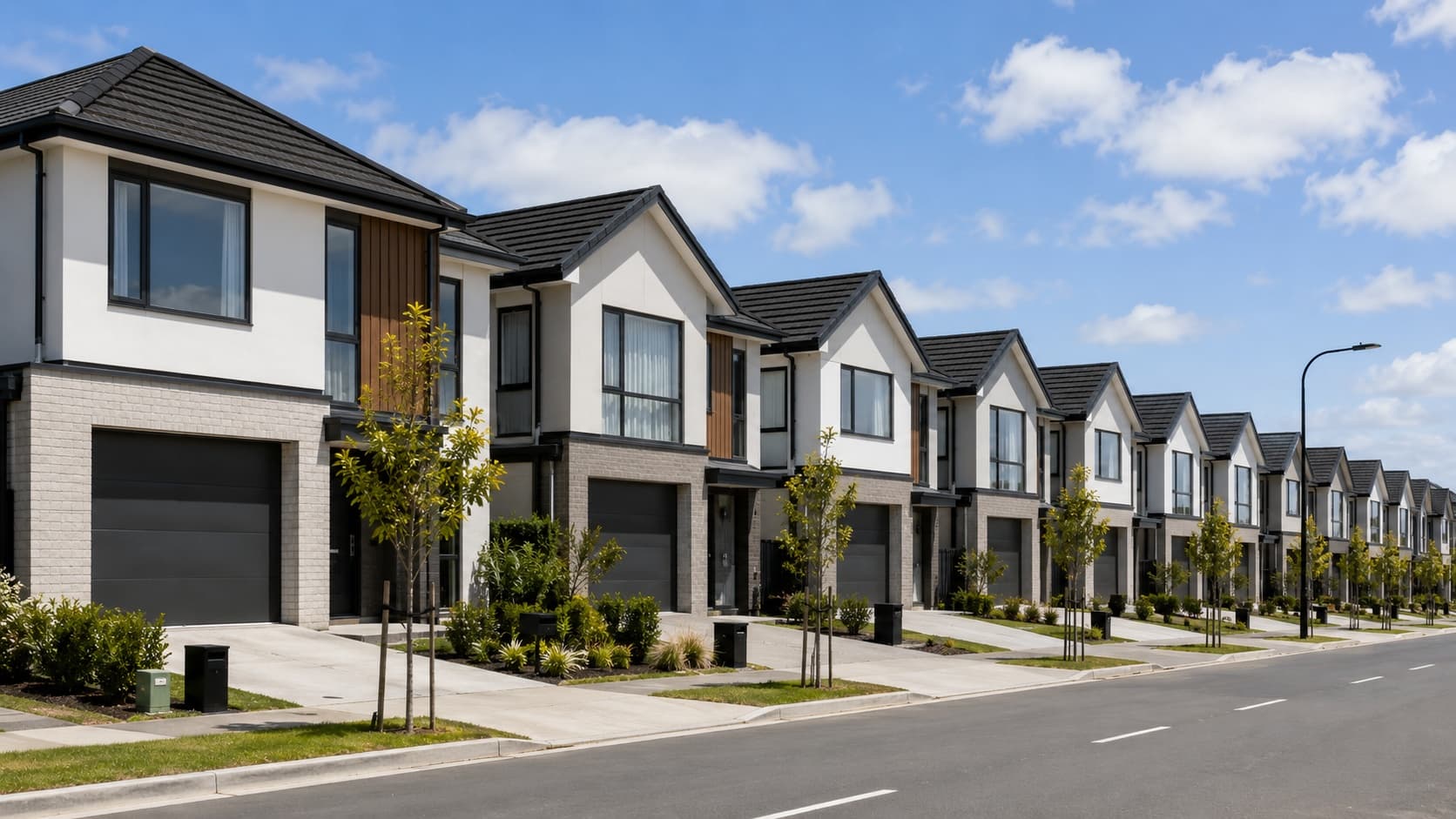
In July 2026, REINZ recorded 33,252 residential properties for sale nationwide, up 9.3 per cent from a year earlier. The median number of days to sell had reached 50, while sales volumes were down 10 per cent year on year.
For a developer, the question quickly becomes much more specific.
If the house next door is about the same size, has a similar layout and a similar fit-out, but is $20,000 cheaper, why should a buyer choose yours?
In a strong market, a row of similar new homes is not necessarily a problem. There are plenty of buyers and homes move quickly. One sells, then the next one sells.
In a weaker market, similarity makes comparison easy.
Floor area can be compared. Specifications can be compared. Completion dates can be compared. Eventually, price gets compared too.
The question Charlie faces is not the big one in the headlines - ‘When will New Zealand property recover?’
It is the group of listings sitting beside his own on a computer screen.
How far will the others cut?
How much room does he have left?
At that point, the market question comes back inside the company.
Charlie starts taking the work back
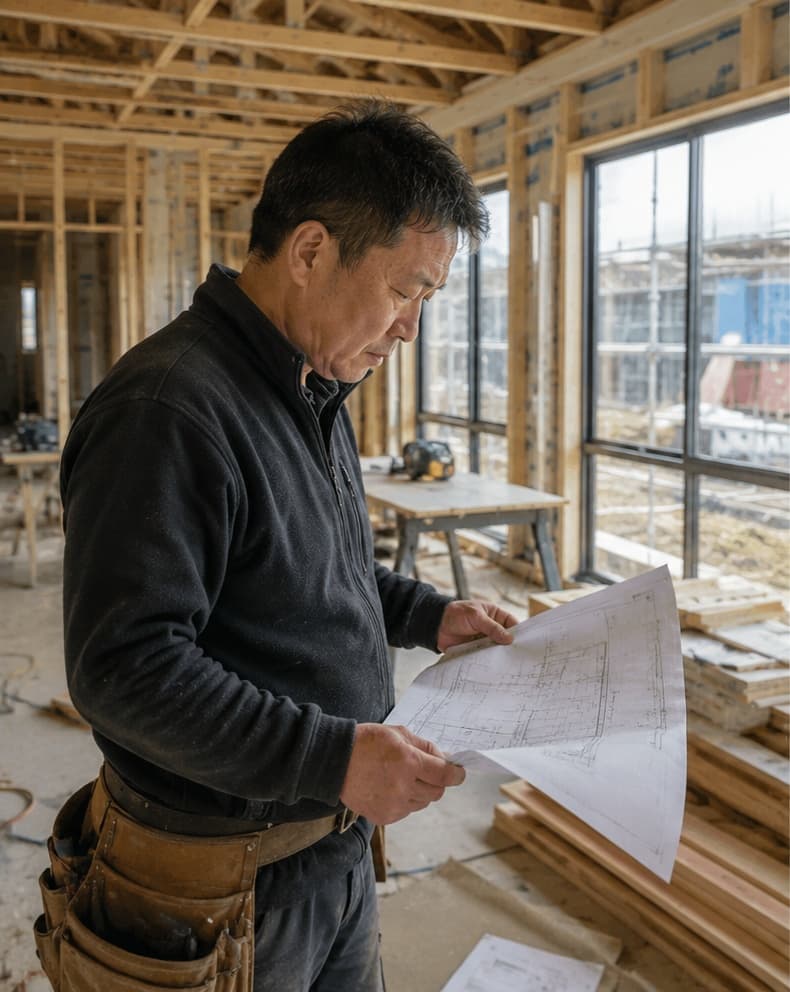

When Charlie’s company had a dozen or twenty people, there were people responsible for the sites and others managing the projects.
Most of them are gone now.
The headcount fell. The work did not. Jobs that had been handed out gradually came back to Charlie. If a site had a problem, he went. If a project was slipping, he watched it himself. He was still the owner, but now he was also doing much of the project management and site supervision.
He sold the Bentley so he would not fall behind on wages.
Once I asked him, ‘Are you tired?’
‘Tired? Of course, a bit.’
He paused.
‘But the projects are actually moving much faster now, and I’m saving a lot of money.’
I did not ask anything else.
With fewer people, management overhead came down. If a project moves faster, the money tied up in it is tied up for less time.
When costs come down, there is more room for the selling price to come down too.
In a strong market, another $20,000 on the sale price might simply mean more profit. In a weak one, the equation can run the other way: the developer who can first reduce his own costs has more room to give that $20,000 back.
Charlie is working on the things he can still control.
Some pull out vines. Some shrink the company.
For Australian grape growers facing oversupply, the adjustment is brutally direct.
Too many vines. Pull some out.
Property cannot adjust that quickly. Completed houses do not disappear, and a half-built project cannot be pulled out of the ground by its roots. Supply contracts somewhere else.
The next piece of land is not bought. The next project does not start. Someone sells a development. Someone makes the company smaller. Some businesses eventually go into liquidation.
Charlie’s response is another form of contraction.
A company of a dozen or twenty people shrinks. Work once delegated comes back to the owner. Expenses that can be cut are cut. Projects that can be finished sooner are pushed through sooner.
He still has to eat. He still has a family to support. Employees expect their wages at the end of the month. The bank collects interest when it is due. Half-built houses remain half-built until somebody finishes them.
When the problems arrive, you deal with them one by one.
BYD
It is much harder now to get Charlie out for a drink.
We used to be able to sit down for dinner, have a few drinks and talk for an evening. He rarely goes to those gatherings now. If he has the time, he would rather get something done himself.
He used to take two overseas holidays a year.
Now, when he talks about getting away, sometimes it means a trip to Hamilton.
Lately he has started asking me to go hiking.
He likes that.
It does not cost much, and it is good for you.
One day I arrived at the place we had agreed to meet and saw a BYD pull in.
Charlie got out.
It was not the Bentley.
I looked at it.
He did not explain.
I did not ask.
We gathered our things and started walking.
Sources & Notes
- Wine Australia: Australian Wine Production, Sales and Inventory Report 2025
- Wine Australia: National Vintage Report 2026
- ABC Australia: reporting on vineyard removals in the Riverina (March 2024)
- Stats NZ: GDP, employment, international migration and building consents
- REINZ: July 2026 Property Report



READER NOTES