NEW ZEALAND BUSINESS · STORE OBSERVATIONS
The Dragon Restaurant
Duck feet are very well behaved when you eat them. They are troublesome when you make them.
A film called Welcome to the Dragon Restaurant had become popular. My daughter asked me, “When can we see it in New Zealand?” She watches Chinese films with subtitles. Without them, there are still things she cannot quite catch. I did not know. But I did know a Dragon Restaurant in New Zealand.
One Became Three
That is not, of course, its real name. The owner’s surname is Long — dragon — and I have known him for many years, so here I will call him Dragon Eldest. There are three brothers in the family: Dragon Eldest, Dragon Second and Dragon Third. Each now has a restaurant of his own. Their parents started in the restaurant business after coming to New Zealand from China in their thirties. Later, as the sons grew up, one after another joined the trade. One restaurant slowly became three.
The parents are old now, but they have never really retired. Dragon Mum still goes to the eldest son’s restaurant every day. She is not tall, but her voice is formidable. When she speaks, I sometimes think she could shake dust from the rafters. She usually speaks Cantonese. I do not know how much English she has; in all these years I have hardly heard her use it.
A younger manager looks after the front. Customers order and pay there. Dragon Eldest has enough everyday English for dealing with the outside world, so if something needs handling, he usually does it. Dragon Mum leaves all that alone. She runs the kitchen.
Dragon Eldest once said to me, “The hardest people to manage in a restaurant are the chefs.” Dragon Mum knows whose greens are freshest, whose rice is cheaper this week, and how much of each thing should be ordered. Ask her and the information comes straight out: which supplier is good, who has put prices up, what has changed. She remembers it more clearly than I do. She has no particular hobby that I know of. She still goes to the restaurant every day.
A Great Plate of Duck Feet
There is another older woman at the restaurant: Dragon Eldest’s mother-in-law. She is nothing like Dragon Mum. You can hear Dragon Mum through the kitchen wall; her in-law speaks softly. She usually arrives a little after eleven, helps through the lunch rush, goes home when the afternoon quietens, then comes back in the evening. She picks vegetables, prepares things, and lends a hand wherever she is needed.
One day I found the two women sitting together working on duck feet. A large plate in front of them was already full. The restaurant makes duck feet two ways: braised, and cold dressed. I have eaten both. Once the bones are removed, what remains is mostly skin and tendon. The braised version takes on the flavour slowly; it is soft, but not collapsing. The cold version is cleaner and more springy, with a little resistance when you bite.
Eating them is easy. Pick one up and there it is. I had never really stopped to think about who removed the bones. Duck feet have joints everywhere and plenty of small bones. Each one has to be worked out without tearing the skin and tendon to pieces.
Duck feet are very well behaved when you eat them. They are troublesome when you make them.
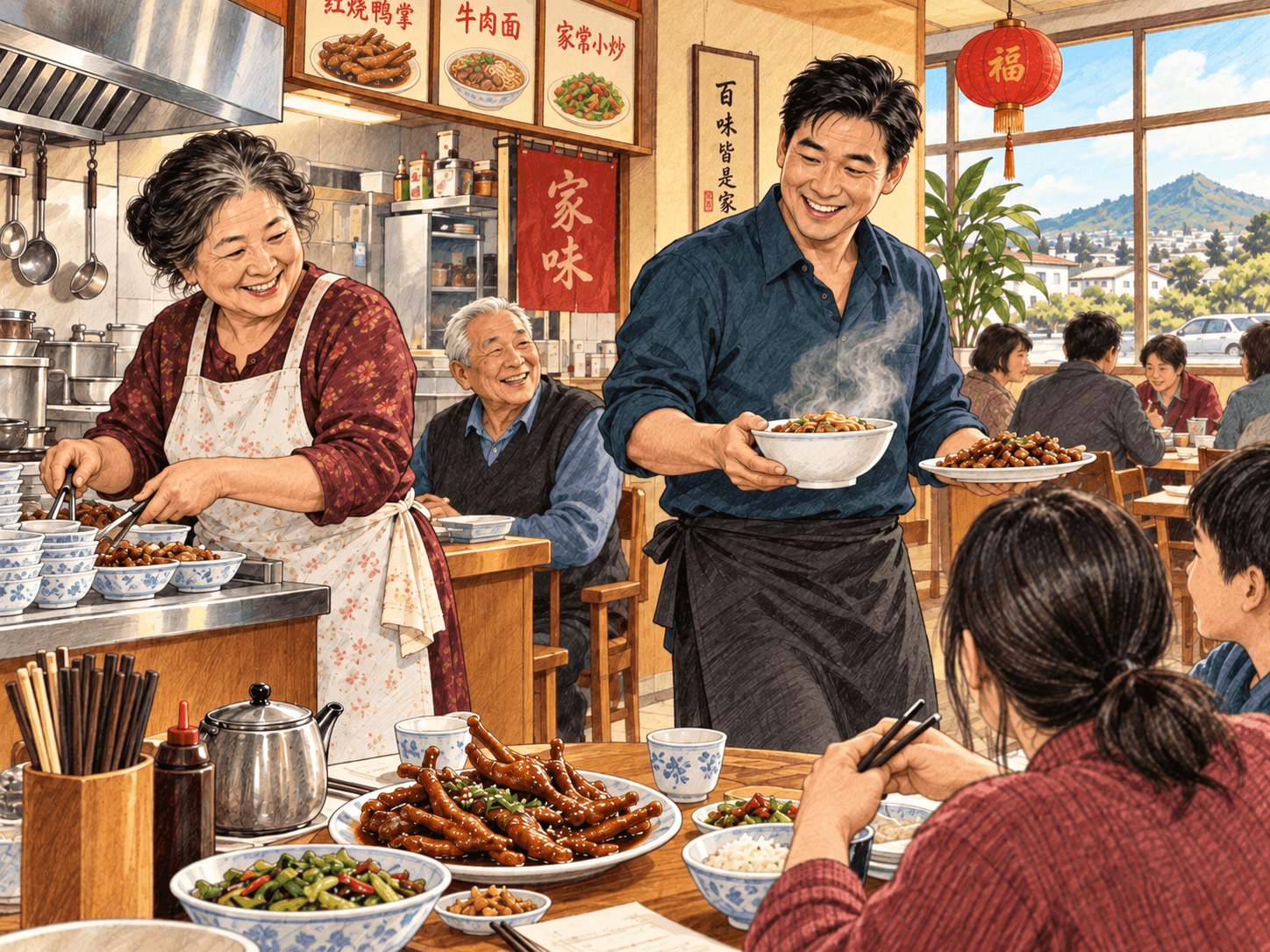
I looked at the great pile and asked, “Doesn’t it wear you out, doing them one by one?” Dragon Mum looked up, a duck foot still in her hand. “呢啲嘢呀,你咪睇少,真係唔係個個都做得嚟㗎。後生仔唔肯做㗎,嫌麻煩。” Do not underestimate this work, she was saying. Not everyone can do it. Young people do not want to; too much trouble.
Customers like the dish. “洋人都食㗎。” Westerners eat it too. Sometimes a few Western customers come in and order a whole plate. “好食吖嘛,人哋肯食㗎。” If it tastes good, people will eat it. The duck foot in her hand was still not finished.
Fewer Work Clothes
I have been in business in Botany Junction for ten years, which means I have also watched the houses of Flat Bush and Ormiston go up piece by piece. When property was booming, I often saw Chinese workers from nearby building sites at the Dragon Restaurant at lunchtime: dust on their trousers, dirt on their shoes. They came in together, sat down and ate. No one spent long studying the menu. They had to go back to the site in the afternoon. The restaurant’s customers have always been mixed — Chinese and Western. The prices were reasonable, the food substantial, and people working nearby liked the place.
Then property slowed. The work clothes at lunchtime became fewer too. Sometimes you do not need to look at a house-price index first. Walk into a restaurant at noon and see how many people are still wearing work clothes; you already know something.
These days when Dragon Eldest sees me, he often says the same thing: “The restaurant business is hard now.”
“We Can’t Do That”
A while ago, some restaurants started offering ten-dollar meals. I asked Dragon Eldest, “Why don’t you do it? No one around here is exactly the same as you. At ten dollars, you’d probably be busy.”
He shook his head immediately. “We can’t do that.”
“Why not?”
Ten dollars could be done, he said. But once the price went down, the food would have to go down with it. A little less meat. Cheaper ingredients. Save a bit here, cut a bit there. “Once you start doing that, you can’t go back.”
In the end he put his prices up a little. “No choice. If there’s less business, then there’s less business.”
“Forget It”
A few years ago, a Western customer came in to eat and afterwards said there had been an insect in the food. Dragon Eldest apologised and did not charge for the meal. The customer still posted about it on Facebook and left a bad review. For a while, business was quieter.
Dragon Eldest was upset. He said the customer had been eating roast duck. The duck had been roasted in the open oven, and he simply could not understand where the insect could have come from. Neither could I. He mentioned it to me several times around then.
I suggested, “Do you want to deal with it formally? If you have to, take legal action.” He waved his hand at once. “Forget it. Forget it. This kind of thing — you can’t explain it clearly.” Wait, he said. Get through it. Maybe things would slowly improve.
Later, no one mentioned it any more. The doors still opened every day.
Stay a Little Longer
When I go to the Dragon Restaurant, Dragon Eldest usually comes over and sits with me for a while. First he pours tea. We talk about business. Sometimes he has not finished a sentence before the phone rings. He gets up to answer it, comes back and has barely sat down before someone at the front calls him. Up again, into the kitchen. After a while his voice comes from the back: “Add one dry-fried beef ho fun!” Eventually he returns. The tea has cooled a little.
Now that business is difficult, he does not offer me grand theories. “No choice. Just get through it.” Sometimes he says, “Hang on a bit. Stay in the shop a little longer yourself. Do a little more.” Then the phone rings again and he disappears towards the kitchen.
I turn back to Dragon Mum and we start talking about duck feet again. Her voice is as loud as ever. “得閒就多食幾次啦。” Come and eat them a few more times when you have time. She points towards the kitchen. “等我做唔郁嗰陣——你就冇得食喇。” When I can no longer do it, you will not get to eat them.
I stand up to go and pay. Dragon Eldest runs out from the kitchen.
“Leaving already?”
“Sit a little longer.”