
A University Campus in the 1990s
There is something about a university campus in the 1990s that is almost impossible to recreate now.
I was doing my postgraduate study at Tongji Medical University in Wuhan.
China had only recently begun opening itself properly to the outside world, and for young people like us, the world beyond China still felt both distant and irresistible.
Most of us were around twenty. Some were younger. The boys grew their hair a little longer than their parents would have liked. Some owned guitars. In the evenings, they would sit beneath the girls' dormitory windows and play for hours, sometimes well into the night.
Every now and then, a window upstairs would open. A girl might lean out for a moment. Or a curtain would move, just slightly.
It was a time when hormones were running high.
And our dreams were even bigger.
Love, poetry, English, rock music, going overseas, seeing the world - somehow they all belonged together.
I had come from a small city near China's border and worked my way through university into postgraduate study. Looking back, I knew almost nothing about the world.
I had never been overseas. I had barely spoken to a foreigner. English lived in textbooks. The rest of the world lived on maps.
"The West" was not yet a collection of actual countries populated by ordinary people. To me, it was one vast, slightly mysterious place somewhere beyond the horizon.
But there is one useful thing about being young. You don't yet know how big the world is. And you don't fully understand how small your own place in it might be.
So you have a go.
Once I became a postgraduate student, I became almost hungry to learn English properly. I had made it this far; surely I could go a little further.
Windows - and Opportunities
Back then, learning English required rather more hardware than it does now. No smartphones. No YouTube. No podcasts. Certainly no AI waiting patiently for you to mangle a sentence and then try again.
Listening practice came on cassette tapes. And cassette tapes required a cassette player.
Our foreign teachers used to carry around one of those enormous double-deck tape recorders - black, boxy things that seemed to weigh roughly the same as a small farm animal.
We had two foreign teachers. One was a young American bloke. The other was a young woman from New Zealand.
They were windows - and opportunities.
Behind them was a world I had spent years trying to imagine.
So whenever I had the chance, I volunteered to carry the New Zealand teacher's tape recorder.
I would take it from the foreign teachers' building to the classroom before her lesson and, sometimes, carry it back afterwards.
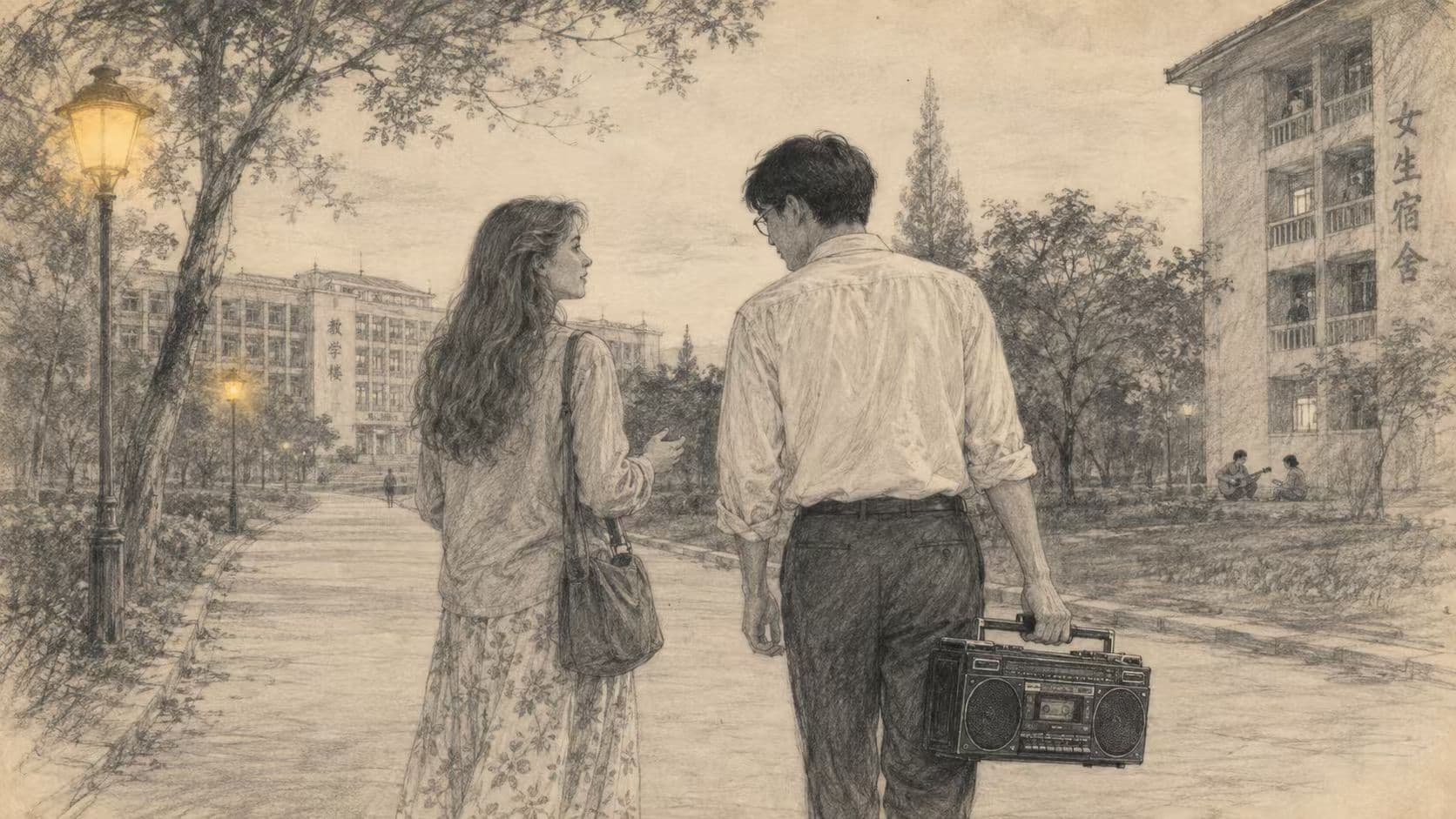
Looking back, I'm not entirely sure that machine was heavy enough to require assistance.
At the time, however, I was quite convinced that it was.
Preferably for as long as possible.
Those few minutes walking across campus gave me something precious: a chance to talk to a native English speaker on my own.
So I talked. Or, more accurately, I tried very hard to talk.
My English was the sort you might expect from a young man who had learnt it in classrooms in a small Chinese city. I knew a fair bit of grammar. I had memorised plenty of vocabulary. Speaking was another matter.
But young people have one advantage over older ones. They are often too confident to realise how badly things can go.
One-night Stand
One evening, we were walking through campus with the tape recorder. Some boys were sitting beneath the girls' dormitory, playing guitar.
I decided this would be an excellent opportunity to explain a particularly romantic feature of Chinese university life.
I wanted to tell her that a boy might sit outside a girl's dormitory all night, playing guitar for her.
This seemed straightforward enough. I even had what I thought was a rather impressive English phrase ready.
"They can one-night stand here," I told her.
She turned and looked at me. Not shocked. Not amused, exactly. Just very, very carefully.
"Are you sure you mean 'one-night stand'?"
She paused.
"Or... 'stand one night'?"
To me, the two expressions meant exactly the same thing.
One night meant one night. Stand meant, well, stand. A boy stayed there for one night. Perfectly logical.
So I suspect I nodded with considerable confidence.
She did not explain. That was the worst part.
She didn't laugh at me. She didn't correct me. She simply looked at me - seriously - and let the conversation move on.
Some time later, I came across the actual meaning of one-night stand. I can no longer remember whether it was in a dictionary or something I was reading.
I do remember the moment of understanding. And then the replay.
The girls' dormitory.
The boys with guitars.
My confident explanation.
And that Kiwi teacher looking at me.
I had, in effect, solemnly informed a New Zealand woman that Chinese university boys regularly had one-night stands outside the girls' dormitory.
All night.
My English improved significantly that day.
For quite some time afterwards, I found it difficult to meet her eyes.
She never mentioned it again. Which somehow made it worse.
If she had laughed, perhaps the whole thing would have been over in thirty seconds.
Instead, she knew.
And I knew that she knew.
That was enough.
Then, as if matters were not already sufficiently awkward, she casually mentioned on another occasion that one-night stands were quite common in New Zealand.
I had only recently discovered what the expression meant. I remember suddenly finding the surrounding architecture extremely interesting.
Walls.
Windows.
Floor tiles.
Anything, really, apart from her face.
An Echo Decades Later
There are things between young men and women that are difficult to define even when they come from the same culture.
Add a young Chinese student who had barely encountered the outside world and a New Zealand woman who represented, in his mind at least, that entire outside world, and even a perfectly innocent conversation could acquire a certain... density.
Looking back, there was probably nothing in it at all.
But youth has a way of making the air thicker.
A glance, a sentence, a pause half a second too long - at twenty-something, any of these can keep you thinking for days.
Our American teacher had a different story.
He was young, not particularly tall, but good-looking. And he was American. In a Chinese university in the 1990s, that was more than enough to make him rather popular with the women students.
Eventually, a student one year below me started going out with him. Then they got married. She moved to the United States with him.
Many years later, at a reunion attended by my wife, the former student came back - with that same American teacher, now her husband.
Some youthful stories, apparently, really do get a happy ending.
Whether theirs began with a stand one night or a one-night stand, I have absolutely no idea.
And at our age, some questions are best left unasked.
It is only when you reach middle age that you begin to notice how strangely some of the smallest events in your youth echo back decades later.
There I was in Wuhan, a young man from a small border city, carrying a heavy tape recorder for a Kiwi teacher and speaking English with more enthusiasm than accuracy.
I wanted to know what was beyond the world I already knew.
New Zealand, if I thought of it at all, was probably just two islands somewhere near the bottom of a map.
It never occurred to me that, years later, I would end up living here.
Working here. Raising a family here.
Learning the rhythms of the place - its humour, its understatement, its boundaries, and the particular Kiwi habit of saying quite a lot without making too much fuss about it.
A Place He Would One Day Call Home
Sometimes I wonder what I would say if I ran into that teacher again.
Perhaps I would tell her that my English eventually improved. That I finally learnt the difference between one-night stand and stand one night.
And that, rather unexpectedly, I ended up in her country.
I never did see her again.
The old tape recorder disappeared too, along with cassette tapes, language labs and quite a few other things that once seemed indispensable.
These days, anyone learning English can put on a pair of headphones and hear almost any voice in the world.
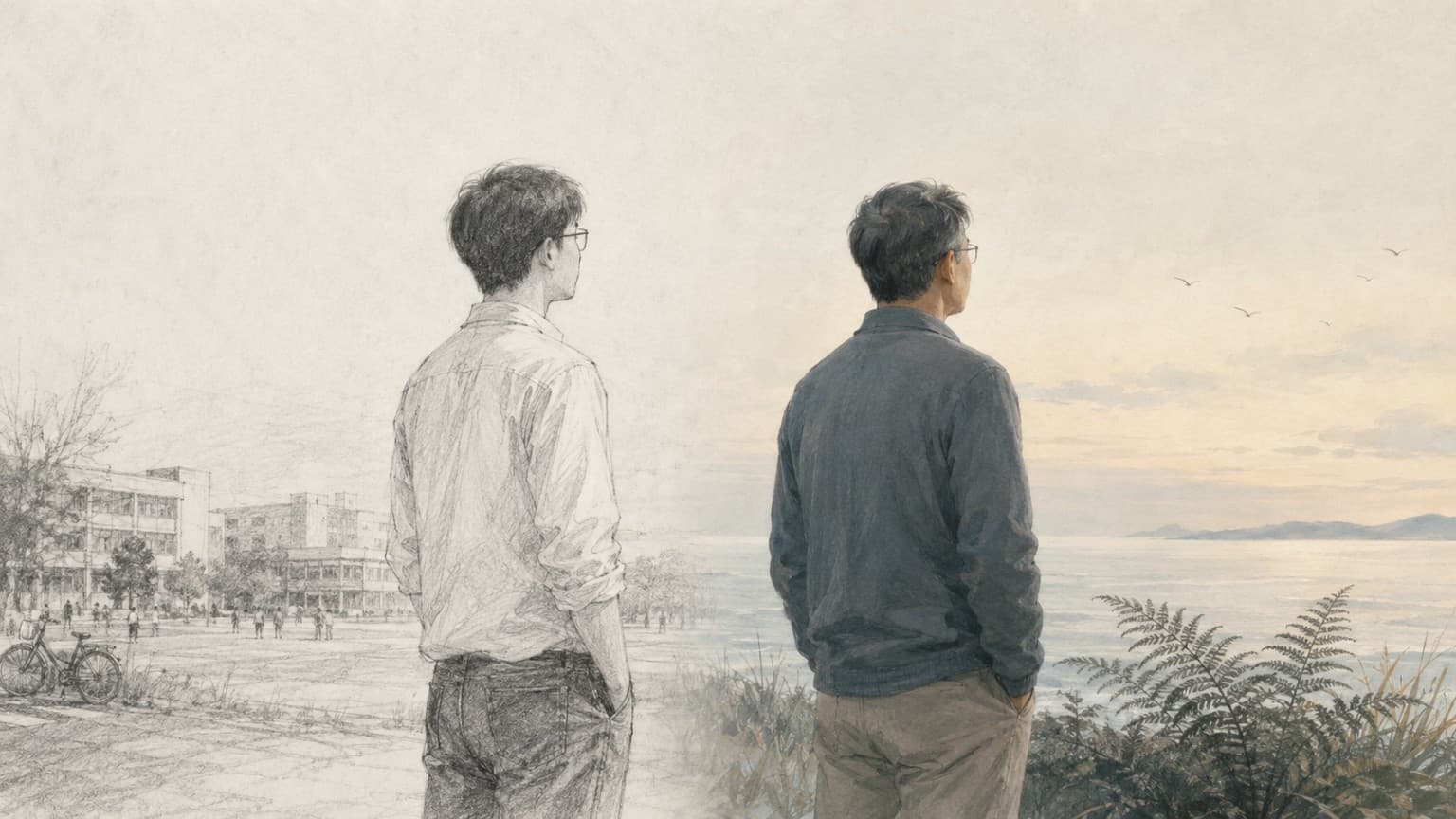
But every now and then, I still think about that young man walking across the campus at dusk, carrying a heavy tape recorder.
His English wasn't very good. He hadn't seen much of the world. But he was desperately curious about it.
He kept listening. Kept talking. Kept trying to catch every word.
At the time, he thought he was learning a language.
He had no idea he was slowly making his way towards a place he would one day call home.

READER NOTES