
This SeriesTe Aroha
- 01The Town of LoveCurrent
- 02The Gift of Mistakes
1. The King’s Breakfast
“Give him a big breakfast. Today he’s my king.”
Katherine said it to the owner as if it were the most natural thing in the world.
It was 2 June 2025, New Zealand’s King’s Birthday holiday.
Whitaker Street was bright with winter sun. The name immediately made me think of Whittaker’s chocolate, which I happen to like. Katherine had already pointed out that the spelling was different.
I decided to call it Chocolate Street anyway.
Most of the buildings were low, with small shops running along the street. Behind the rooftops, the dark green mountain sat so close that the town seemed to have grown straight out of its foothills.
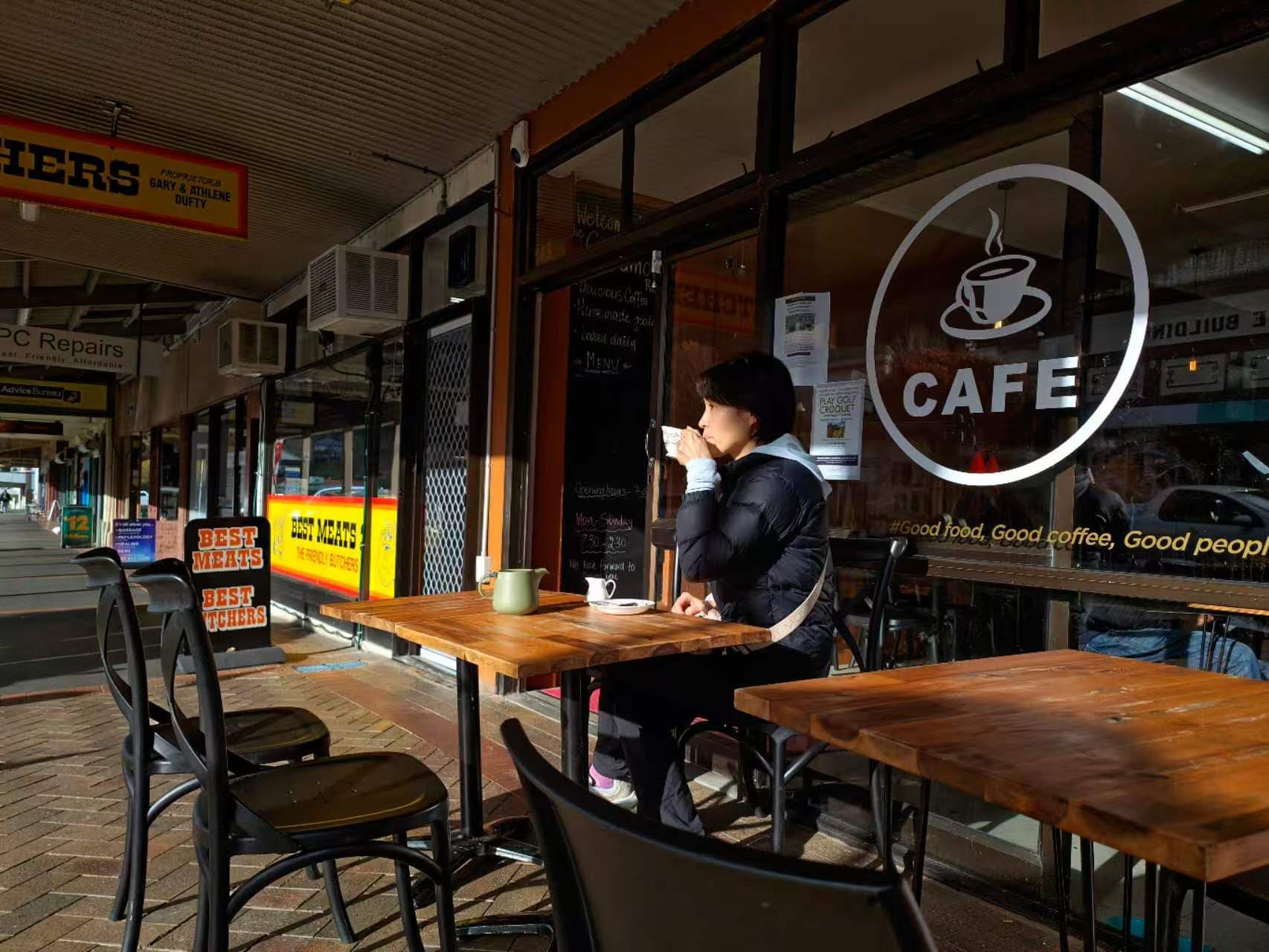
We took a table outside the Cinnamon Room, on the pavement next to a butcher’s shop. Katherine looked at the menu and made her announcement about “my king.” I was slightly startled. She wasn’t.
A few minutes later, the King’s Breakfast arrived. Bacon, sausages, eggs and several sides crowded a large plate, with little dishes of sauce around the edge. A dark green teapot sat on the table. The cup in front of me was almost absurdly delicate by comparison: white china, tiny pink flowers and a fine gold line around the rim.
June meant winter. I was sitting outside in a puffer jacket, yet the sun was warm on my shoulders. A car went past now and then. Street, rooftops and mountain all seemed to be resting in the same morning light.
I looked at the enormous breakfast, then at the floral cup.
This was not a meal to rush.
2. A Night in the Nuns’ House
The day before, we had driven into the grounds of The Nunnery.
We knew before booking that the red-brick building had once housed Sisters of Mercy nuns, and I had been curious all the way from Auckland. What would it feel like to stay in a place that had once been a convent residence?
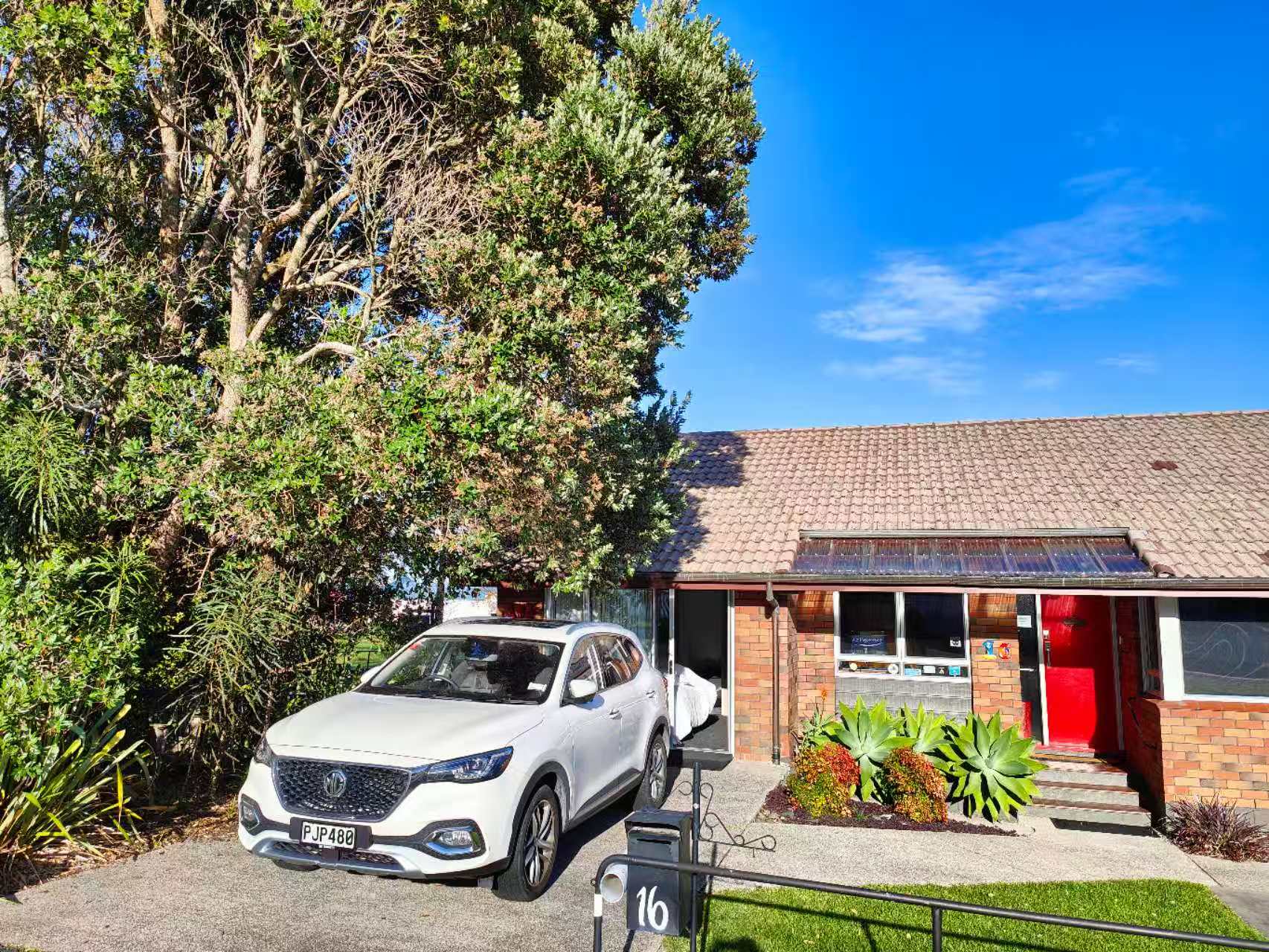
The first thing we saw was a low brick building with a grey-brown tiled roof and bright red doors. Old trees had grown high enough to hide part of the house.
Our self-contained room was close to the driveway, so we carried the bags in within a few steps. The owner showed us around and then, almost in passing, said, “This room used to be where the bishop stayed.”
I stopped for a moment.
That had not been in the booking description.
The room was not large, but it had everything we needed. Once the bags were down, I wandered outside. Behind the house I found several orange trees, their leaves still dark green in early June but their branches heavy with fruit. Some oranges were already yellow; others were still half green. A few branches sagged under the weight.
Oranges happen to be one of my favourite fruits.
The owner saw me looking and smiled.
“Help yourself.”
She said there were far too many to eat and they were not going to be sold.
Free?
In that case, I was not going to be shy.
I started with the fruit within reach, then found myself stretching for the higher branches. I would pick one orange and, before I had even put it down, be looking for the next.
I ended up with quite a few.
There was a cat in the grounds too. The owner told us she had never really planned to have one. Her mother had lived into her nineties and, when she died, left her cat behind. The daughter took it in. Eventually, having a cat in the house simply became normal. Later, a stray appeared in the garden. She kept that one as well.
One of the cats wandered past us with very little interest in its two new guests.
Farther around the property, I noticed a For Sale sign. The business was on the market.
I looked at it for a moment. I was curious, but I did not ask.
While we were talking, the owner mentioned that there would be horse racing in town the next day.
“You should go and have a look.”
That casual suggestion ended up changing our plans.
We had intended to leave on 3 June. She would be away that day, visiting her sister, which made me wonder how checkout was supposed to work.
“So what do we do when we leave?”
She waved the question away.
“Don’t wait for me. Leave your bags in the room. Come back after the mountain and pick them up.”
Then she added:
“Just leave the key in the room when you go.”
I still had not quite understood.
“We don’t need to lock the door?”
She smiled.
“It’s fine. I have another key.”
3. One Eye Behind a Ginkgo Leaf
After the King’s Breakfast, we wandered along Chocolate Street — Whitaker Street.
And yes, I know the spelling is different.
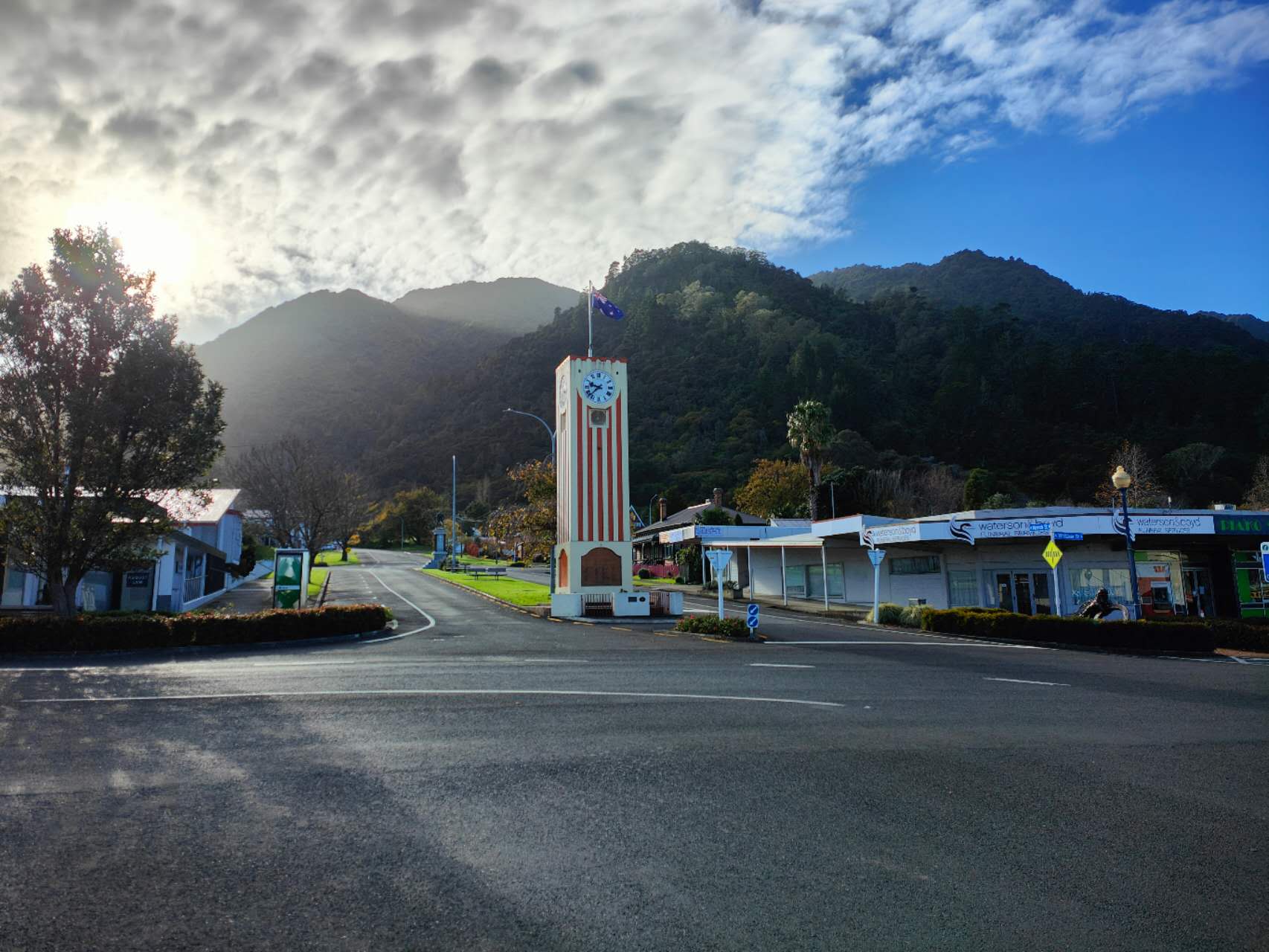
Te Aroha’s centre is small. Most of the shops are only one or two storeys high, and there is not much traffic. A clock tower rises above the low roofs at the intersection. Beyond it is the mountain.
Mount Te Aroha is remarkably close to town, almost pressed up against the rooftops. The 952-metre mountain rises straight from the plain. Walk past the clock tower and it is still there. Reach the church and look up again, and another dark green slope appears between the buildings.
There is more than one local account of how Te Aroha got its name. One tells of the Arawa ancestor Kahumatamomoe, who became lost around the Waihou Valley and later climbed the mountain, from where he was able to identify the direction of his distant homeland.
In te reo Māori, *aroha* can carry meanings of love, care and affection.
I like the name.
A short walk from the main street brought us to Te Aroha Domain. The town sounds quickly faded behind us. Lawns spread across the slope, paths curved through the trees, and old buildings sat beneath the mountain.
By early June, the ginkgo leaves had turned yellow. Some still clung thickly to the branches; others had fallen along the paths. When the wind moved, a few more drifted down.
Katherine picked up a ginkgo leaf, held it over one eye and smiled at me.
I took a photo.
It is in the Gallery at the end of the article.
A little farther on we found a large swing. I cannot remember who started it, but a few minutes later two people over fifty were behaving like children: one sitting on the swing, the other pushing from behind.
The swing went higher.
Our laughter went into the trees.
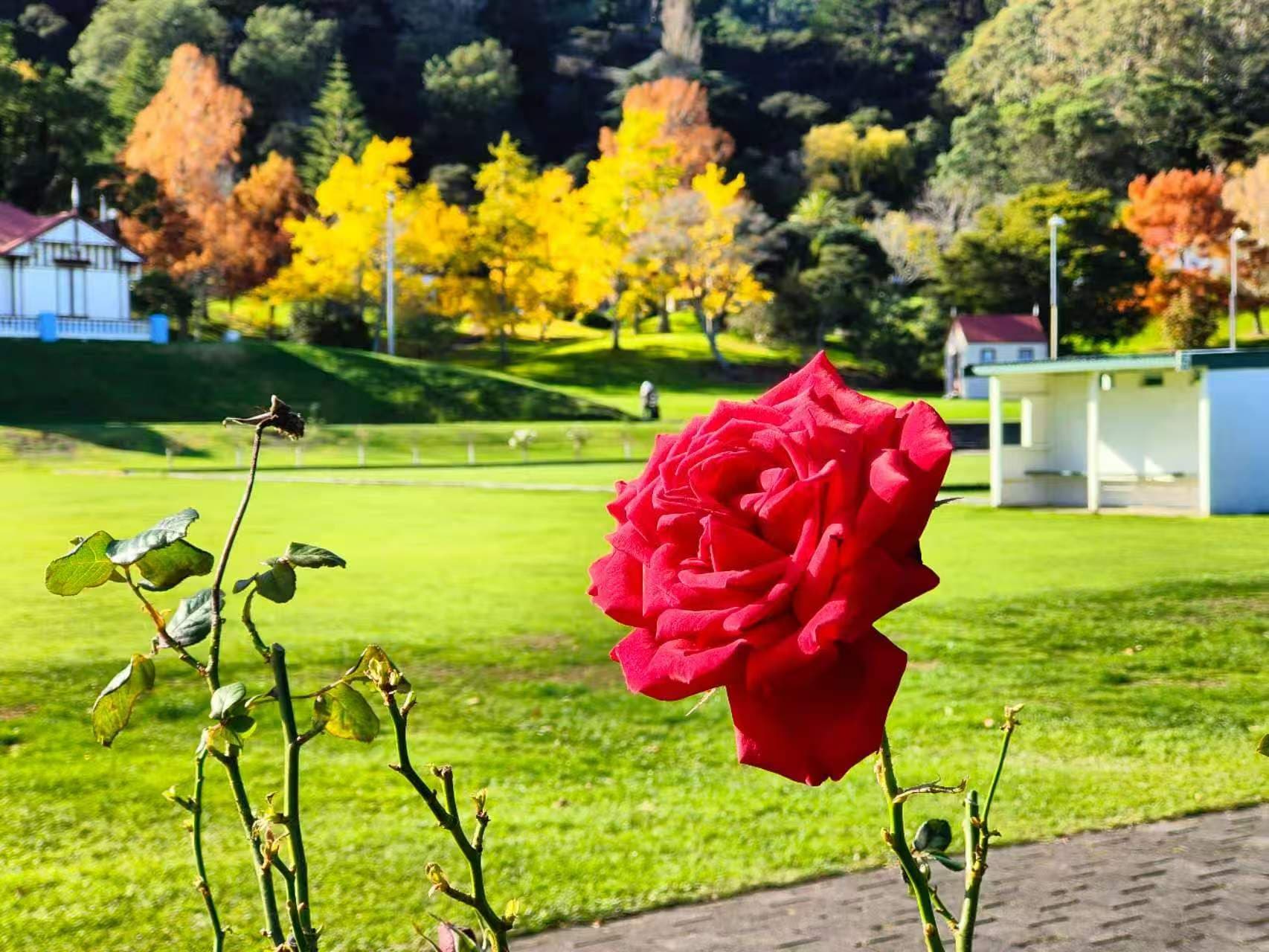
There were roses beside the lawn as well. One red rose was still fully open. Behind it were grass, yellow ginkgo leaves and, farther back, the deep green mountain.
Winter had arrived.
The ginkgo leaves were falling.
The roses had not finished yet.
4. Why Him?
In Te Aroha Domain stands an old building with pale timber walls and a red roof. Built in 1898 as the Cadman Bath House, it is now the Te Aroha District Museum.
Katherine and I went inside.
The museum is not large. Old photographs, furniture, objects from the bath-house years and fragments of the town’s everyday past are spread through a series of rooms.
Then I came to a large blue display wall and stopped.
The first thing I noticed was Chinese:
“从中国到蒂阿罗哈。”
Underneath it was the English:
*From China to Te Aroha.*
Beside that was a name.
Wong Foo.
I was surprised, but not simply because I had found a Chinese name in a New Zealand museum.
What puzzled me was the size of the display.
Photographs, documents, newspaper cuttings and material about Wong Foo and Wong Wah covered a substantial part of the wall.
The first question that came into my head was simple:
Why him?
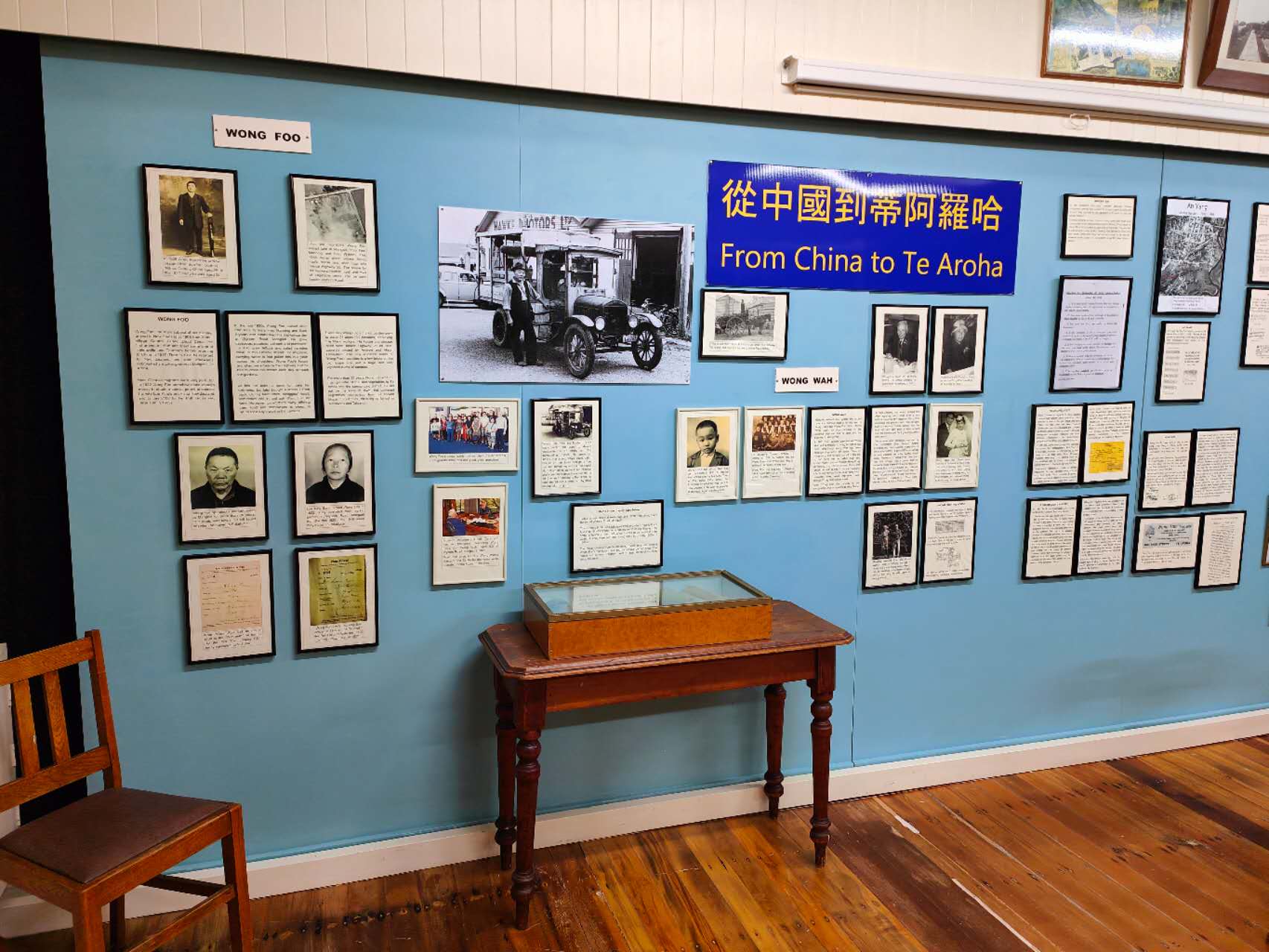
Wong Foo was not a famous person I had heard of. In the first half of the twentieth century, he grew vegetables at Mangaiti, not far from Te Aroha, and brought them into town to sell. In one old photograph, he is pushing a vegetable cart.
A Chinese man.
A market gardener.
Growing vegetables, selling them, making a life.
Why, decades later, had this small town given him so much space in its museum?
I stood in front of the photograph for a long time.
A few months earlier, in Queens Gardens in Nelson, Katherine and I had stopped at a memorial stone linked to Huangshi in China. I wrote about that afternoon in New Zealand Abel Tasman 01 | Nelson. That time, what caught my attention was a Chinese place name in a New Zealand park.
This was different.
Here was a person who had actually lived here.
Wong Foo’s son, Wong Wah, later became a registered electrician. In the 1950s, when a community hall was built at nearby Hungahunga, he was responsible for the electrical wiring.
Those details helped me understand a little more.
But they still did not answer the question completely.
Why would a Chinese market gardener who pushed a vegetable cart through town be remembered on a wall this large?
I still do not really know.
5. Why Are Jockeys So Small?
The Nunnery owner’s suggestion — “You should go and have a look” — brought us to the racecourse the next day.
And it happened to be King’s Birthday.
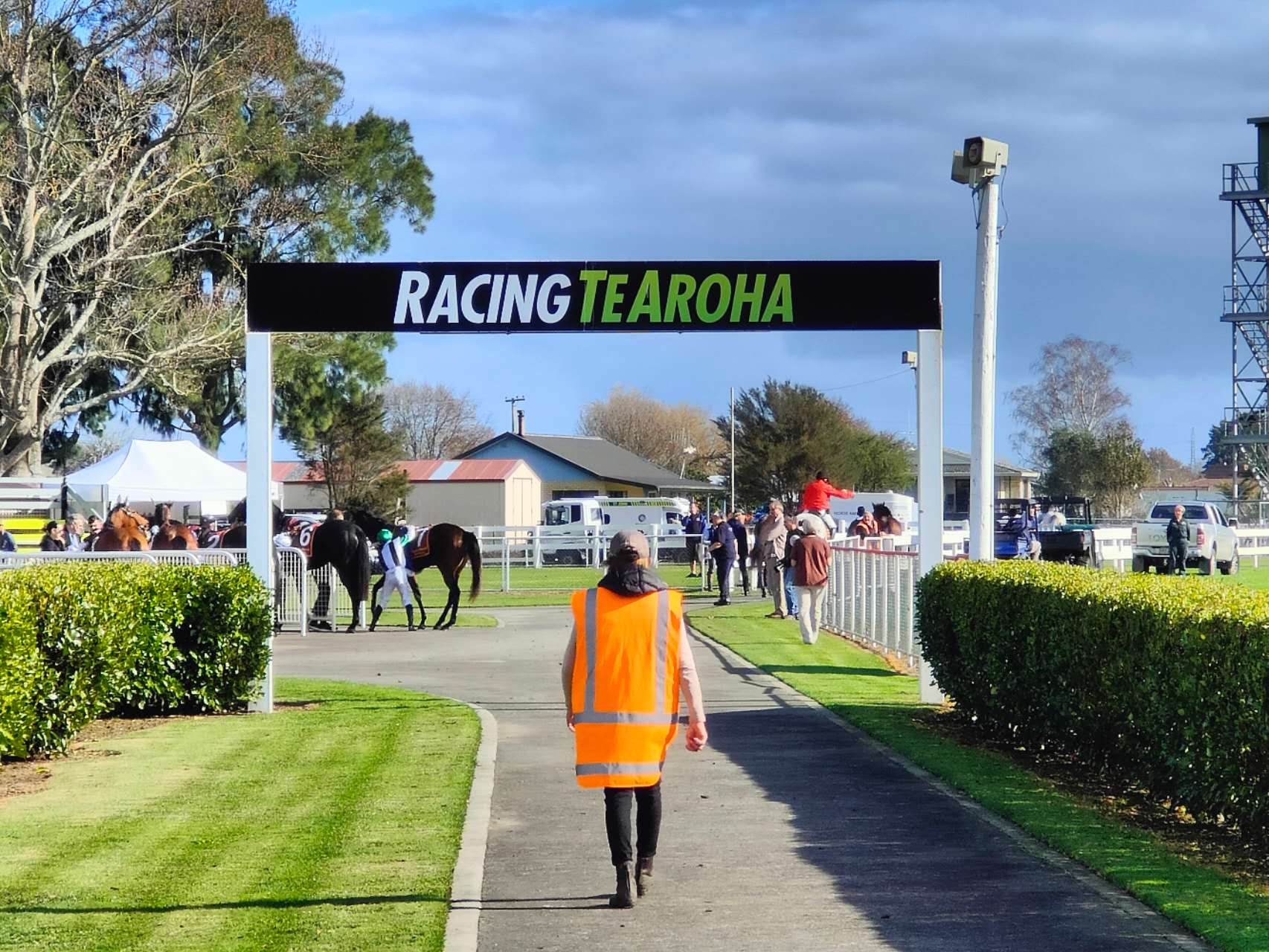
The racecourse was nothing like the grand race-day spectacle I had imagined. White rails enclosed a broad, carefully mown field. The grandstand was modest, and the crowd was not especially large. Horses, jockeys, staff and spectators were all close enough to one another that the whole place felt surprisingly informal.
Before the racing began, the horses were led slowly past us one by one.
That gave us time to look.
Some were dark brown, with manes and tails almost black. Some were chestnut, their coats brightening in the sun. Others were so dark they looked almost black.
They looked nothing like the horses we usually saw standing in paddocks. These were tall, long-legged animals, lean through the belly, with muscle shifting visibly through their shoulders and hindquarters as they walked.
I have always liked horses.
Ella once asked me:
“Dad, what’s your favourite animal?”
“A horse.”
She said horses were her favourite too. One day, she told me, if she had her own farm, she would keep a horse.
Then she reconsidered.
Several would be better.
The racehorses continued past us. Sitting on animals that large, the jockeys looked tiny.
After watching for a while, I asked Katherine:
“Why are jockeys all so small?”
She burst out laughing.
“Have you ever seen a racehorse carrying a fat person and still winning?”
I paused.
Then I laughed too.
Around us, other people were studying the horses, the jockeys and the odds. Some had racing guides and were reading them with great concentration.
We studied the information as well.
We understood almost none of it.
So we did not bet.
We watched.
A little later, the horses that had been walking so calmly suddenly exploded into motion. Several came charging towards us from the far side of the track, the jockeys dropping low almost at once. Legs that had been easy to see a moment earlier became a blur. Green, white and blue racing silks flashed over the grass.
The hoofbeats came towards us in waves, heavier and faster.
Then the field swept past.
I turned quickly to follow them.
The horses that had filled my view a second earlier were already shrinking into the distance.
Katherine asked:
“Which one won?”
I looked at her and shook my head.
“Too fast. I couldn’t tell.”
6. Birdsong Under the Bald Cypresses
That afternoon, we went to Howarth Memorial Wetlands.
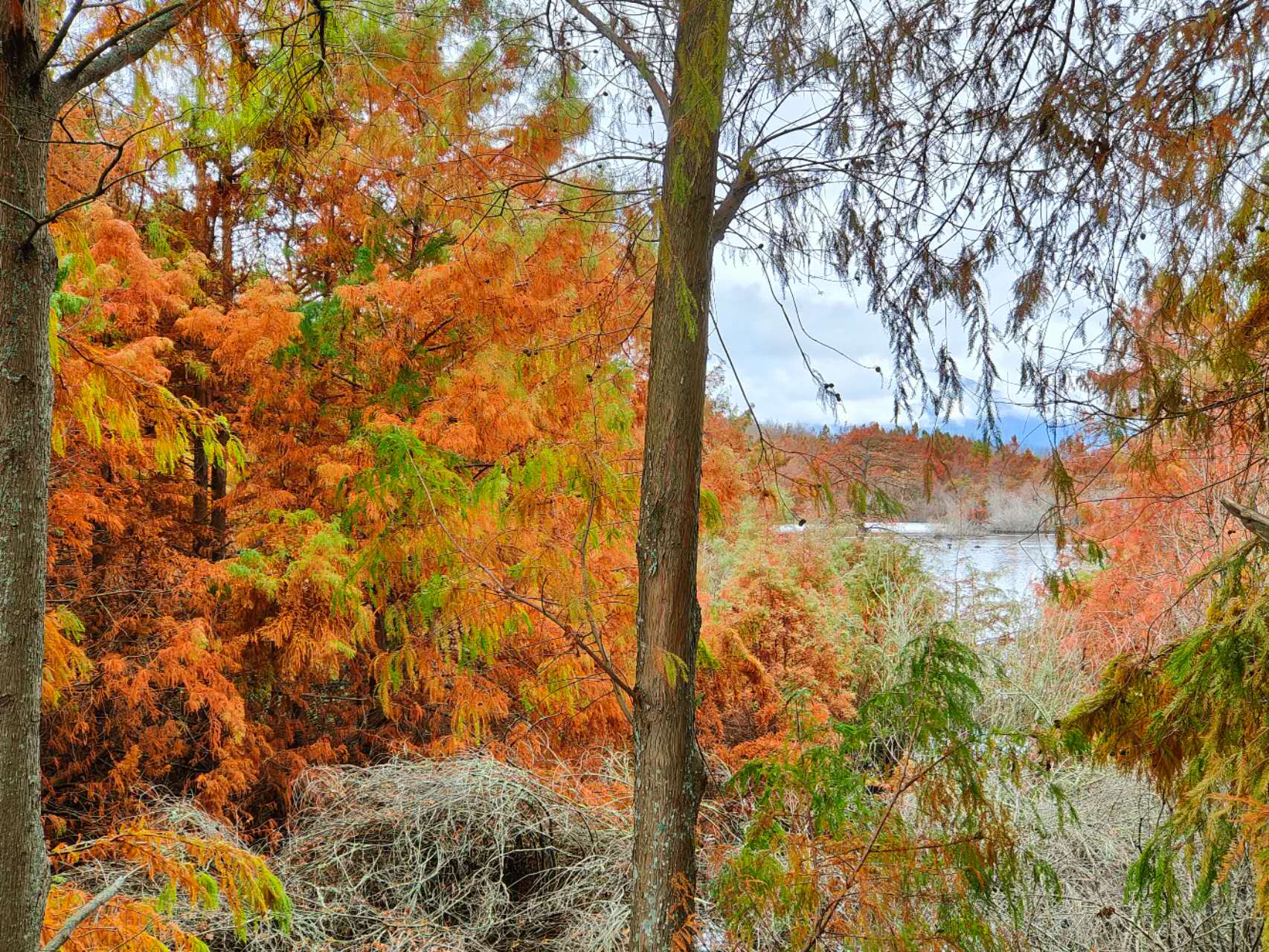
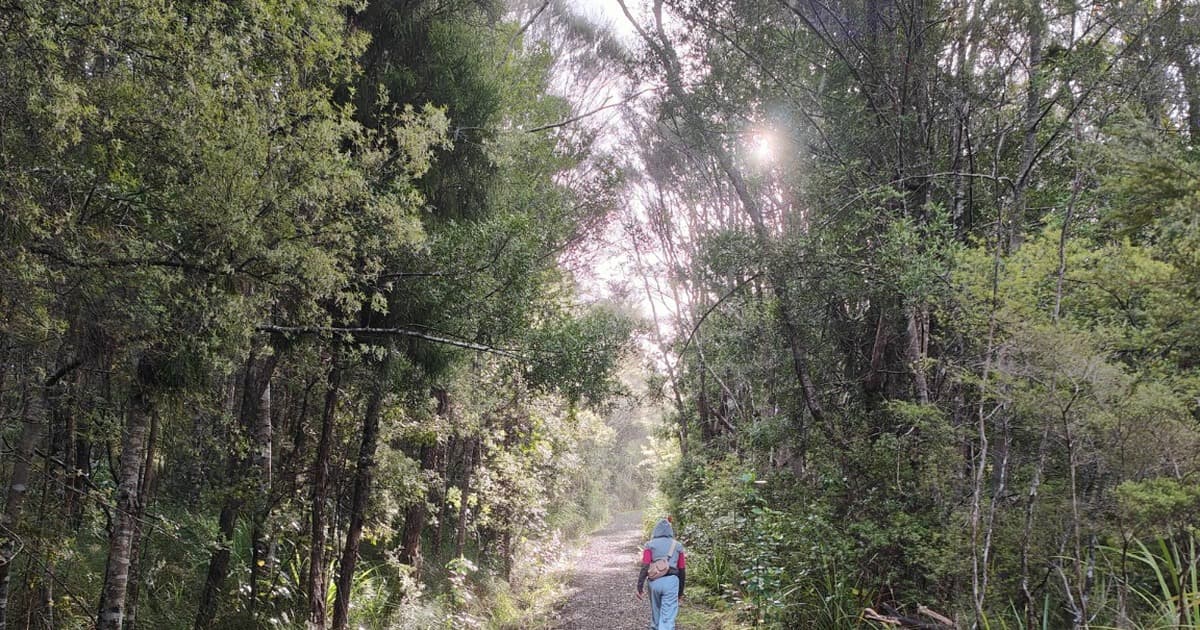
The entrance is tucked into the trees. At first the path was narrow. On one side, much of the foliage was still deep green; on the other, early winter had already begun to change the colours. Yellow-brown, orange and rusty red showed between the trunks, with fallen leaves along the edges of the path.
The air had the clean dampness of wetland.
I took a few deep breaths.
The woods were not quiet at all.
Bird calls came from somewhere inside the canopy, one after another. Farther away, ducks and other waterbirds called from the water. Sometimes we heard them before we could see them.
Farther in, the dirt path ended and a narrow timber boardwalk continued through the trees.
Katherine walked ahead. I fell behind.
My shoes landed on the boards, step after step. With birds calling all around us, the sound of my own footsteps became strangely distinct.
Water appeared on both sides. Roots, broken branches and fallen leaves lay below the surface, and some bald cypresses seemed to rise directly from the water.
I kept stopping to take photos.
Katherine got farther ahead, then noticed I had fallen behind again. She turned and waved for me to catch up.
I nodded.
My feet did not get much faster.
The deeper we went, the more colour appeared. Some trees still held patches of green. The tree beside them had turned orange-yellow. Farther in were copper, russet and the darker browns of early winter. Sometimes one tree held several colours at once.
Fine branches hung low over the water. When the wind moved them, the reflection below broke apart too.
Red, yellow and green blurred together, then slowly reassembled themselves.
The birds never stopped.
Sometimes they were directly overhead. Sometimes the calls were distant and indistinct. Now and then a duck called from the water and another answered from somewhere across the wetland.
What we did not hear was anyone else’s footsteps.
Then the trees opened.
Water spread out in front of us.
Several bald cypresses stood in it. The nearest still carried rusty-red foliage. Farther away the colour had faded to pale brown; farther still, only fine grey-white branches remained.
The sky had fallen into the water, turning it a soft blue-grey. Red trees and yellow trees were reflected there too.
Several waterbirds moved slowly across the surface, drawing long lines behind them and cutting the joined reflections of sky and trees into strips.
Through a gap in the branches, Mount Te Aroha appeared.
Deep green.
Far away.
Katherine had gone ahead again. She turned and waved.
I was still standing there.
Somewhere in the distance, a duck called again.
7. The Soda-Water Spa
Our last stop that day was the spa.
We had booked a private room for two. A staff member showed us in, explained the facilities, checked the water temperature and adjusted it. She showed us how to make the water warmer or cooler, then gave us one particular warning.
“The water is very slippery.”
The pool had a metal lining, which made it even more slippery when wet.
Once she was sure we understood, she quietly closed the door behind her.
Only Katherine and I were left.
The water was clear, with steam lifting gently from the surface. Te Aroha’s geothermal water is different from some of the sulphur springs we had visited before. There was none of the familiar rotten-egg smell.
The water here is rich in bicarbonate and has long been described locally as hot soda mineral water. When I put my hand into it, I could feel what the staff member meant: the water really did feel unusually smooth and slippery.
Mokena Geyser at the foot of the mountain comes from the same geothermal system. It is described locally as the only known hot soda-water geyser in the Southern Hemisphere.
More than a century ago, people were already coming to Te Aroha for these waters. In the year ending March 1887, the baths here recorded 28,553 visits. Over the same period, Rotorua — now far more famous internationally for geothermal tourism — recorded 4,878.
That surprised me.
Today, mention New Zealand hot springs and Rotorua is usually the first place that comes to mind.
Back then, Te Aroha was drawing far more bathers.
More than a century later, we sat in the water too.
The heat rose slowly over our shoulders.
The hoofbeats from the racecourse were gone. The birds from the wetlands had been left outside. After a full day on our feet, my legs finally had nowhere else to go.
I leaned back against the pool and thought about nothing.
Outside, the light slowly faded.
As for photographs of us in the pool, there will not be any.
Two people over fifty are entitled to a little privacy.
The water was still warm.
Neither of us felt much like moving.
At the time, we thought our Te Aroha trip had already gone very well.
There was only one thing left for the next day: climb the mountain, come back down around three or four in the afternoon, collect our luggage, and drive home to Auckland.
It sounded like a perfectly reasonable plan.
READER NOTES