
My two daughters gave me the book for Father’s Day.
It has an orange-red cover, with one large word running down the middle: POWER. Robert Greene’s The 48 Laws of Power.
I have only just started reading it. The first law is:
Never Outshine the Master.
I sent that line to Katherine. She replied: “Isn’t this basically houhei xue?”
She meant the old Chinese idea of “thick skin and a black heart” — the kind of worldly wisdom that studies ambition, calculation and the less flattering parts of human nature. I did not argue with her. I kept reading.
Greene begins the first law with a story from seventeenth-century France. In 1661, Louis XIV had only recently begun to rule France in his own right. One of the most powerful men around him was his superintendent of finances, Nicolas Fouquet. Fouquet was wealthy, influential and deeply interested in art. Outside Paris, he had built an extraordinary estate, Vaux-le-Vicomte, bringing together some of the finest architects, painters and landscape designers in France.
On 17 August 1661, Fouquet invited the king to visit. The gardens were ready. The fountains were running. Tables were laid for dinner. Molière performed a new play written for the occasion. When darkness fell, fireworks rose over the estate. For one evening, everything Fouquet possessed — his wealth, his taste, his connections and his ability to bring talented people together — was on display before the king.
Nineteen days later, on 5 September, Fouquet was arrested. The man sent to arrest him was d’Artagnan, captain of the Musketeers, whose name would later become far more famous through Alexandre Dumas’s The Three Musketeers. Fouquet was taken away, put through a long trial and eventually sentenced to life imprisonment.
Later, when Louis XIV transformed Versailles into the great palace we know today, several of the same architects, artists and garden designers who had worked at Vaux-le-Vicomte went on to work for the king. Greene places Fouquet at the beginning of his first law.
Then he gives us another man. Galileo Galilei. In 1610, Galileo turned his telescope towards Jupiter. He saw several tiny points of light beside the planet. On the first night they were in one position. The next night they had moved. After watching them over several nights, Galileo realised they were not fixed stars in the distant sky. They were moving around Jupiter. He had discovered four moons.
Galileo did not name them after himself. He called them the: Medicean Stars. The Medici family ruled Tuscany at the time. Galileo dedicated the discovery to the young Grand Duke Cosimo II de’ Medici, and dedicated Sidereus Nuncius — The Starry Messenger — to the family as well.
Not long afterwards, Galileo left Padua and returned to Tuscany, where he became mathematician and philosopher to the Grand Duke.
There are three small stories about Yang Xiu in Chapter 72 of Romance of the Three Kingdoms. Cao Cao had a new garden built. When it was finished, he walked through it without saying whether he liked it or not. Before leaving, he asked for a brush and wrote a single Chinese character on the gate: 活, huo — “alive.” Then he left. The workmen stood around the gate, unable to understand what he meant.
Yang Xiu came along and took one look. Put the character 活 inside the character 門 — “gate” — he explained, and together they form 闊: “wide.” Cao Cao was saying the gate was too wide. The workmen rebuilt it. When Cao Cao returned, he was pleased. He asked who had understood what he meant. Someone told him: Yang Xiu.
Cao Cao praised him, but in his heart began to fear him.
Sometime later, someone from the northern frontier sent Cao Cao a box of pastries. Cao Cao tasted one and wrote three characters on the box: 一合酥, yi he su — literally, “one box of pastry.” Then he left it there. Yang Xiu came in, saw the inscription, picked up a spoon and invited everyone to share the pastries. One mouthful each.
When Cao Cao returned, the box was empty. “Why did you eat my pastry?” Yang Xiu explained that the three characters could be taken apart and read another way. They could become 一人一口酥: “One person, one mouthful of pastry.” The order was written right there on the box, he said. How could they disobey? Cao Cao laughed.
But in his heart, he disliked him.
Then came the story of the chicken rib. Cao Cao was fighting Liu Bei for control of Hanzhong. The campaign had dragged on. Advancing was difficult. Retreating felt like admitting defeat. One evening, the general Xiahou Dun entered Cao Cao’s tent to ask for the password for the night. Cao Cao was eating. He looked down and saw a chicken rib in his bowl. “Chicken rib,” he said. The password passed through the camp.
When Yang Xiu heard it, he began telling the men around him to pack. Xiahou Dun asked why. A chicken rib, Yang Xiu explained, has almost no meat on it. There is little pleasure in eating it, but it still seems a waste to throw away. The campaign was the same. There was little to gain by staying, but Cao Cao was reluctant to leave. Yang Xiu said the army would soon withdraw. Xiahou Dun began packing as well. The word spread. Before long, soldiers throughout the camp were preparing their baggage.
That night, Cao Cao walked through the camp and saw men packing. He asked what was happening. Again, the answer led back to Yang Xiu. This time, Cao Cao did not laugh. Yang Xiu was executed for “spreading false words and disturbing the army.”
There is also a dragon in the I Ching. In the Qian hexagram, it first appears like this:
“Hidden dragon. Do not act.”
The Xiang, the commentary on the image, explains that the yang force is still below. The Wenyan calls it:
“the virtue of the dragon, hidden.”
In modern language, the idea is not especially mysterious. It is already a dragon. It does not lack strength. But it is still below the surface. Its position and its moment have not yet arrived.
Higher up in the hexagram comes:
“The dragon appears in the field.”
The dragon has emerged.
Later:
“Perhaps leaping in the depths.”
It is close to rising.
Then, at the fifth line:
“The flying dragon is in the heavens.”
The dragon has reached the sky. Its time has come. Its position has come. But the Qian hexagram does not end with the flying dragon.
There is one more line above it:
“The arrogant dragon will have cause for regret.”
The commentary explains:
“Fullness cannot endure.”
The dragon has gone too high. It has reached the extreme. And once something has reached its fullest point, it cannot remain there forever.
The Wenyan puts it another way:
“Knowing how to advance but not how to retreat; knowing how to remain but not how to perish; knowing how to gain but not how to lose.”
In today’s language: knowing only how to move forward, but not when to step back; knowing how to gain something, without considering that it might one day be lost.
More than twenty years ago, I worked in sales for a listed company. At the time, I produced the best sales results in the company. I led my own team, and roughly half of the company’s sales came from us. The salespeople trusted me. They wanted me to keep leading them forward.
Then my boss began finding different ways to push me out. Eventually, I left the company. For years, I was deeply unhappy about what had happened.
I had produced the best results. My team was responsible for roughly half the sales. People trusted me and wanted to work with me. Why would a boss want to get rid of an employee like that? For about ten years, my answer hardly changed. The problem was my boss.
A few days ago, I watched an interview with Robert Greene. He talked about his own early working life. Whenever he entered a company or joined a team, he said, he was too eager to show people how smart he was. He wanted them to see what he could do. He made enemies. More than once, he lost his job. At the time, he did not even understand why.
I finished watching the interview and thought again about that company more than twenty years ago. If I could go back and do that job again, I think I would still try to make the best sales I could.
But there are some things I would not do the same way.
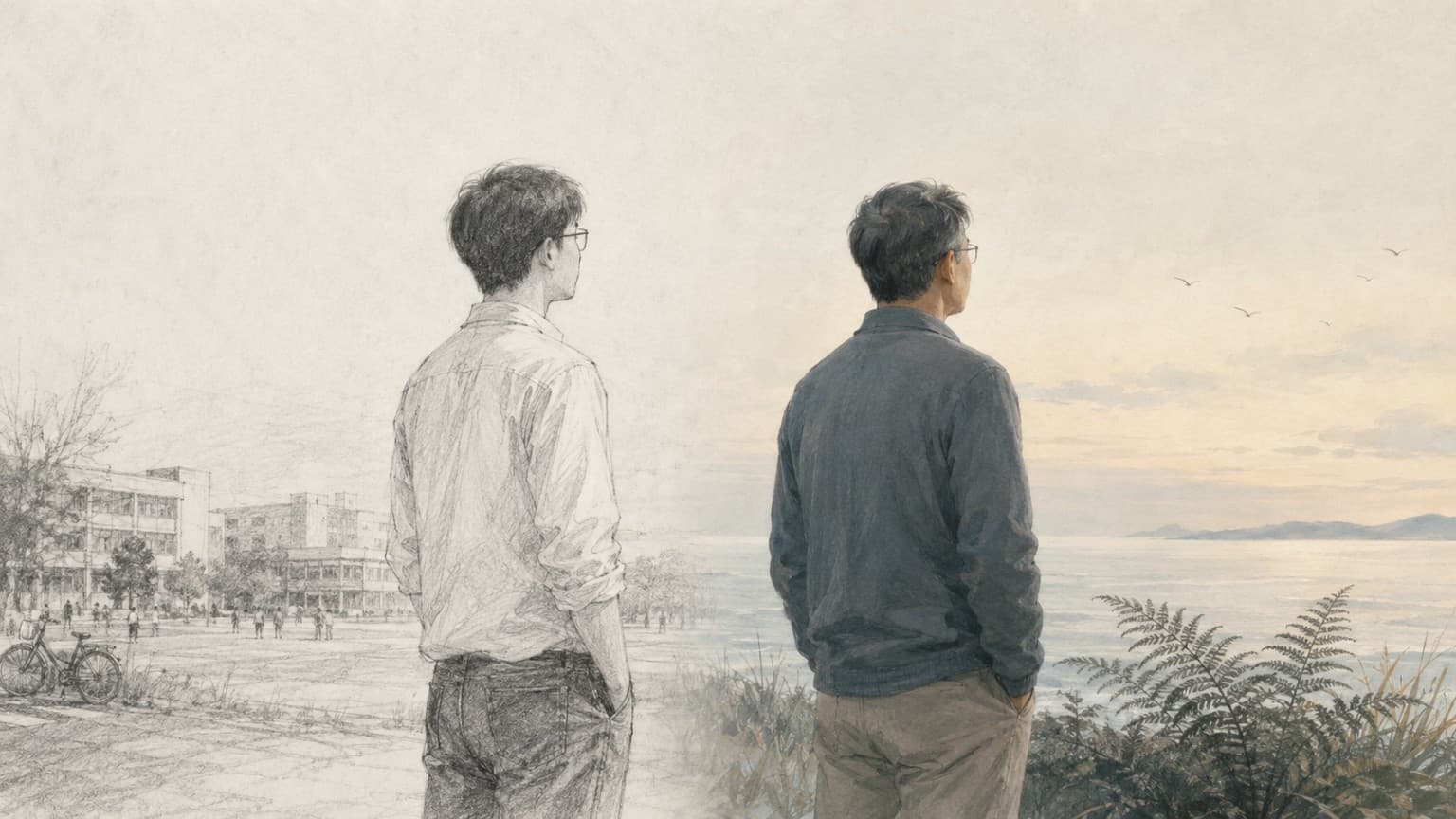
There are forty-seven laws left in the book. I have only just begun. When my daughters gave it to me for Father’s Day, they probably did not expect that the first person I would think of would not be Louis XIV, or Fouquet.
It would be the man I was more than twenty years ago.