
Li Kui looked at the dark-faced man in front of him.
Dai Zong told him: this was Song Jiang, the famous “Timely Rain.”
Li Kui dropped to the floor and bowed.
In Water Margin, Song Jiang was not a great warrior. At the time, he was still little more than a clerk from Yuncheng County, a short, dark-complexioned man with no imposing appearance.
What travelled ahead of him was his name.
When people fell into trouble, Song Jiang had a habit of helping if he could. A widow named Yan Po had drifted to Yuncheng with her family. Her husband died there, and she did not even have enough money to bury him. When Song Jiang heard about it, he arranged a coffin and gave her ten taels of silver.
Yan Po thanked him over and over, saying she would repay him even if she had to serve him like an animal.
Song Jiang told her not to speak that way.
He handed over the money and left.
Things like that accumulated quietly. One man had borrowed money from him. Another had received help when his family was in trouble. Someone else had never met Song Jiang at all, but had heard his name over wine or along the road.
Eventually, three words began to travel with him:
Timely Rain.
Rain that arrives when it is needed most.
Later, Song Jiang found himself staying at the estate of Chai Jin, a wealthy man known for sheltering people in trouble.
One evening, Song Jiang stepped outside after drinking. He accidentally kicked the handle of a fire shovel, sending hot coals into the face of a large man who was recovering from illness nearby.
The man jumped up, seized Song Jiang and raised a hand to strike him.
Chai Jin hurried over.
“Don’t you know what remarkable man you have in front of you?”
The stranger looked Song Jiang up and down.
“Remarkable? However remarkable he is, he cannot compare with Song Jiang of Yuncheng!”
Chai Jin asked whether he had ever met Song Jiang.
No, the man said. But everyone on the roads knew of Song Jiang, the “Timely Rain,” a man said to give freely, help those in danger and come to the aid of the poor. Once he recovered, he intended to go looking for him.
Chai Jin smiled and pointed to the man he had nearly punched.
“The man you are looking for is standing right here.”
The stranger stared.
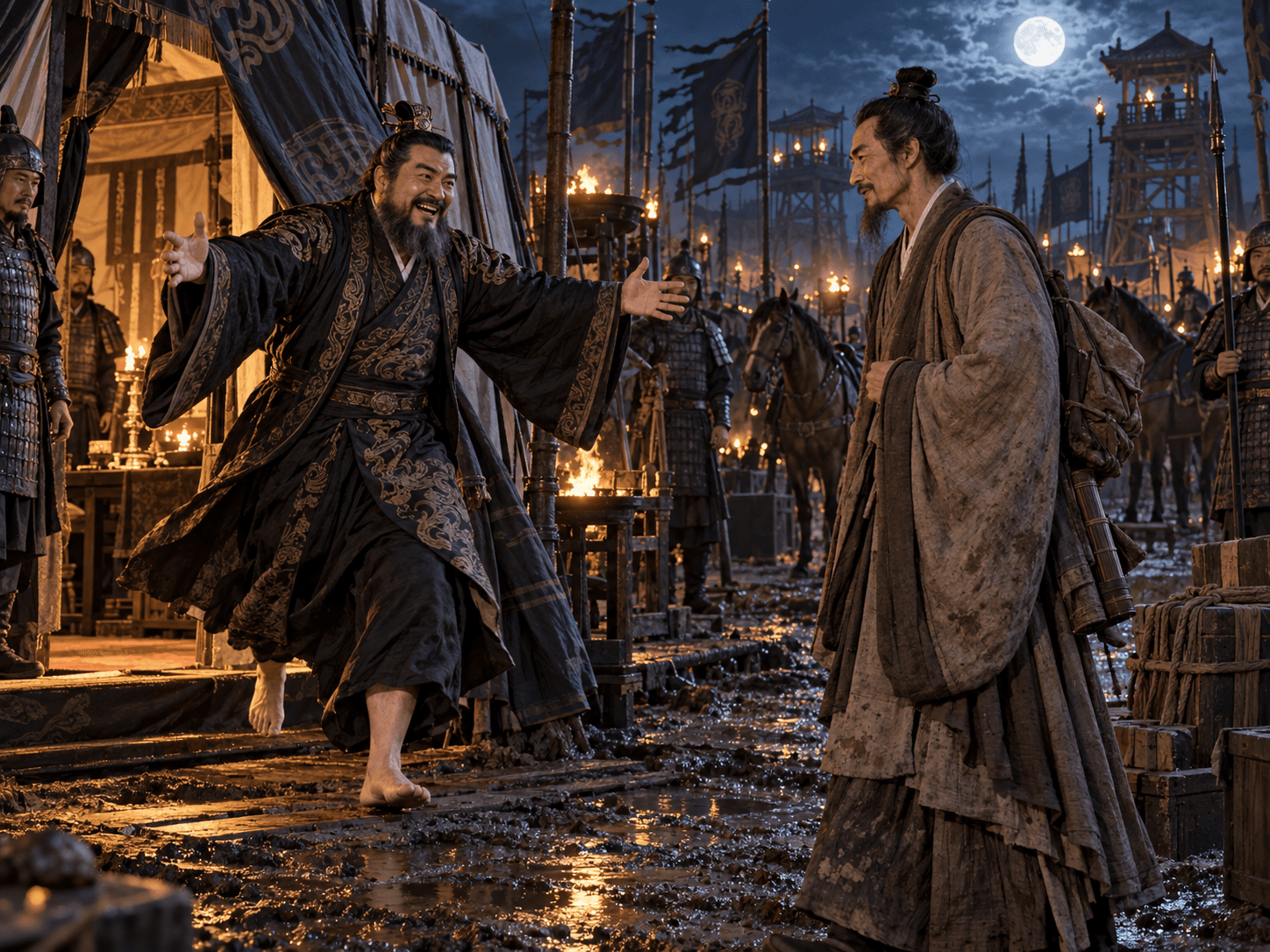
Song Jiang said quietly, “I am Song Jiang.”
The man immediately bowed.
His name was Wu Song.
Some time later, Song Jiang was sentenced to exile and sent under escort to Jiangzhou. On the road, he entered a small inn on Jieyang Ridge with the two guards accompanying him. They drank several bowls of wine.
Before long, all three collapsed.
The wine had been drugged.
The innkeeper, Li Li, dragged Song Jiang into the back room and laid him across a butcher’s bench. He was waiting for the right moment to finish the job when another man, Li Jun, arrived with two companions.
Li Jun had been waiting around the ridge for days.
He was waiting for a man he had never seen.
Song Jiang of Yuncheng.
Li Li suddenly remembered the dark, short prisoner he had just drugged.
They rushed into the back room.
Li Jun crouched beside Song Jiang.
He did not recognize him.
He looked at the penal tattoo on Song Jiang’s face.
Still nothing.
Finally, he opened the escort guards’ bundle and found the official papers.
There was the name.
Li Jun cried out:
“We almost killed my brother!”
Li Li ran for the antidote.
By the time Song Jiang slowly came round, Li Jun was already kneeling in front of him.
In Jiangzhou, it was Li Kui’s turn.
Li Kui needed money. He claimed he had a large piece of silver somewhere and only needed ten taels to redeem it. Dai Zong knew he was making it up and was about to stop him, but Song Jiang had already taken out the money.
Li Kui walked downstairs with the silver and headed straight for the gambling tables.
On the way, he thought to himself:
“We have hardly known each other, and Brother Song has already lent me ten taels. He really is generous and righteous. The stories are true.”
Robert Greene writes in Law 5 of The 48 Laws of Power:
“Reputation is the cornerstone of power. Through reputation alone you can intimidate and win.”

Li Kui later followed Song Jiang to Liangshan, the marsh stronghold where the outlaws of Water Margin gathered.
Years later, Li Kui and Yan Qing were travelling back from the capital when they spent the night at the home of an old man named Liu. During the night, Li Kui could hear the old couple crying. The next morning he asked what had happened.
Their eighteen-year-old daughter had been taken.
The man who took her had called himself Song Jiang of Liangshan.
Two horsemen had arrived at the house several days earlier. One of them gave Song Jiang’s name. Liu had heard of the famous Liangshan leader and of the banner under which his men claimed to “Act on Heaven’s Behalf.” He welcomed them into his home and even asked his daughter to come out and offer them wine.
In the middle of the night, the two men abducted her.
Yan Qing immediately doubted the story.
“Our brother is not that kind of man. There are plenty of people outside using other men’s names to do whatever they please.”
Li Kui would not listen.
He turned around and went straight back to Liangshan.
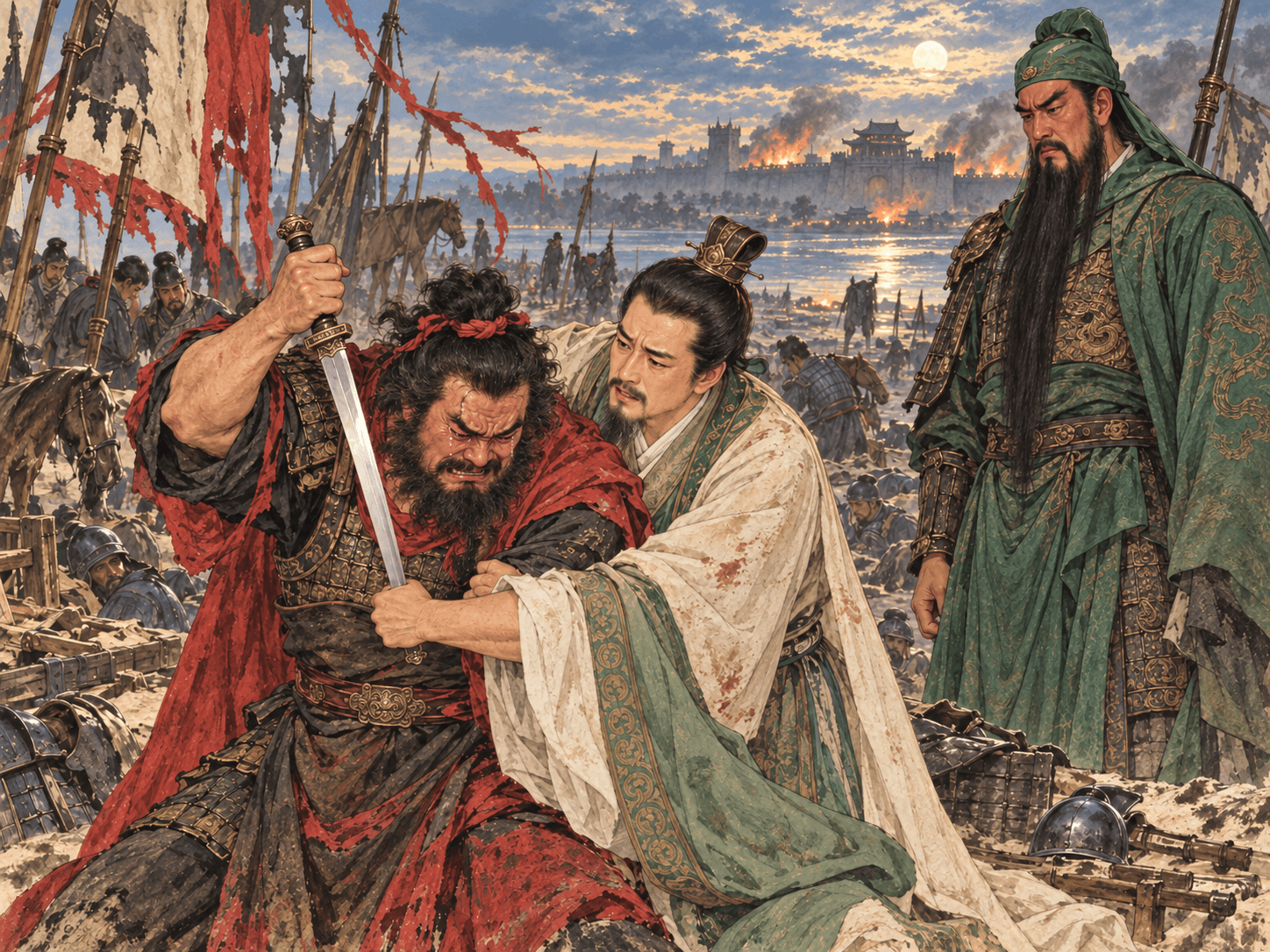
Song Jiang saw him approaching and was about to ask where he had been. Li Kui said nothing. His eyes widened. He pulled out his axe and went first for the great yellow banner.
One blow.
The banner came down.
Li Kui tore apart the four characters written across it—“Act on Heaven’s Behalf”—then charged toward Song Jiang with his axes. The others rushed in and wrestled the weapons away.
Li Kui pointed at Song Jiang.
“All this time I took you for a good man. So you are a beast after all!”
Song Jiang told him they would go back together and let the old man identify the culprit face to face. If Song Jiang had done it, Li Kui could cut off his head.
And if he had not?
Li Kui answered:
“If I have accused you wrongly, I’ll give you this head of mine.”
They even put the wager into writing.
At Liu’s home, the old man narrowed his eyes and examined Song Jiang carefully.
No.
The rest of the household came out to look.
Still no.
The men who had taken the girl had borrowed Song Jiang’s name.
On the road back, Li Kui told Yan Qing that since he had already lost his head by the terms of the wager, he might as well cut it off now and send it back to Song Jiang.
Yan Qing stopped him and suggested another way.
Li Kui removed his shirt, strapped thorny branches across his back and returned to Liangshan to ask forgiveness.
Greene writes another line:
“Once it slips, however, you are vulnerable.”
Centuries later, another name seemed to be everywhere.
Tiger Woods.
By 2009, he had won fourteen major golf championships. On Sundays he walked onto the course in a red shirt, and galleries moved with him. Television cameras followed him from hole to hole. Some of the world’s largest companies wanted their own names beside his.
The consulting firm Accenture had worked with Woods for six years, building campaigns around an athlete who represented ideas such as integrity and high performance.
Then, shortly after 2 a.m. on November 27, 2009, Woods crashed his car outside his home in Florida.
Over the following weeks, reports of multiple extramarital relationships emerged. Sponsors began to step away. Gillette reduced his presence in its advertising. The next day, Accenture ended its six-year relationship with him. By the end of December, AT&T had also ended its sponsorship.
His fourteen major championships were still there.
His clubs were still there.
His golf swing had not disappeared overnight.
On February 19, 2010, Tiger Woods stood in front of the cameras again.
He wore a dark suit. No cap. No Sunday red shirt. His mother and friends were in the room. He acknowledged his infidelity and the damage he had done to his wife, his family, his friends, his fans and his business partners.
His son Charlie had just turned one.
Speaking about his wife, Woods said:
“My real apology to her will not come in the form of words. It will come from my behavior over time.”
Seven years passed.
Early one morning in May 2017, police in Florida found a car stopped on the road with its engine still running.
Tiger Woods was asleep behind the wheel.
Police woke him and arrested him on suspicion of driving under the influence. Breath tests found no alcohol. Woods later said alcohol had not been involved and attributed the incident to an unexpected reaction to prescription medication.
By then, he had already endured repeated back problems and several surgeries. At one point, even sitting or lying down could be difficult. He no longer knew whether he would ever compete at the highest level again.
On April 14, 2019, he was back at Augusta.
It was the final round of the Masters.
Tiger Woods was wearing red again.
He moved into the lead on the fifteenth hole. On the sixteenth, his ball rolled down the slope of the green and stopped close to the cup. He reached the eighteenth tee with a two-shot lead.
On the final hole, he took one stroke more than par.
It was enough.
The tournament was over.
The sound came rolling in from every side.
“Tiger! Tiger! Tiger!”
Woods raised his arms and walked away from the eighteenth green.
Then he saw Charlie.
The one-year-old boy from 2010 was now ten.
Tiger bent down and pulled him into his arms.
His mother and daughter were there too.
Fourteen years after his previous Masters victory, Tiger Woods put on the green jacket again.
It was his fifth.

Feathers grow one by one.
They can disappear in a moment.
And if they ever come back, they can only grow the same way they did before—
one by one.
Notes
1 | Water Margin
Water Margin—also known in English as Outlaws of the Marsh—is one of the major classical Chinese novels. Its stories combine history, legend and literary invention. The Song Jiang, Wu Song, Li Jun and Li Kui episodes used in this essay are treated as episodes from the novel, not as verified events in the historical life of the real Song Jiang.
The relevant scenes occur in the 120-chapter version of the novel: Wu Song’s meeting with Song Jiang in Chapter 22; Song Jiang’s near-death encounter on Jieyang Ridge in Chapter 36; Li Kui’s first meeting with Song Jiang and his remark that the reputation was “true to its name” in Chapter 38; and Li Kui’s attack on the Liangshan banner and later apology in Chapter 73.
The nickname “Timely Rain” reflects Song Jiang’s reputation for helping people at the moment they most needed it.
2 | Yan Po and Yan Poxi
Yan Po was the mother of Yan Poxi. After Song Jiang helped Yan Po during a family crisis, Yan Po later introduced her daughter to him. Yan Poxi became closely connected to Song Jiang and later discovered a letter linking him to Chao Gai and the outlaws. Their confrontation ended with Yan Poxi’s death at Song Jiang’s hands.
After the killing, Song Jiang fled Yuncheng and sought refuge with men such as Chai Jin. It marked the point at which the county clerk increasingly became part of the outlaw world.
3 | Robert Greene
The two quotations are from Robert Greene’s The 48 Laws of Power, Law 5:
“So Much Depends on Reputation—Guard It with Your Life.”
4 | Tiger Woods, 2017
Although Woods’ breath-alcohol tests were 0.00, a later toxicology report found several substances in his system, including prescription painkillers, an anti-anxiety medication, a sleep medication and THC.
In October 2017, Woods pleaded guilty to reckless driving and entered a diversion programme. The original DUI charge was dismissed under the plea agreement.
5 | Charlie Woods
Charlie Axel Woods was born in February 2009. He had just turned one when Tiger Woods made his public statement in February 2010. He was ten years old when his father won the 2019 Masters.
6 | The green jacket
The Masters is played at Augusta National Golf Club in Georgia. Its champion traditionally receives a green jacket, one of the most recognizable symbols in golf.
Tiger Woods’ 2019 victory was his fifth Masters title and his fifteenth major championship.


READER NOTES