
Zhang Fei had lost Xuzhou, and Liu Bei’s family was trapped inside the city.
Ashamed, Zhang Fei drew his sword to kill himself. Liu Bei grabbed him and stopped him.
Then Liu Bei said:
“Brothers are like hands and feet; wives and children are like clothing.”
I had reached Law 2 of Robert Greene’s The 48 Laws of Power:
Never Put Too Much Trust in Friends, Learn How to Use Enemies.
The story comes from Romance of the Three Kingdoms, the great Chinese historical novel about the collapse of the Han dynasty and the wars that followed. Liu Bei had to leave Xuzhou to campaign against another warlord. Someone had to remain behind and defend the city. Guan Yu, one of Liu Bei’s two closest lifelong companions, offered to stay. Liu Bei refused. He wanted Guan Yu beside him because he relied on his judgment.
Then Zhang Fei stepped forward.
“I’ll stay.”
Zhang Fei was the other man Liu Bei treated almost as a brother. He was brave, fiercely loyal and formidable in battle. Liu Bei also knew exactly what was wrong with him. He drank too much. When he drank, his temper became worse. He was quick to beat his soldiers, quick to anger, and not always willing to listen when others tried to restrain him.
Before leaving, Liu Bei warned him.
Zhang Fei promised everything Liu Bei wanted to hear. No more drinking. No more beating soldiers. He would listen to advice. One of Liu Bei’s advisers still had doubts. Zhang Fei was offended. He had followed Liu Bei for years. When had he ever broken his word? In the end, Liu Bei left Xuzhou in his hands. Not long after Liu Bei departed, Zhang Fei held a banquet. His reasoning was simple enough: his elder brother had told him to drink less, so tonight everyone would drink properly one last time. Tomorrow, he would stop. At the banquet, a man named Cao Bao refused to drink any more.
Zhang Fei was already drunk.
He forced him.
Cao Bao still refused.
Zhang Fei ordered him flogged.
Trying to save himself, Cao Bao mentioned that his son-in-law was Lü Bu, a powerful military commander nearby.
That only made Zhang Fei angrier.
Cao Bao was beaten.
That night, he sent word to Lü Bu.
Liu Bei was away.
Zhang Fei was drunk.
The gates of Xuzhou opened in the dark. By the time Zhang Fei was shaken awake, enemy soldiers were already inside the city. He fought his way out with only a handful of riders.
Liu Bei’s family remained behind.
When Zhang Fei finally caught up with Liu Bei and told him what had happened, Guan Yu confronted him.
You lost the city, he said. Liu Bei’s family is still inside. What happened to the promise you made?
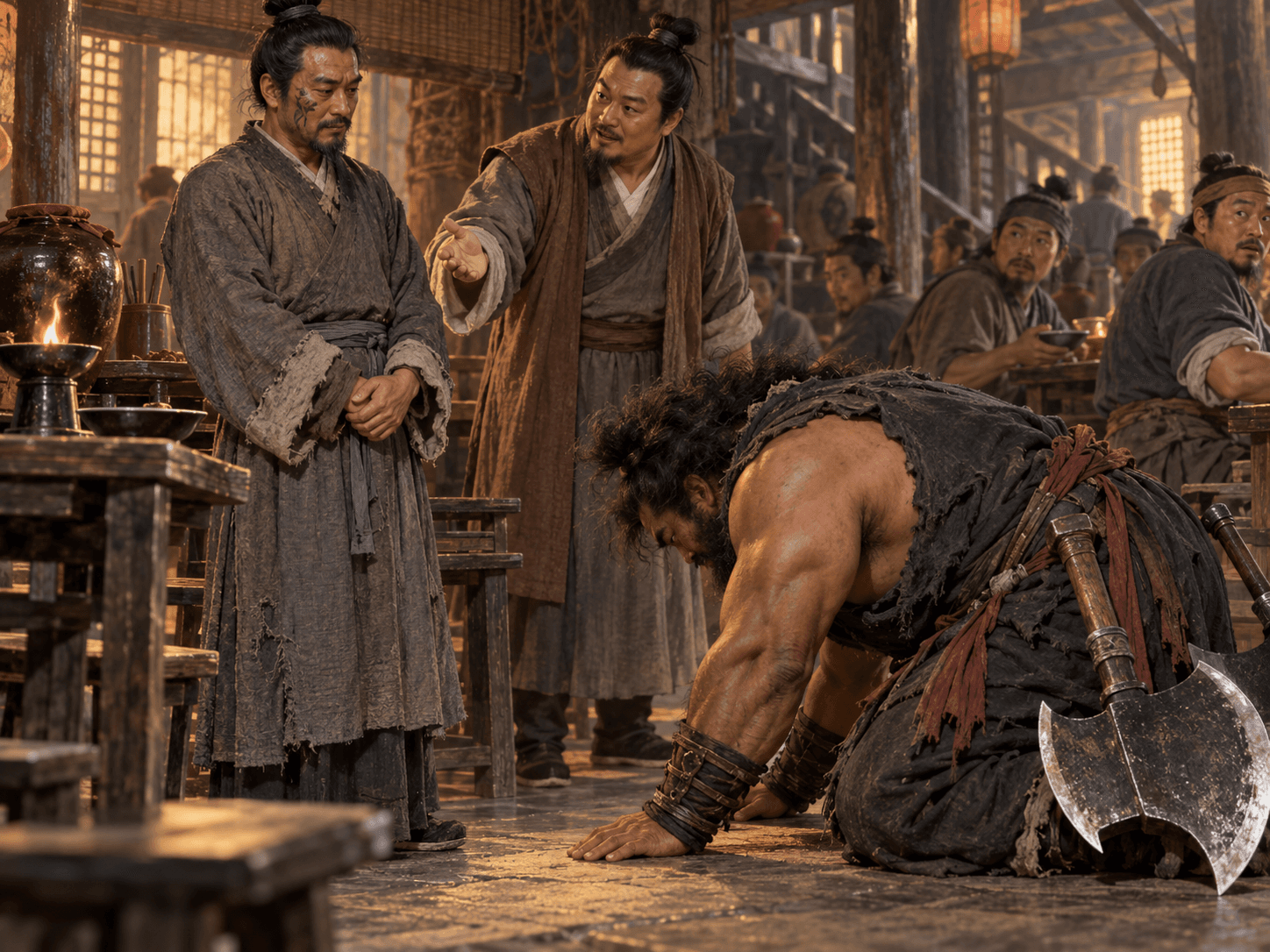
Zhang Fei drew his sword to kill himself.
Liu Bei stopped him.
“Brothers are like hands and feet; wives and children are like clothing.”
Greene writes in Law 2:
“When you decide to hire a friend, you gradually discover the qualities he has kept hidden. Strangely enough, it is your act of kindness that unbalances everything.”

Years later, Liu Bei placed something even more important in the hands of the other man closest to him.
This time, it was Guan Yu.
By then Liu Bei had established himself in southwestern China. Guan Yu was left in command of Jing Province, a strategically vital region along the middle Yangtze.
Guan Yu was no ordinary general.
He had been with Liu Bei from the beginning. In 219, Guan Yu marched north from Jing and attacked Cao Cao’s forces around Fancheng.
Then the autumn rains came.
The river flooded.
An entire enemy army was overwhelmed. Its commander surrendered. Another famous general was captured and executed. The official Records of the Three Kingdoms says that Guan Yu’s power now shook the realm. But while Guan Yu was advancing in the north, the rear behind him had already begun to crack. Two commanders responsible for key positions in Jing, Mi Fang and Shi Ren, had long resented the way Guan Yu treated them. The official history says they believed Guan Yu looked down on them. During the campaign, they failed to supply his army to his satisfaction.
Guan Yu sent word back that when he returned, he would punish them. The history records what happened next just as plainly:
Both men became fearful and uneasy.
That was when Sun Quan, the ruler to Liu Bei’s east, moved against Jing.
Shi Ren surrendered.
Mi Fang surrendered as well.
Guan Yu was still fighting in the north.
By the time the news reached him and he turned back, his route home was disappearing.
His army broke apart.
He was eventually captured and killed.
Zhang Fei had lost Xuzhou. Guan Yu lost Jing Province, and with it far more than a single city.
After Guan Yu’s death, Liu Bei prepared for war against Sun Quan. Zhang Fei was supposed to bring his troops and join him. Liu Bei had known for years what Zhang Fei’s temper might eventually cost him. The Records of the Three Kingdoms preserves a warning Liu Bei once gave him:
You punish and kill too excessively. You beat strong men day after day, then keep them beside you. This is the road to disaster.
The history then adds only one short sentence:
He still did not change.
Before the campaign began, Zhang Fei was murdered by two men from his own command.
Liu Bei went to war anyway.
His army was destroyed at Yiling.
He retreated to White Emperor City.
The following year, he died there.
Cao Cao, Liu Bei’s great rival, faced a very different kind of relationship. A man named Zhang Xiu had once surrendered to him.
Then Zhang Xiu rebelled.
Cao Cao barely escaped.
His chief bodyguard, Dian Wei, was killed.
His nephew Cao Anmin was killed.
His eldest son, Cao Ang, gave his own horse to his father so Cao Cao could escape.
Cao Ang died there too.
A few years later, as Cao Cao prepared for his decisive confrontation with the northern warlord Yuan Shao, Zhang Xiu had to choose a side again.
He hesitated.
After what had happened, how could Cao Cao possibly accept him?
His adviser told him to go anyway.
Zhang Xiu went.
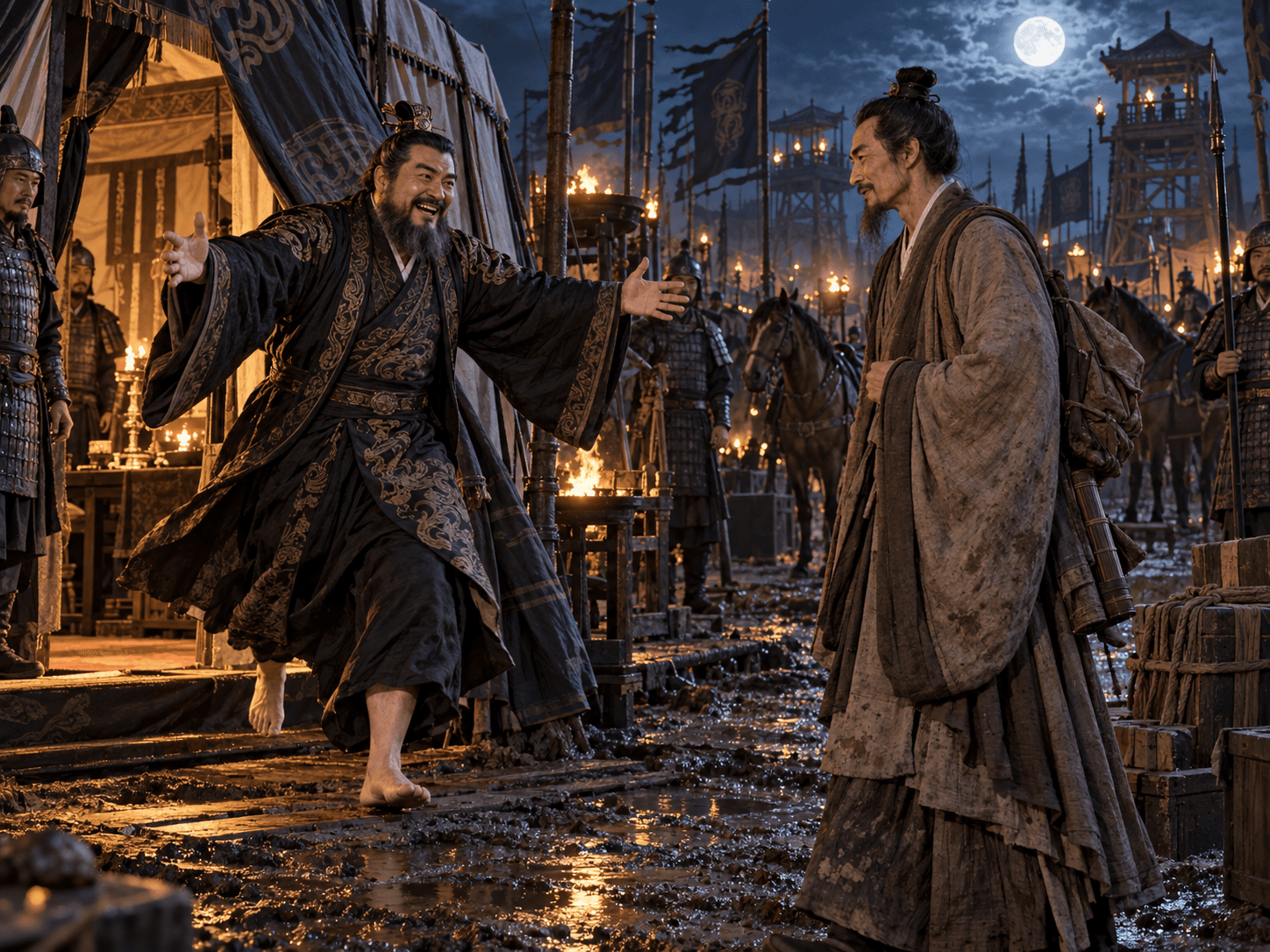
In Romance of the Three Kingdoms, he arrives at Cao Cao’s court and kneels before him. Cao Cao immediately raises him up, takes his hand and says:
“A small offense. Do not keep it in your heart.”
A small offense.
Cao Ang was dead.
Cao Anmin was dead.
Dian Wei was dead.
Zhang Xiu stayed.
And then he fought for Cao Cao.
The historical record later says that at the Battle of Guandu:
Zhang Xiu fought fiercely and earned merit.
He was promoted.
Later, he fought again for Cao Cao at Nanpi and received further rewards. His fief eventually reached two thousand households—an unusually large grant at a time when years of war had drastically reduced the population and many of Cao Cao’s generals held far less. Greene makes another observation in Law 2:
A former enemy has more to prove.

Cao Cao himself later issued an order calling for talented men to be recommended without being rejected because of reputation, background or past conduct. In that order, he referred to another famous former enemy:
“Guan Zhong was Duke Huan’s enemy; yet he employed him, and prospered.”
The man Cao Cao was referring to had once come close to killing the ruler he would later serve. At the time, Duke Huan of Qi was still a prince named Xiaobai. Two princes were competing for the throne.
Guan Zhong served one.
Bao Shuya served Xiaobai.
They stood on opposite sides.
To stop Xiaobai from reaching Qi first, Guan Zhong intercepted him on the road and fired an arrow. It struck the metal hook on Xiaobai’s belt.
Xiaobai fell and pretended to be dead.
Guan Zhong believed he had succeeded and sent word back to his own side.
They slowed down.
Xiaobai did the opposite.
He changed horses, travelled day and night, and reached Qi first.
He took the throne.
He became Duke Huan.
Duke Huan wanted Guan Zhong killed.
Bao Shuya persuaded him not to.
Instead, he recommended Guan Zhong for office. Guan Zhong entered Duke Huan’s government and became one of the most important statesmen of his age. With Guan Zhong running the government, Duke Huan became the leading ruler among the Chinese states of his time. Centuries later, Cao Cao still remembered the story:
“Guan Zhong was Duke Huan’s enemy; yet he employed him, and prospered.”
Later in Law 2, Greene writes:
“The key to power, then, is the ability to judge who is best able to further your interests in all situations.”
There is another ancient Chinese story that is much quieter.
No city falls.
No son is killed.
No armies meet.
It comes from The Annals of Lü Buwei, a Chinese text compiled more than two thousand years ago. Duke Ping of Jin needed someone to govern Nanyang. He asked an official named Qi Huangyang:
“Who is suitable?”
Qi Huangyang answered:
“Xie Hu.”
Duke Ping was surprised.
“Isn’t Xie Hu your enemy?”
Qi Huangyang replied:
“You asked me who was fit for the job. You did not ask me who my enemy was.”
Duke Ping appointed him.
Later, another important post became vacant.
Again, Duke Ping asked Qi Huangyang:
“Who is suitable?”
This time, Qi Huangyang answered:
“Qi Wu.”
Duke Ping was surprised again.
“Isn’t Qi Wu your son?”
Qi Huangyang replied:
“You asked me who was fit for the job. You did not ask me who my son was.”
The ancient text later records this judgment:
“When recommending from outside, he did not avoid an enemy. When recommending from within, he did not avoid his own son.”
But the line that remains is still Qi Huangyang’s answer:
“You asked me who was fit for the job. You did not ask me who my enemy was.”
Notes
Zhang Fei and Xuzhou.
The Xuzhou episode follows Romance of the Three Kingdoms. Zhang Fei’s drinking, the flogging of Cao Bao, Lü Bu’s seizure of the city, Zhang Fei’s attempted suicide and Liu Bei’s line about brothers being “hands and feet” all belong to the novel’s narrative rather than to the official history.
There is also a small relationship in the background. In the novel, the adviser who doubts whether Zhang Fei should be left in charge is Mi Zhu. More than twenty years later, Mi Zhu’s younger brother, Mi Fang, would be one of the commanders who surrendered in Jing.
Guan Yu and Jing Province.
The internal conflict in the Jing section draws mainly on the historical Records of the Three Kingdoms. The official history states that Mi Fang and Shi Ren already resented Guan Yu for treating them with contempt. After problems with military supplies, Guan Yu threatened to punish them when he returned. The record then says they became fearful and uneasy before later surrendering.
Jing was more than territory. Liu Bei’s years there connected him with an important network of scholars and officials, including Zhuge Liang, Pang Tong and Ma Liang. Losing Jing therefore meant losing strategic space as well as part of an important pool of talent and political connections.
Zhang Fei’s death.
Liu Bei’s warning about excessive punishment, and the line “he still did not change,” come from the historical Records of the Three Kingdoms. Zhang Fei was later killed by men from his own command before he could join Liu Bei’s campaign against Wu.
Zhang Xiu.
The dialogue in which Cao Cao calls the past “a small offense” comes from Romance of the Three Kingdoms. The deaths of Cao Ang, Cao Anmin and Dian Wei in the rebellion, and Zhang Xiu’s later service under Cao Cao, are historically grounded. The official record also credits Zhang Xiu with fighting with distinction at Guandu and records his unusually large fief.
Guan Zhong and Duke Huan.
Traditional historical accounts, including the Records of the Grand Historian, preserve the story of Guan Zhong shooting Prince Xiaobai, who later became Duke Huan of Qi. Bao Shuya subsequently persuaded Duke Huan to employ Guan Zhong rather than kill him.
Qi Huangyang.
The story of Qi Huangyang recommending first his enemy and later his own son appears in The Annals of Lü Buwei, in a chapter often translated as “Removing Private Interest.” Its point is not that enemies are better than friends. The ruler asks who is fit for the position; Qi Huangyang answers that question without allowing either affection or hostility to decide for him.


READER NOTES