Journey · Auckland Coast
The Beach Where Almost No One Goes
There were so few people around, this guy wasn’t wearing a thing. Now that was freedom.
Beyond Kawakawa Bay, the road hugged the coast.
It was narrow and full of bends, with hillside and bush on one side and the sea on the other. Around one corner the water suddenly opened out; around the next, trees and slope closed it off again. Every so often another small bay appeared below the road.
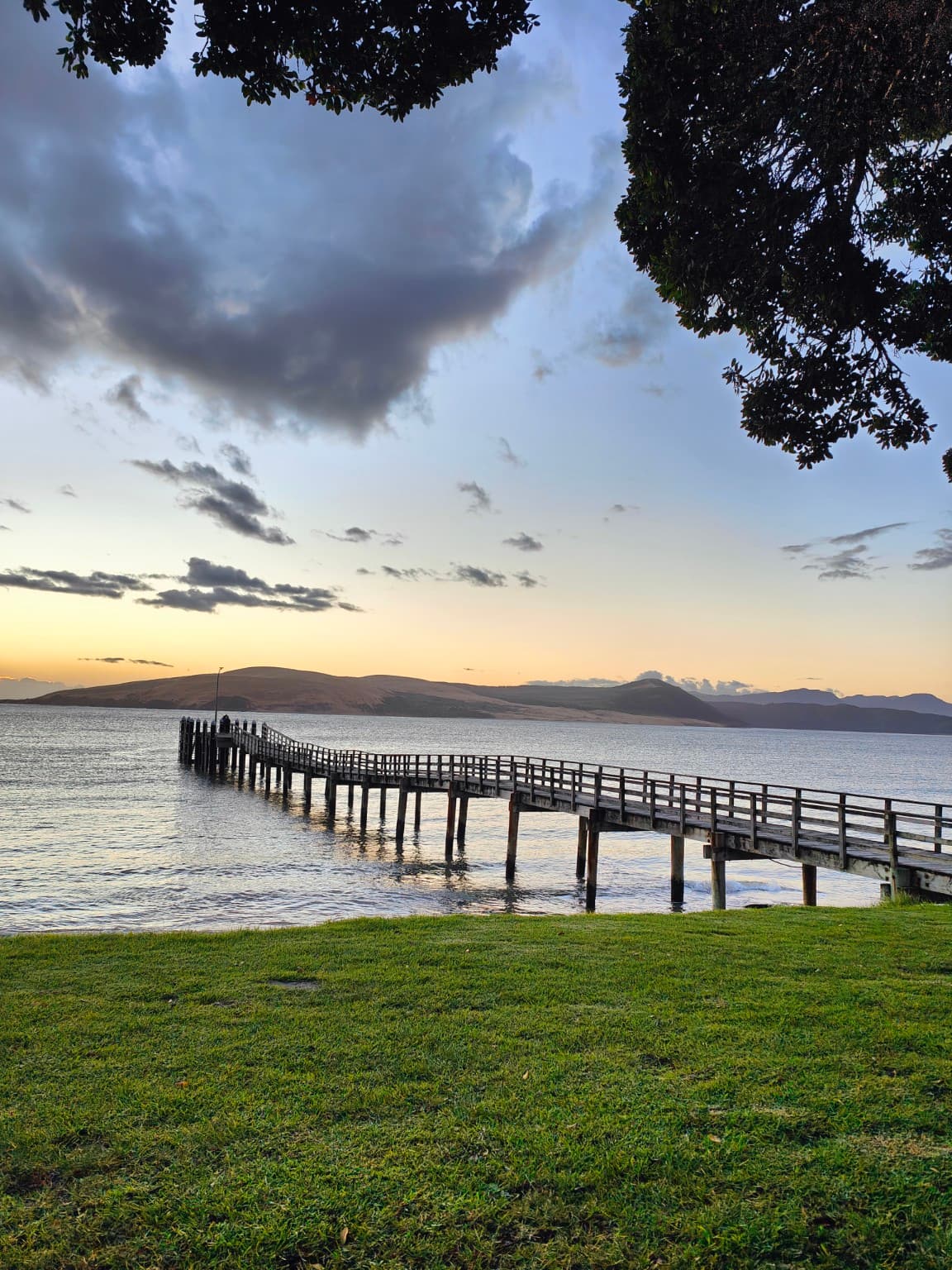
The weather was beautiful. The sky was blue, islands sat far out on the water, and the farther we drove, the fewer houses we passed.
At Waiti Bay, we parked the car. The road ended there.
And almost immediately, we went the wrong way.
We should have gone right and down to the shore. Instead, we headed left. After a while the path began to feel wrong, so we turned around and came back.
Once we found the way down, the receding tide had exposed a broad shelf of rock. Grey and brown stone ran along the coast, with small pools of seawater left between the ridges. The surface was still wet, and in places the sun made it shine almost white.

A few people were fishing farther out on the rocks.
We followed the shoreline past Tuturau Bay, then the track left the water and began climbing Papanui Point. The bush thickened as we went up. Rock became earth, then steps. From higher on the headland, the sea appeared between the branches and the coast we had just crossed narrowed to a thin line below us.


On the other side, the track began to descend again. There was a long run of steps.
Two boys were coming up as we went down. We said hello. As one of them passed us, he said,
“Good luck.”
I paused for a moment.
Then thought nothing more of it.
We kept going.
Once we crossed Papanui Point, Tawhitokino Beach finally opened in front of us.

The beach ran a long way. The sea was calm, a thin wash of water spreading over the sand and quietly drawing back. The wet sand had been smoothed almost flat, light shifting across it as the water moved. There were no houses here. No road in sight.
The bush came all the way down the hillsides to the beach. Some trees grew almost at the water’s edge, their roots showing through the sand. Others had fallen and bleached pale, their trunks and branches reaching towards the sea.
Katherine walked ahead. The beach was so wide that she soon became a small figure in it: sea on the left, bush and hillside on the right, and a long strip of sand still stretching ahead. For a long time there was no one else in sight.
The clouds sat high. The water was quiet. Every so often a small wave slid up the beach and disappeared again.
Eventually, we saw someone.
A man was sunbathing near the bush. He was wearing absolutely nothing.
My first thought was not embarrassment.
It was envy.
There were so few people around, this guy wasn’t wearing a thing.
Now that was freedom.
We walked on.
In places, a shallow stream crossed the beach, cutting a small curve through the sand before reaching the sea. The water was clear; step into it and the fine sand loosened and drifted away around your shoes.
Farther along, people were fishing from another outcrop of rock. By then the tide was already coming in, and water was beginning to gather around the rocks they were standing on.
I watched them for a moment.
“How are they going to get back?” I said to Katherine. “Are they going to swim?”
“They’ll be fine,” she said. “They must know this place.”
So we left them to it.
The beach was too beautiful to hurry. With almost no one around, there was nothing pushing us to turn back. We kept walking until we reached the campsite at the far end, and stopped there for a rest.
We started back at about half past five.
It was still bright, and we were not worried at all.
All we had to do was find the way back over Papanui Point. The problem was that the entrance was easy to miss. It sat among rocks and gaps in the shoreline, hardly looking like the beginning of a track.
On the way in, we had come down from above. Going back, we had to find that small opening from the shore.
We walked straight past it.
Neither of us noticed.
Because part of the outward route had also followed the rocks, nothing felt obviously wrong. We kept moving along the coast, finding one place to put a foot, then the next.
The tide kept rising.
Rock that had been exposed earlier was slowly being surrounded. Water filled the cracks. Places that would have been easy to step across before were now under water.
Farther on, the sea was pushing against the base of the cliff.
We found ourselves inside a small bay.
The way ahead was gone.
I looked up at the hillside. If we could not get through by the water, perhaps I could find a way over the top.
I left Katherine below and started climbing.
The slope was steep. At first there were rocks I could use for footholds. Higher up, there was only dense scrub. Bush, vines and branches crowded together with no track through them.
The scrub was full of small, hard thorns. I was wearing hiking trousers, but they still pushed through the fabric into my shins and thighs. They got me on the way up, then again when I came back down.
I can still remember that fine, sharp sting.
Higher up, the trees only became denser.
There was no track.
I stood there for a while, then backed out.
Katherine was still waiting below.
We went back to the rocks.
There was no formed track now. If there was somewhere to put a foot, that was where we went. Sometimes we had to climb high, cross the top of a rocky rise, then work our way down the other side.
At one point we climbed what felt like a small peak. A tree grew out beside the rocks, and Katherine sat there for a while. Below us was the sea, with the shoreline we had already crossed spread out underneath.

Farther on, the going got harder.
The rock edges were sharp. In many places I had to grip the stone with my hands and pull myself up.
After a while, whenever seawater touched my hands, they began to sting. I did not stop to look. We just kept going.
It was only after we got home that I saw how many cuts there were across both hands. Some of the marks were still there days later.
By then, the light was going.
At first we could still see the rocks ahead. Then only the rocks close to us. Later, even the next place to put a foot had to be tested before we trusted it.
The sea became easier to hear.
Waves ran into the gaps between the rocks, withdrew, then came back again. Wind moved in from the water. Sometimes a wave hit somewhere below us and the sound was suddenly very close.
When I looked up, the sky was full of stars.
There were no city lights out there. The stars were very bright.
Under our feet, it was getting harder to see anything.
I kept watching Katherine. Some of the climbs were high, and some of the rock sloped straight towards the water. I was confident enough moving on my own. I was worried about her missing a step.
By then I had only one thing in mind.
Get her out.
Back to the car.
Home.
The tide was still coming in.
More and more of the gaps between the rocks were filling with water.
Then we came to one where the route had disappeared completely.
There was only water ahead.
It was too dark to tell how deep it was.
I went down first.
One step.
Then another.
The water rose to my thighs.
I stopped.
The first thing I thought about was my phone. If I slipped into the water, the phone would go with me.
I put it into my pack and moved the pack from my back around to my chest.
Then I went back to Katherine and bent down.
She climbed onto my back.
I stepped into the water again.
I could not see the bottom. I had to feel for every step. The water pushed at my legs, Katherine’s weight was on my back, and the pack was pressed against my chest.
At one point my foot slipped.
For a moment, we nearly both went into the water.
Then it grew shallower.
I put Katherine down.
There were more rocks ahead.
We had no idea how far we still had to go.
If we could not get out, we would have to stay there for the night and wait for daylight.
Later I asked Katherine whether she had been frightened.
“Not really,” she said. “Worst case, we spend the night here.”
She said it calmly.
But when we eventually made it out of one section of rocks and onto a flatter piece of beach, her legs had gone soft. She was unsteady on her feet and could barely stand properly.
Then, in the darkness, I saw people farther ahead.
“There are people fishing up there,” I said.
Katherine let out a long breath.
I still wanted to try a little farther on by ourselves. Maybe the way out was just ahead.
Almost immediately we reached another corner.
It was high and steep.
We stood below it for a while.
“Why don’t we go back and ask them?” Katherine said.
So we turned around again.
A few minutes later, we reached the fishermen.
There were four of them, two men and two women.
“We’re lost,” I told them.
Then I asked, “Can we follow you back?”
“Sure,” they said.
We went with them.
At one point the climb was so high that one of the women tried several times and could not get up. One of the men stood below her and let her step onto his shoulder. From there she managed to catch the rock above and pull herself over.
One man seemed to lead the group. He carried several fishing rods and usually went first.
Whenever he reached a difficult section, he crossed it, then stopped.
If someone could not get up, he held out a hand.
If someone could not find a foothold, he waited above.
Katherine crossed.
I crossed.
Only when both of us were through did he move on.
In the dark, we travelled one by one over the rocks. No one moved quickly. Sometimes the people in front stopped, and everyone behind stopped with them.
The wind was still coming in from the sea.
The waves were still below us.
Eventually the ground under our feet was no longer rock.
It was sand.
We walked slowly back towards the car park.
Then the cars appeared.
Only when we reached them did we realise that the four fishermen had parked right beside us.
They began packing away their rods.
“We should thank them,” Katherine said.
I went through my pack and found some loose cash. I took a handful and offered it to them.
“It’s late,” I said. “Thank you for bringing us out. Go and buy yourselves a few beers.”
They waved it away.
“I ought to be buying you the beers,” I said, “but there’s nowhere around here. Please, get some yourselves.”
After a bit of back and forth, they accepted it.
The rods were packed away. Everyone was getting ready to leave.
Then the man who had led the group came over and gave Katherine and me a big hug.
“Nice to meet you. Good luck.”
The car park was completely dark.
We got in the car and drove back along the same coastal road we had taken in daylight.
The sea had disappeared. The headlights picked up one bend at a time, then left it behind in darkness.
By the time we reached home, it was nearly ten o’clock.
Katherine and I looked at each other and smiled.
I said,
“Good luck.”
More from the day
Additional photographs are kept outside the main narrative so the story can keep moving.