
“Did you finish hiking?”
“Yes. I’m going home to have my beer.”
We had only just arrived at Waharau Regional Park.
The man had a white beard and looked as though he had been out on the track for some time. He was heading towards the car park. We were heading the other way.
It was about 3:40 in the afternoon.
The Map Kept Moving
The walk had not been planned.
Auckland was bright that day, but the wind was strong. I wanted somewhere with hills and sea, preferably a track that spent enough time in the bush to keep us out of the worst of it.
I searched near Flat Bush first.
We had already been to most of the places that looked right.
So I kept pulling the map farther out.
That was how I found Waharau.
Then I noticed something odd. The park sat beyond Auckland’s administrative boundary, in Waikato, yet it was still managed by Auckland Council.
When we arrived, the signs looked familiar.
Auckland Council on the information building.
Auckland Council on the map.
Auckland Council on the track board.
The map had crossed the Auckland boundary. The signs had not.
At the entrance, the board said:
Waharau Ridge Track — 11 km — 3 hr 20 min.
A red arrow pointed the way.
We were following red.
Green
Inside the forest, the first marker was green.
So was the next one.
And the next.
We stopped.
The track board at the entrance had been clear: Waharau Ridge Track was red. Yet all we could see were green posts.
We checked the map again and decided that several tracks must share this first section before separating farther in.
We kept walking.
Eventually a red marker appeared.
After that, red kept turning up.
Beside the gravel road.
At a junction.
On a post half hidden by the bush.
See red. Keep going.
The track climbed steadily.
Katherine was not feeling quite right. She had eaten a mooncake at lunch and said it still seemed to be sitting in her stomach. The climb did not help.
She walked for a while and drank some water.
Walked again.
Drank again.
Mid-Autumn Festival was only a few days away. I had brought two mooncakes with me.
Somewhere on the way up I ate the first one.
Later the second disappeared too.
Gentle Stairs
The track itself did not look difficult.
Much of it was wide gravel road under thick bush. The wind that had been battering Auckland was quieter here. Sunlight came through the canopy in patches.
Then the steps began.
They were not steep.
Neat wooden steps. Easy enough.
You climbed one flight and returned to the gravel.
A little farther on, another flight appeared.
Then another.
I said to Katherine:
“The stairs are very gentle, but very clingy.”
You thought you had finished with them.
Walk another hundred metres.
There they were again.
We kept climbing.
Now It’s Your Turn
Partway up, a short track left the main route and went to a lookout.
Katherine was tired.
“I’ll keep going slowly,” she said.
She stayed on the main track. I took the side path.
There was a bench at the lookout.
A man was sitting on it with a DSLR camera.
When he saw me, he stood up.
“I have been here for a while,” he said. “Now it’s your turn.”
“No worries.”
He shouldered his camera and walked away.
I sat for a while, then went back to the main track and caught up with Katherine.
For most of the climb, the bush had held the view close.
Trees.
Ferns.
Gravel.
Red markers.
No sea.
Then, higher up, the trees began to open.
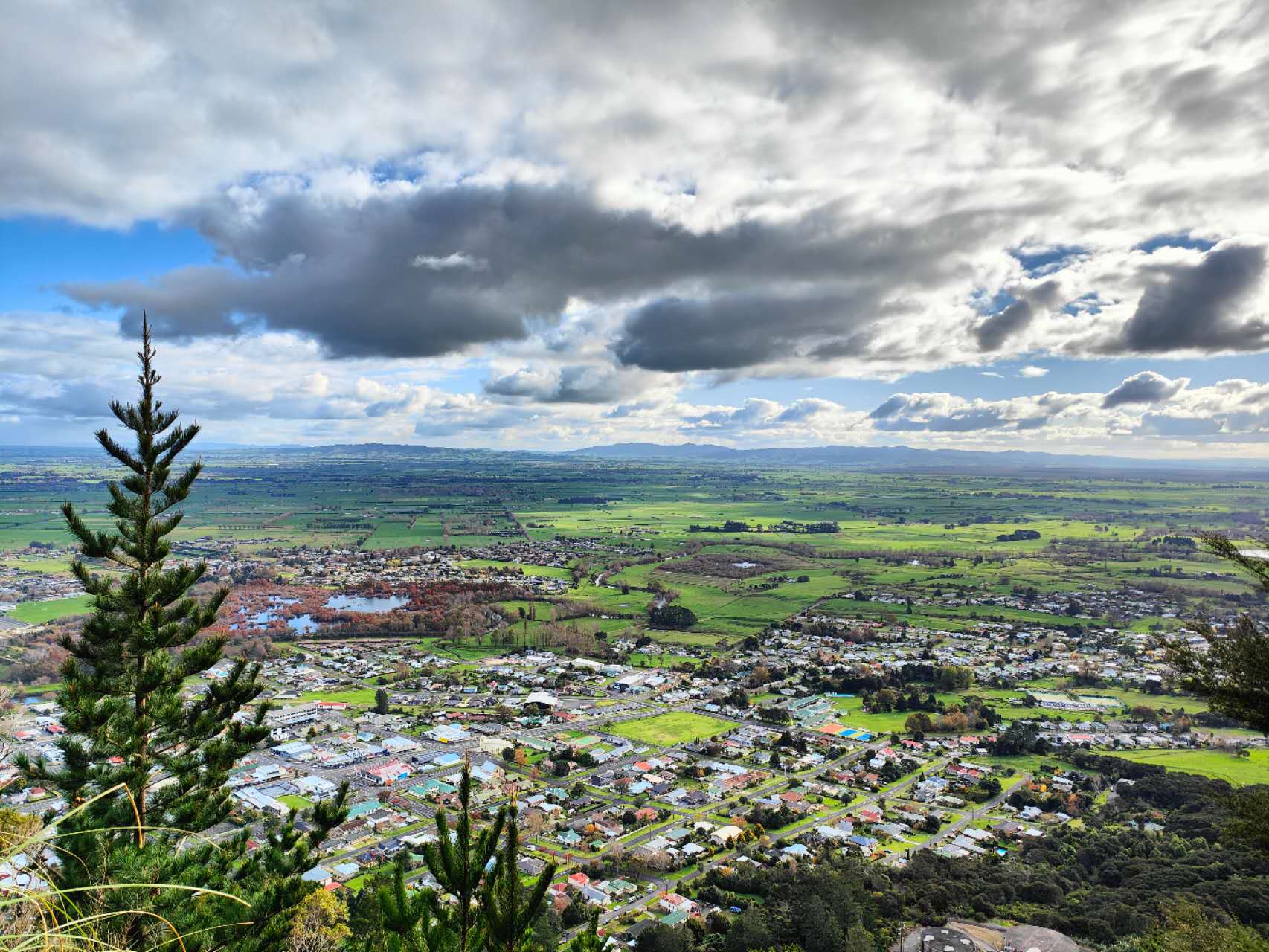
First the hills below us.
Then farmland.
Beyond that, water.
The Firth of Thames had been there all afternoon. We had simply had to climb high enough to see it.
There was an ordinary wooden picnic table near the track.
Beyond the table were the hills and the sea.
One Hour Forty Minutes
At the highest part of the walk, we came out of the bush onto a wide road.
There was another sign.
Car park — 1 hr 40 min.
I looked at my watch.
5:15.
If the sign was right, we would be walking until almost seven.
Katherine was not concerned.
“Downhill is easier.”
She thought we would be back at the car by about 6:30.
We started down.
We had not seen anyone since the photographer at the lookout.
The wind became noticeable again.
Trees moved hard above the track, bending and shaking in the gusts.
My mind started moving with them.
I did not say anything.
I just walked faster.
The sun was still above the trees when we began the descent.
Later it had dropped to halfway down the trunks.
Later still, it disappeared behind the hills.
The red markers kept coming.
One marker.
Keep going.
Another.
Keep going.
The forest grew darker.
Red Again
With about a kilometre left, the track became difficult to see.
We reached a junction.
I stopped and tried to read the sign.
There was not enough light.
I went forward.
A fallen tree lay across the track.
I assumed the route went around it to the left.
I followed that way for a short distance.
Something felt wrong.
I turned back.
For the first time that afternoon, I felt a little panicked.
Back at the fallen tree, I looked again.
Instead of going around it, I ducked underneath.
A little farther on, there was red.
I saw the marker and relaxed.
We kept going.
By the time we came out of the forest, it was completely dark.
We found the car.
Only then did I feel we were properly out.
The two mooncakes were long gone, and I was hungry again.
“Where should we eat?”
Neither of us needed much time to think.
We drove away from Waharau.
For a long time there was only the road caught in the headlights. The bush and hills on either side had disappeared into black.
Eventually, closer to the city, lights began to appear again.
More lights.
More houses.
More cars.
It took us more than an hour to reach the restaurant.
We pushed open the familiar door and sat down.
Two cups of tea.
A plate of peanuts.