Ella had been studying so hard lately that she was getting headaches. I thought a Sunday away from her books might do her some good. A change of scenery, some fresh air, a few hours in the bush.
I chose the Zion Hill Loop at Karekare, on Auckland's wild west coast. The track had been closed since 2017 to protect native kauri trees from dieback disease. It reopened only in May this year. It promised coastal forest, ridgelines, wetlands, sand dunes and an old tunnel once used to carry timber to the coast.
Best of all, it was a loop. We could climb a hill, see the sea and end up back where we started.
We arrived around midday. A sign near the car park gave the walking time as four and a half hours. We followed the path towards Pōhutukawa Glade and entered the forest.
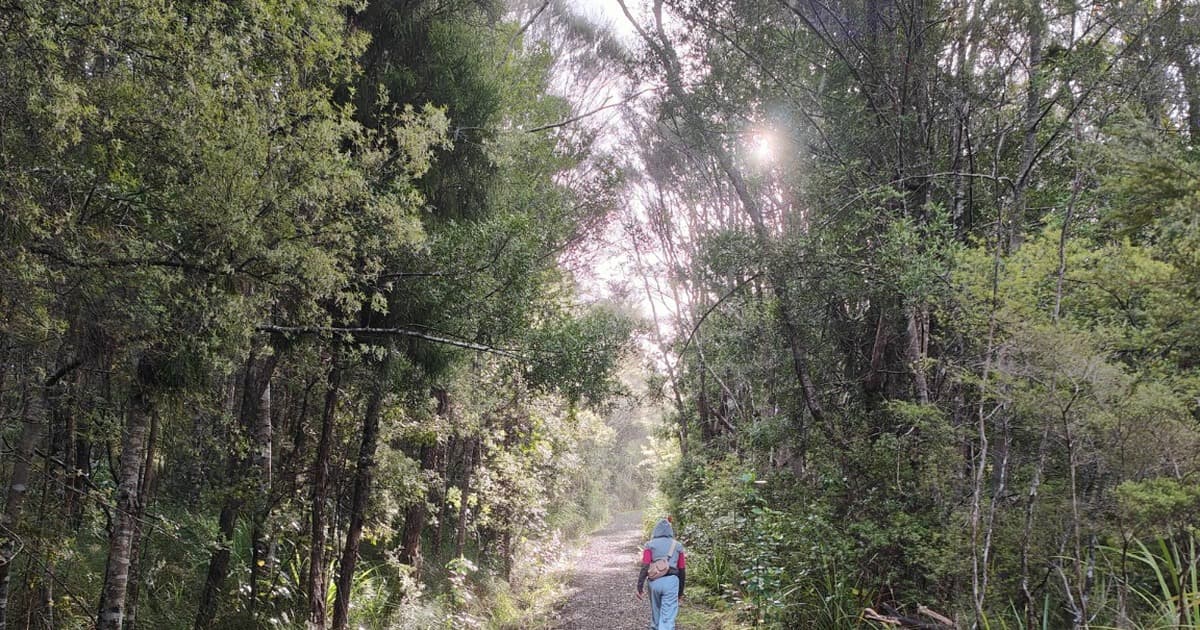
I had expected a hard climb. As it turned out, the ascent was kinder than I had imagined. The track rose steadily but seldom went straight up. It wound through the trees, turned a corner, climbed a little more, then turned again. Enough to make me work, but not so much that I couldn't enjoy what was growing around us.
Near the bottom, nīkau palms were everywhere. Their slender trunks carried great crowns of feathery leaves, giving the forest an almost tropical appearance. Higher up, the palms gradually gave way to mānuka, whose flowers provide the nectar for New Zealand's famous mānuka honey.
Then came the kauri, some towering above us, others still young. Here and there, kōwhai hung its bright yellow flowers among the green.
Partway up, we passed a mother walking with a little girl, perhaps two or three years old. The child was taking tiny, careful steps uphill. Her mother didn't pick her up. She let her walk at her own pace, and we quietly passed them.
A little farther on, we came across a father carrying a much younger child on his back. The little one looked barely a year old.
Taking children that small on a hike couldn't be easy, I thought.
"I think they're all together," Ella said, glancing back towards the mother and daughter.
Then she looked at the little one on the father's back.
"So cute!"
Before reaching the top, we came to a wooden viewing platform.
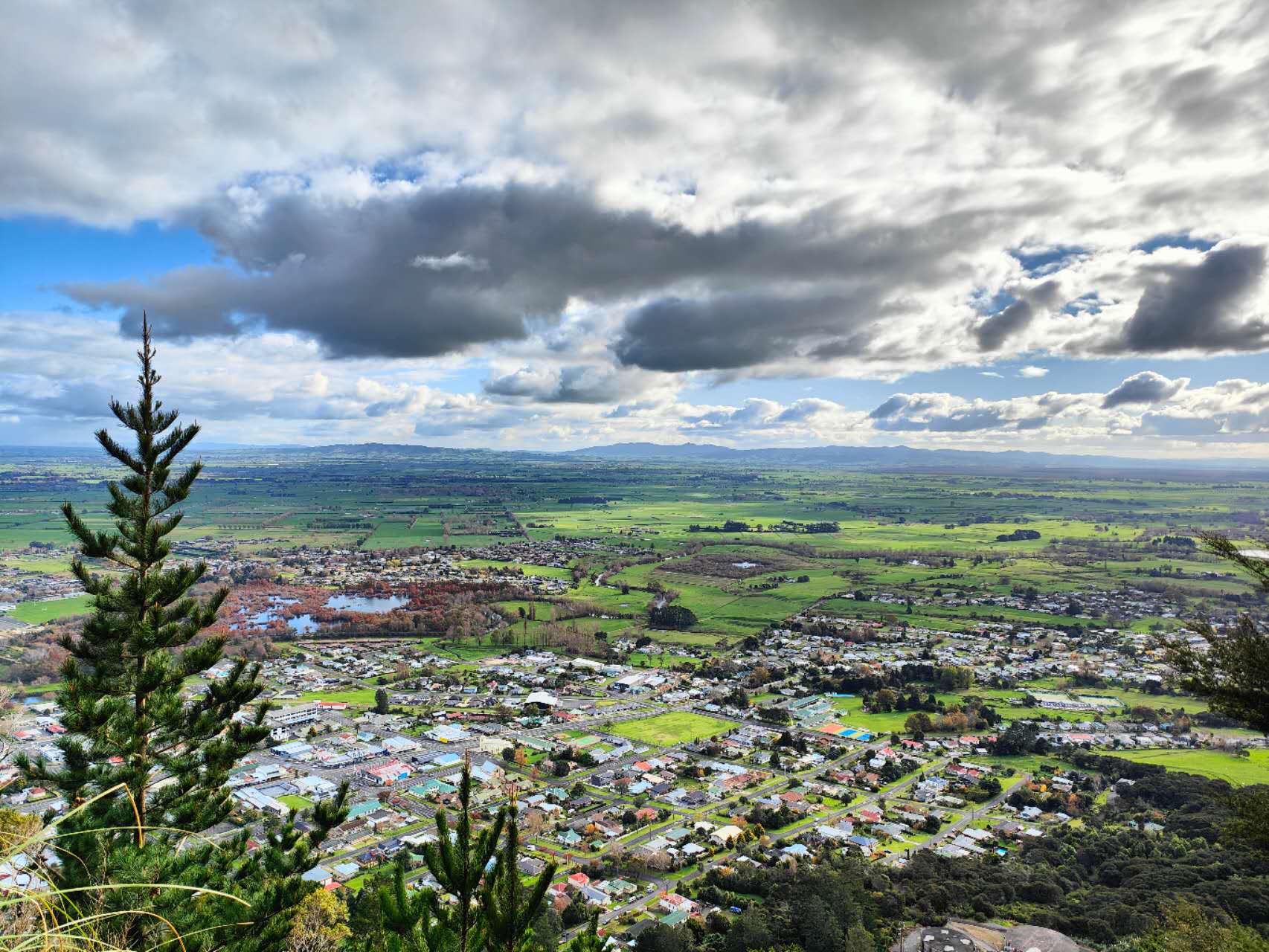
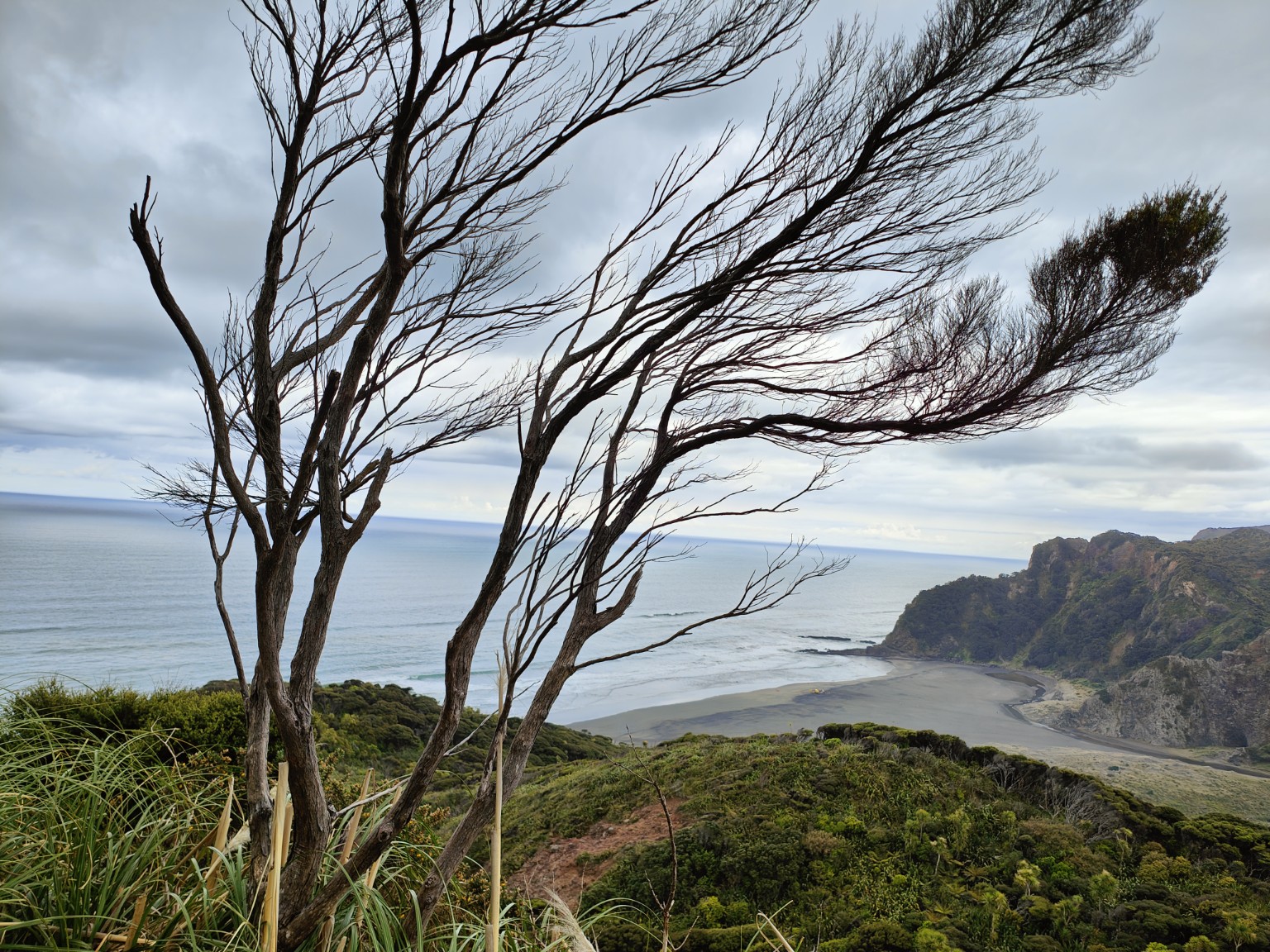
Beyond the green slopes, the Tasman Sea spread out under a heavy sky. A long black beach curved beneath the cliffs, and white surf rolled towards the shore.
We continued climbing. The trees grew thinner, and the view kept widening. What had appeared only in glimpses through branches now lay almost entirely before us. Headlands rose one behind another along the coast, the dark beach stretched into the distance, and the breaking waves looked like fine white lines drawn across the water.
Beyond the highest point, the track began to descend. We soon found a bench and sat down.
Ella started telling me about endorphins.
Exercise, she explained, can cause the body to release chemicals associated with pleasure and wellbeing. She thought the good feeling that came from being physically active was healthier than the quick satisfaction of endlessly scrolling through short videos.
I sat listening, my legs a little sore, my heart still beating faster than usual, yet feeling remarkably good. I wondered whether my endorphins had already begun to kick in.
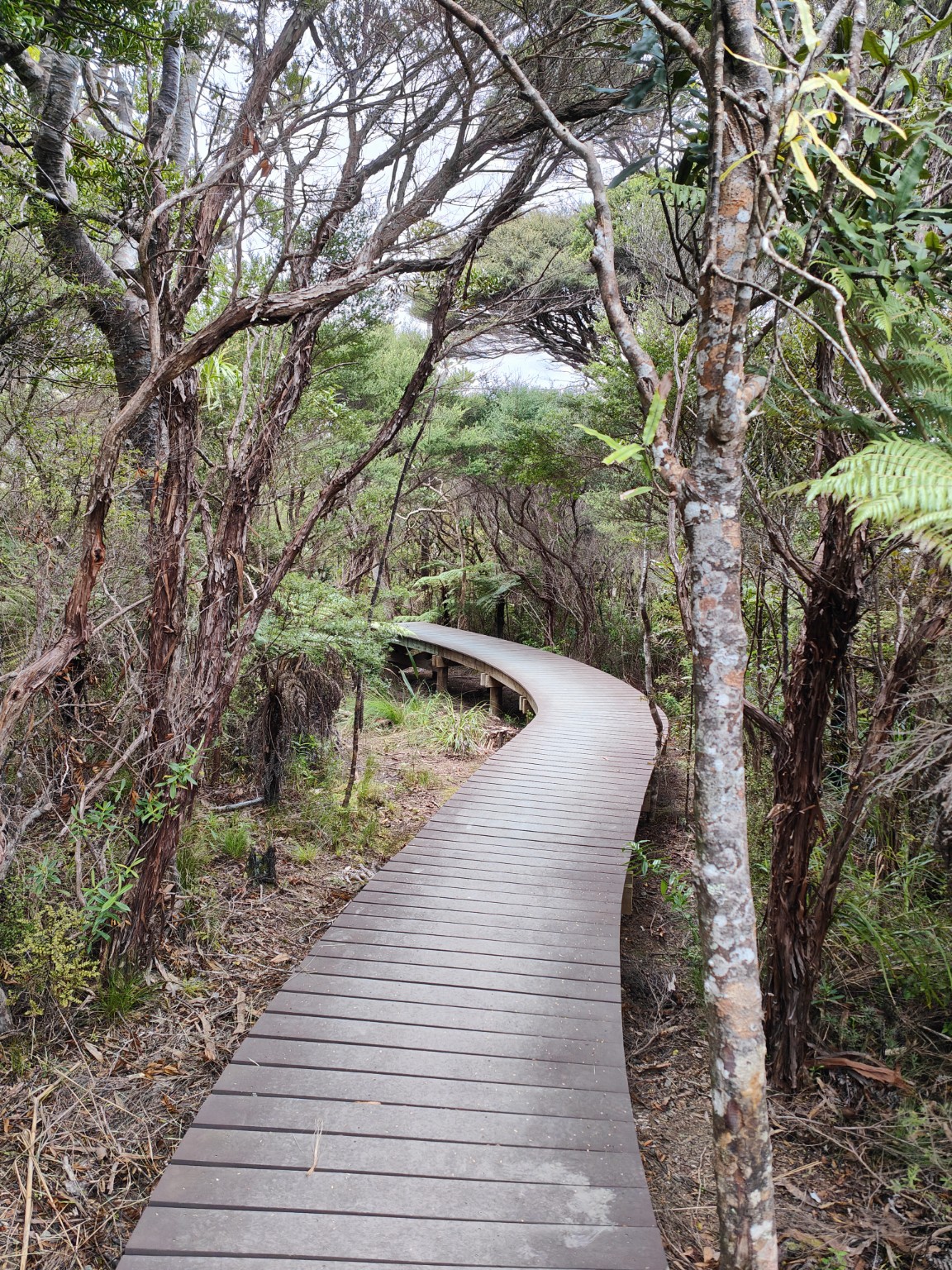
Farther down, we came to a beautifully built boardwalk. It curved between the trees, raised above the forest floor. Kauri of different sizes stood among ferns and thick undergrowth on either side.
Ella explained why the walkway had been built this way. It wasn't simply to make the track easier for visitors. Kauri roots and the soil around them are vulnerable to disturbance, and contaminated soil carried on footwear can spread kauri dieback. Keeping people above the ground helps protect the trees.
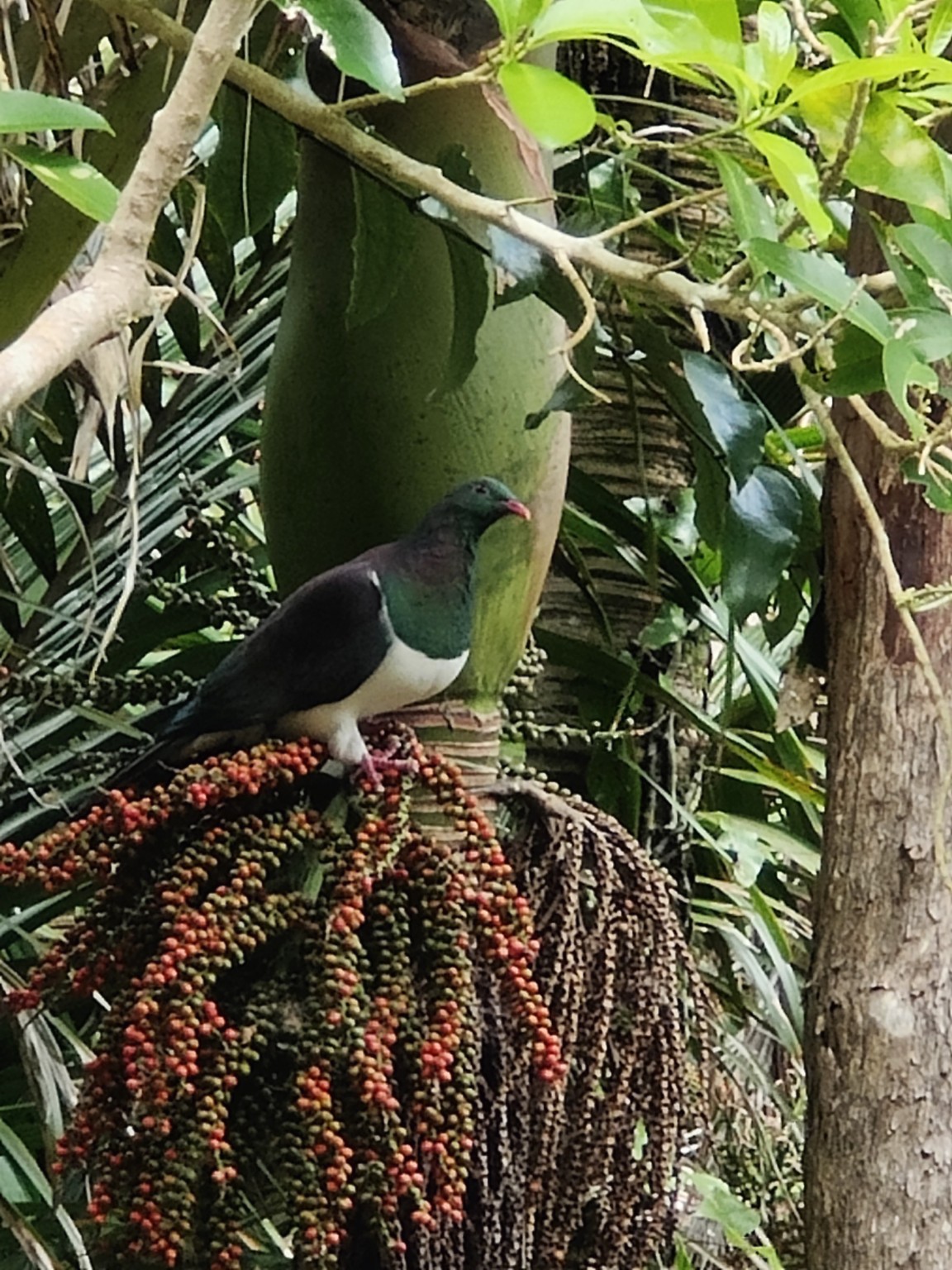
A little later, Ella spotted a kererū, New Zealand's native wood pigeon.
It was perched among the fruit of a nīkau palm, with a glossy green head and neck, a broad white breast and a pinkish-red bill. Strings of orange-red berries hung beneath it. The bird sat quietly among them.
Not much farther on, a loud call rang out from the trees.
We looked up. A dark bird was perched high on a branch. A small tuft of white feathers at its throat gave it away: a tūī.
Ella noticed another bird nearby and thought the noisy tūī might be trying to impress it. "A dating dance," she called it.
I watched it for a while. It was calling with extraordinary enthusiasm, its feathers puffed out as though every note required its whole body. Whether it was trying to impress a mate, I couldn't tell.
Ella had another theory.
The track had been closed for more than eight years. Perhaps, she suggested, having so few people passing through had given the birds a quieter place to live and breed. Maybe that was why we had been lucky enough to see them.
Near the bottom of the hill, we passed a kauri cleaning station. Soon afterwards, the forest ended.
A broad wetland opened before us.
A long wooden boardwalk ran through tall grasses and plants with sword-shaped leaves. Green hills rose in the distance. After the enclosed forest, the openness was striking. Ella walked ahead, her blue jacket standing out against the pale greens and browns of the marsh.
Beyond the wetland, the landscape changed again.
Sand dunes.
A great many of them.
The firm track and timber boards were gone. Underfoot was soft, almost black sand. Each step sank a little, and lifting a foot required more effort than it should have. Cliffs towered beside us, while the dunes stretched ahead with no obvious end.
And just then, the sun came out.
There was no shade. The dark sand grew hot.
I looked down at my shoes and had an idea.
I spend most of my days sitting in an office. Here was a chance to get close to nature, to feel the earth beneath my feet. Why not take off our shoes and walk barefoot for a while? It might even solve the problem of sand getting into them.
So we took off our shoes, tied them by their laces to either side of our backpacks and set off across the dunes.
At first, it felt rather pleasant. The sand was soft and fine, warm against the soles of my feet.
Then it got warmer.
And warmer.
Ella was the first to protest.
"It's too hot."
I told her to put her shoes back on.
"Are you going to?" she asked.
It had been my idea. I couldn't surrender that quickly.
"I'm fine," I said, doing my best to sound convincing. "It's actually quite nice. The sand's warm."
Black sand, Ella informed me, absorbs more heat from the sun than lighter sand does.
I listened, but wasn't entirely persuaded.
A little farther on, my feet began lodging complaints of their own. Faced with a choice between dignity and reality, I decided to compromise. I sat down and put my shoes back on.
Without socks.
That brought a new problem. Sand kept finding its way into the shoes, rubbing against my feet with every step.
Yet along the edge of the dunes grew masses of yellow tree lupin.
Tall clusters of flowers rose above the green shrubs, their colour almost startling against the black sand. A rich, sweet fragrance hung in the air. Beneath my feet was sand that was hot and difficult to walk on; around me was the smell of flowers.
Sunshine, dunes, the sweet scent of lupins. For a moment, I felt I'd wandered into Dune, where people kill for spice. Here, the fragrance cost nothing, and at least there were no sandworms.
Eventually, we reached the entrance to the old tunnel.
More than a century ago, a tramway had carried timber through this landscape towards the coast. The timber trains were long gone, but the tunnel remained, cut through the rock.
I decided it was time to empty my shoes.
I took one off and tipped it over. Sand poured out. The other was no better. I reckoned each shoe must have been carrying several generous handfuls.
Then I noticed something else.
On the sole of each foot, just in front of the heel, was a blister about the size of a gold coin.
I stared at them.
I'd wanted to get closer to nature. Well, I'd certainly managed that.
Nature hadn't been inclined to go easy on me.
Ella took a tube of hydrogel from her bag and told me to put some on.
I hadn't even known she'd brought it.
I applied some, walked a while, then applied more. Before long I was reaching for it again. In the end, I quite shamelessly claimed the whole tube as my own.
We went through the tunnel, expecting the beach to be close.
Instead, there were more dunes.
Another long stretch of them.
Unlike the earlier dunes, with their yellow flowers and sweet fragrance, these were almost barren. Grey-black sand spread between low mounds dotted with sparse grass. Steep cliffs rose on one side, and there was no clear path through the sand.
Ella began to worry.
"Are we sure we're going the right way?"
I thought again of Dune, this time of Paul Atreides and his mother struggling to survive in the desert. The image sent a small chill through me.
Then I looked ahead and spotted a few other walkers in the distance.
"There are people up there," I told her. "If we follow them, we should be all right."
We carried on. The soft sand still swallowed our steps, and the gel hadn't magically restored my feet.
Then, beyond another low ridge of sand, the view opened.
The dunes fell away behind us, and in front lay an immense black beach, stretching towards the blue Tasman Sea. To our right, cliffs rose in a long, dark wall, their faces partly covered in green vegetation. A faint haze lingered at their base, where the shoreline curved out of sight.
A few people were scattered across the beach, looking like lonely little trees at the foot of the cliffs.
The most striking feature was a huge, isolated rock near the water. One end was broad and low, while the other rose sharply into a jagged peak. Its dark surface was marked by deep lines and ridges. Beyond it, waves rose from the Tasman, broke into white foam and spread across the sand.
By now, broad patches of blue had appeared between the clouds. Sunlight fell across the sea, changing its colour from the slate grey we'd seen on the ridge to different shades of blue.
But what held my attention was the sand beneath us.
The retreating tide had left a thin film of water over the flat black beach. It reflected the sky, the white clouds and the great rock as clearly as a mirror. There was the rock itself, standing beside the sea, and beneath it another rock, upside down in the shallow water. Fine ripples in the sand showed through the reflection, and the image trembled gently whenever the water moved.
Even the clouds seemed to have found their way beneath our feet.
Earlier, from high on the ridge, the surf had looked like thin white lines in the distance. Down here, we could watch each wave rise, break and spread before drawing slowly back over the wet sand.
We followed the firmer sand nearer the water. After the dunes, it was a relief to have solid ground underfoot again. My blisters still rubbed inside my shoes, and walking still hurt a little. Yet only a short while earlier I had wanted nothing more than to escape the dunes. Now I was reluctant to leave the beach.
We walked along the shoreline towards the car park. The waves kept rolling in beside us, while patches of sky and cloud travelled with us across the shining black sand.
At 3.35 pm, we reached the car.
My walking app showed 11.42 kilometres, 3 hours 14 minutes and 56 seconds of exercise, and 13,597 steps.
"Tired?" I asked Ella.
"A bit," she said. "But I really liked it. Next time I want to bring Mum."
Then she looked at me.
"Do your feet still hurt?"
I thought for a moment. The gold coin under my heel seemed to have grown a little larger.
"No, no. Doesn't hurt."