
NEW ZEALAND BUSINESS · STORE OBSERVATIONS
When the ’90s Kids Reach Middle Age
David came by the shop today.
He had lost a lot of weight.
When he worked for us years ago, he was a little heavier. We had more dinners and business functions back then, and after enough meals with the rest of us, he had begun to develop a small belly.
That was gone now.
He looked leaner. Looking at him, I also thought his back seemed a little more stooped than I remembered.
I was working as we talked, so neither of us really sat down. David stayed on his feet beside me. When he spoke, his body had a habit of swaying slightly without his seeming to notice.
A customer came in.
I went over to help.
David stopped talking and waited off to one side.
When the customer left, we picked up where we had stopped.
He looked around at the shelves.
“There’s so much more stuff in here now.”
Some of it, he no longer recognised.
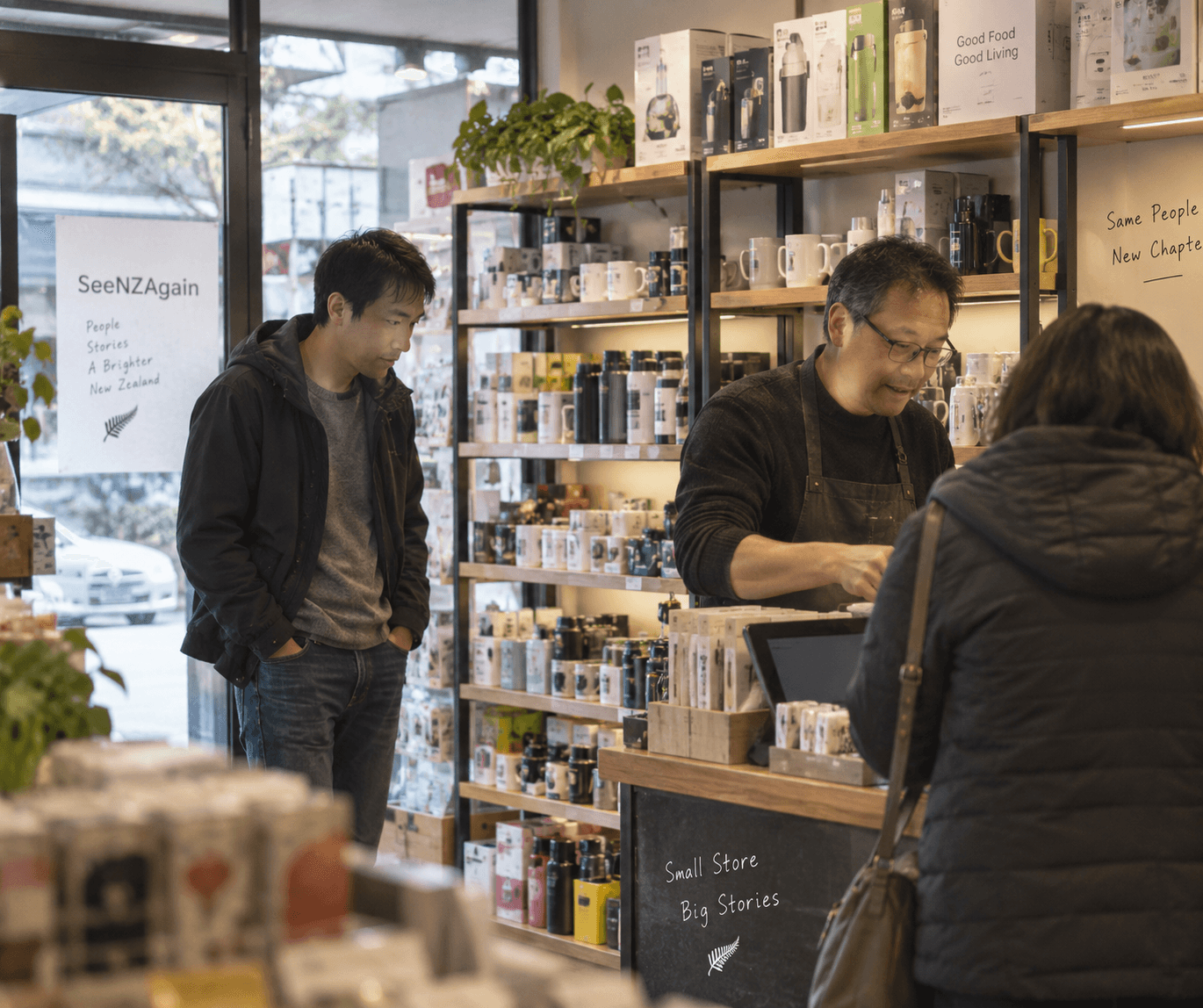
David used to work for me.
He was meticulous.
His temper was another matter.
Once, a customer was being particularly unreasonable. David argued back. The argument grew hotter until—
Bang.
His palm came down hard on the table.
The other staff nearly jumped out of their skins.
After that, I became reluctant to keep him on the front line with customers. I moved him into logistics instead.
Orders came in. He arranged dispatch. He handled the data. Later, I gradually gave him some of the accounts and HR work as well.
Better to let him deal with systems.
Better to let him deal with numbers.
Numbers never argued back.
And he was good at that kind of work. An invoice, an order, a figure that did not quite add up—he wanted to know exactly why.
At one stage, I even thought I might gradually hand more of the management over to him.
Another customer came in.
I went to serve them.
David stood nearby and watched.
He knew this customer from the old days.
When the customer had gone, David said quietly,
“The customers have got old too.”
I smiled.
Back then, David was usually the last person to leave the office.
Everyone else would be packing up and heading home, and he would still be sitting at his desk.
“Why are you still here?”
“I haven’t finished.”
No one had told him everything had to be finished that day.
He simply did not like leaving things undone.
Most people worked five days a week. David often worked six.
I once asked him,
“Why do you keep coming in on Saturdays?”
He said,
“I’m on my own anyway. I’d just be sitting around. I might as well work another day and make a bit more money.”
David’s family was comfortable.
He was an only child, and money was not something his family lacked.
But Saturday came, and he still turned up.
There was always plenty to do in those days.
He ran up and down the stairs. Sometimes he went out to collect stock himself. Orders came in and had to be dispatched. Deliveries arrived and had to be dealt with.
At night, he went home and slept.
Talking about it today, even he seemed a little surprised.
“I slept pretty well back then.”
David had come to New Zealand as an international student.
After graduating, he joined our company. At that time, he did not yet have permanent residence. No one knew whether he would ultimately be able to stay.
One year, his father came over from China to see him.
I had a meal with him.
At the table, his father asked me,
“Do you think he’ll be able to stay in New Zealand?”
I said,
“No one can promise that.”
The next morning, David came to work as usual.
When everyone else left, he was still there.
When Saturday came, he came in again.
“I’d only be sitting around anyway.”
I carried on with what I was doing in the shop.
David was still standing beside me.
We talked about the old days. He said that although life had been busier then, he had not had the problems he has now.
These days, he sleeps lightly.
“The smallest noise wakes me up.”
If he wakes at around five in the morning, he often cannot get back to sleep.
Once at work, his heart started racing. He checked his blood pressure. The systolic reading was over 150.
He also said his hair had started thinning and that he was taking something for it.
I looked at him again.
The little belly was gone.
He had succeeded in losing weight over the past couple of years.
He was thinner now.
His back, though, seemed slightly bent.
When he was younger, David had a fairly lively romantic life.
He was good-looking and had had several girlfriends.
Once, he fell out badly with his family over a woman. For a long time, he barely spoke to his parents.
In the end, the relationship still ended.
Only later did he slowly start talking to his family again.
Today, when we got onto the subject of dating, he said,
“Women around my age are mostly married now.”
His body gave that small sway again.
“If I meet someone now, they’re all born after 2000.”
A while ago, he met a younger woman who had come to New Zealand to study.
They had not known each other long when she asked him,
“If we were together, could you help me get PR?”
If the answer was yes, she said, she could move in with him soon.
Then the clock could start running.
David looked genuinely puzzled.
“How did relationships become like this?”
I paused and looked him in the eye.
“Welcome to the adult world. Everything here has a price.”
He gave a bitter little smile and nodded.
After a moment, he asked,
“If I didn’t have PR, if I didn’t own a house, would she still like me?”
I did not answer straight away.
Another customer had just come in.
I went to serve them.
David stepped aside and waited.
What David had wanted most in those early years was simply to stay in New Zealand.
Eventually, he did.
We helped him through the residency process.
After the pandemic, business at our company was no longer as busy as it once had been. For a period, I handed much of the management over to David and another colleague.
Later, David came to speak with me at length.
He felt the management pressure was becoming too much. He was not optimistic about where things were heading.
He wanted me to come back and take over again.
Eventually, I did.
Not long afterwards, David left the company.
He joined another firm in logistics and customs work.
It was still the kind of work he liked.
Later, he gained a professional qualification in the field.
He had residency.
He bought a house.
Life gradually settled down.
“Do you think I should go back to China?”
He suddenly asked me that today.
I stopped what I was doing and looked at him.
“Why are you thinking about going back now?”
He said work was quiet.
The economy was weak and there was not much business. Many days, he could finish most of what needed doing in the morning. By the afternoon, there was very little left.
In the old days, there was never enough time to finish everything.
Now, everything actually got finished.
Sometimes he sat there in the afternoon and felt strangely empty.
Friends asked him out for dinner.
He did not want to go.
They invited him to play sport.
He did not feel like doing that either.
I told him he should get outside more, move around, exercise.
He said,
“I just can’t get interested in anything.”
We started talking about the old days again.
I said,
“When you worked here, you were running up and down the stairs all day. You even came in on Saturdays.”
He smiled.
“Yeah.”
“You didn’t even have residency then.”
“No.”
“You had no idea whether you’d be able to stay, but at least you slept well.”
He smiled again.
I said,
“So what’s the thing people should be most afraid of?”
He looked at me.
“Getting what they wanted.”
At that moment, another customer came in.
I turned away to serve them.
David stood to the side and waited.
Eventually, he was ready to leave.
Before he went, we somehow got onto driving.
He said that these days, if someone wanted to cut into his lane, he let them in. If someone wanted to push ahead, he let them.
“In the past, I would definitely have fought them on it.”
“What about now?”
His body swayed once.
“Forget it.”
“Let them.”
David walked out of the shop.
I went back to work.
A little later, I looked up at the shelves.
There really was much more in the shop than there used to be.
Some of it, he no longer recognised.




READER NOTES