
This SeriesHokianga
- 00Northbound
- 01The Road Begins with Lunch
- 02A Tree Older than a Nation's History
- 03Donkeys by the Road, a River Turning Below
- 04On Arrival, the Harbour Turned Down the World
- 05Here, the Harbour Is Not an End, but a Threshold
- 06When the Tide Withdrew, Time Left Something Round Behind
- 07In Opononi, Life Happens between the Harbour and Lunch
- 08Before We Left, the Forest Returned Time to the Trees
- 09After Dark, Another Passage Appeared above the Harbour
“You two go on. We’re staying here.”
The children did not even turn around.
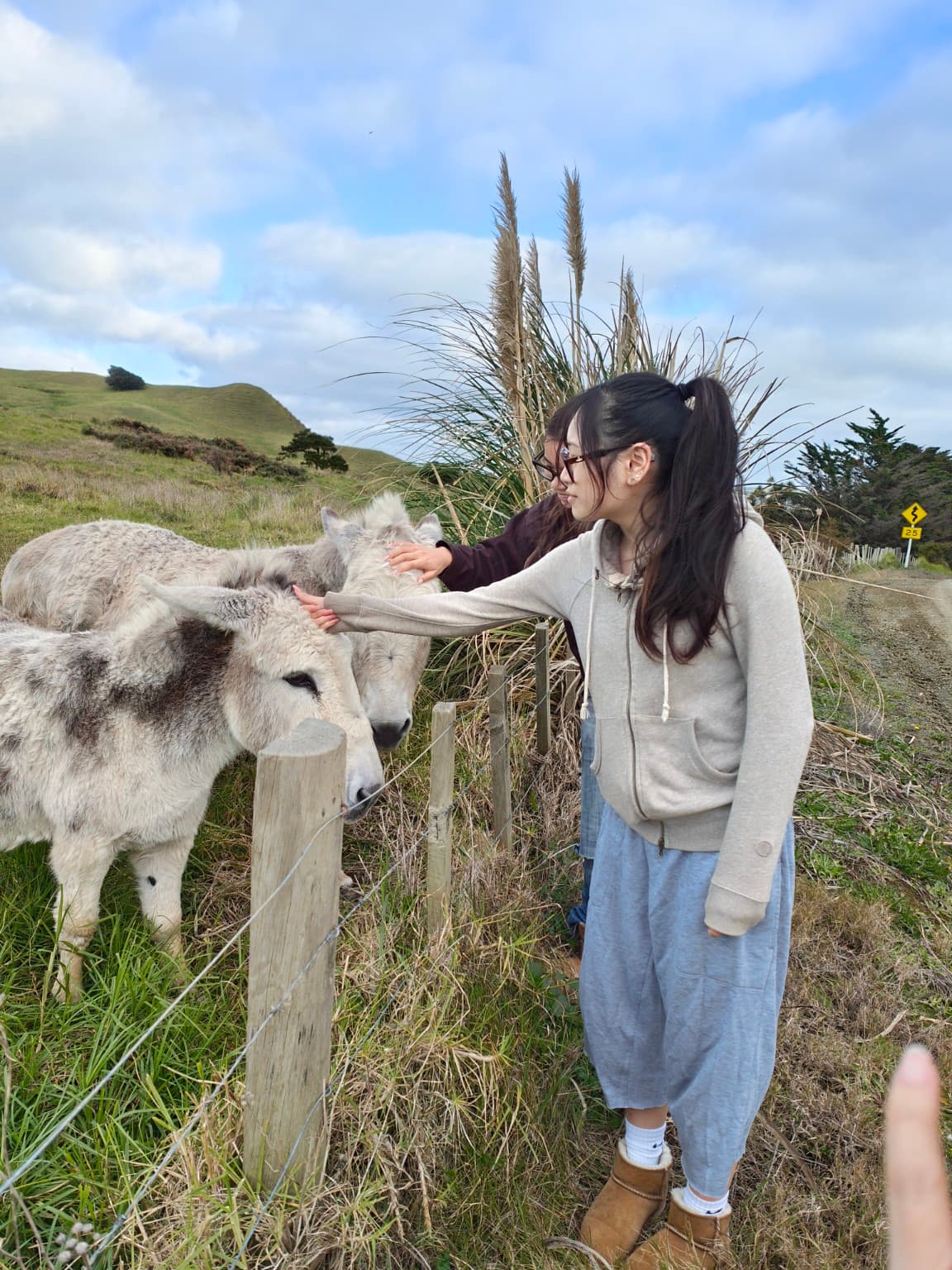
By the roadside, two donkeys had already stretched their heads towards them. Their grey-white winter coats were a little tousled by the wind, their long ears standing upright. As the girls reached out, one donkey lowered its head and sniffed at their palms.
We had come to climb Tokatoka.
At lunchtime that day, we had still been in Wellsford.
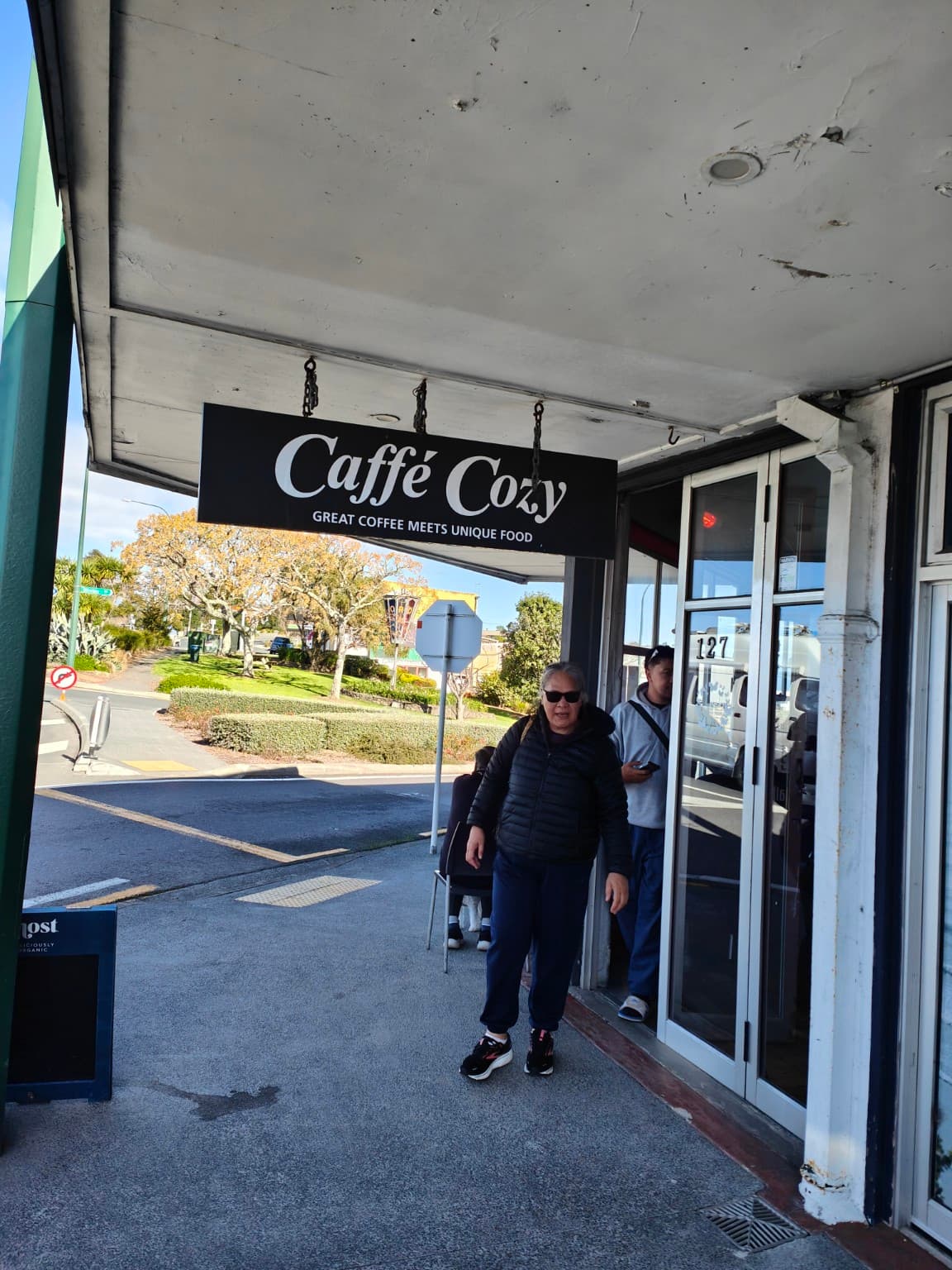
The café had red booth seats. Lunch was almost finished; there was only a little food left on the black plate, with a crumpled napkin beside it. Katherine held a black coffee mug in both hands and drank slowly.
The car was parked outside.
When she finished the coffee, we carried on north.
Since leaving Auckland, the houses had gradually thinned out. There were more paddocks by the road, and the towns were separated by longer stretches of open country. Katherine took the last sip of her coffee. We stood up and went back to the car.
Next stop: Matakohe.
Touching the Rings of Time
The first thing we saw inside The Kauri Museum was wall after wall of black-and-white photographs.
Logging crews stood beside enormous trees. Old houses, sawmills, carts and logs appeared one after another. Farther in were black steam engines, huge flywheels, timber-cutting machinery, and reconstructed scenes from the old logging days.
The stairs were timber. So were the railings, and the beams running one after another above us. Katherine walked upstairs with a boat behind her and machines below that had not turned for many years.
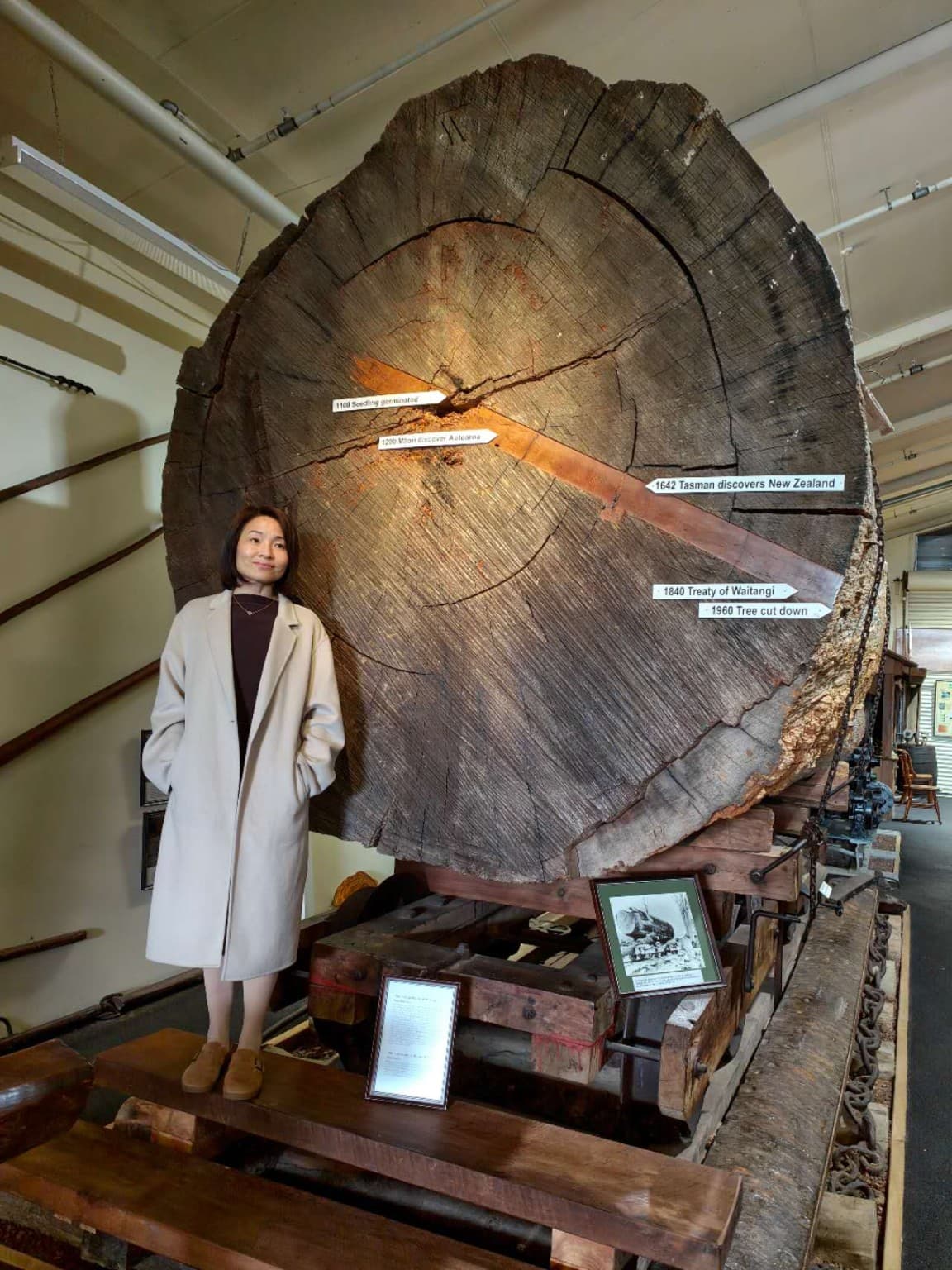
Then we came to the great cross-section of a kauri tree.
It almost filled the wall.
Katherine stood beside the trunk. Her pale coat rested against ring after ring of dark timber, and she looked very small.
The heartwood sat at the centre, and the growth rings moved outward in circles. Cracks cut through the grain. Small labels marking different years had been fixed directly onto the timber.
The innermost one read:
1160.
The tree had only just begun to grow.
Farther out was 1642. By the time Abel Tasman’s ships reached New Zealand, it had already been growing for centuries.
Then 1840.
The Treaty of Waitangi.
Farther still:
1960.
The tree was cut down.
The dates moved slowly outward across the rings. I reached out and traced them with my hand.
The wood still felt slightly damp. Its surface was rough, and under my fingertips I could feel the fine ridges of the grain.
One ring.
Then another.
Running my fingers across them, I realised that time had really been carved into the wood.
I looked back at the small label marked 1160.
The tree had only just begun growing then. The earliest people known to have settled permanently in these islands would not arrive for more than a century.
琥珀里的虫子
再往里面走,玻璃柜里的颜色忽然亮了起来。
Farther inside, the colours in the display cases suddenly changed.
Pieces of kauri gum lay beneath the lights. Some were dark, some honey-coloured, some translucent enough for the light to pass through them. They looked a little like amber.
I stood there for a while.
“Do you remember that Chinese-language lesson we had when we were kids—the one called Amber?” I asked Katherine.
For years I had remembered a bee inside it.
Resin fell around the insect and sealed it in. Much later, when it was found again, the tiny creature was still there.
Only now did I realise I had remembered it wrong.
It was not a bee.
It was a fly and a spider.
Strangely, I had forgotten the insects but never forgotten the piece of clear amber.
All those years later, they were still inside it.
I looked down at the kauri gum in the glass case. When I read that school lesson as a child, I could never have imagined that one day Katherine and I would be standing in northern New Zealand, looking at resin like this and remembering the same story.
Beside the display cases were old photographs.
People stood in mud and swamp, holding long probing poles. They pushed the poles into the ground. When they struck something hard, they dug.
That was how the gum came out of the earth, piece by piece.
Māori dug for it. European settlers dug for it. Later, many Dalmatians who came to Northland made their living this way too.
The people in the photographs had mud up their boots and trouser legs.
The gum behind the glass had been polished until it shone.
What sits in museum cases today was once a living for many people.
Farther on, we came to a display showing how kauri forest had changed over time.
I no longer remember the exact numbers.
What I remember is the shape of the map.
At first, the colour spread across large connected areas.
Then there was less.
And less again.
Until only scattered patches remained.
I stood there for a moment.
When I turned around, the huge black flywheel we had seen earlier was still sitting where it had been.
I thought of the rings I had just touched.
One ring takes a year.
That wheel only needed steam to begin turning.
Later, one kauri after another fell in the forest.
“你们自己走吧”
Still heading north.
孩子们先看见了。
At the foot of Tokatoka, the two donkeys were standing beside the road.
The children saw them first.
The moment the car stopped, they were gone.
I called after them.
“Weren’t we all going to climb the hill?”
One of them did not even look back.
“You two go on. We’re staying here.”
One of the donkeys stood beside a low post and the long grass, its winter coat thick and shaggy, patched grey and white.
A child held out her hand.
The donkey brought its nose close and sniffed at her palm.
She moved a little nearer and rested her hand on its forehead.
The donkey did not pull away.
Instead, it slowly closed its eyes.
The other donkey edged closer. Another hand reached out.
Watching them, I thought of the kauri tree that had begun growing in 1160.
There were no donkeys here then.
No horses, cattle or sheep either.
For a very long time, this isolated land had no native land mammals apart from bats. Then people arrived. Later came European ships, farms, roads, and animals that had once belonged to another part of the world.
I looked at the children and found myself wondering what the first Māori children to see a donkey might have thought.
I do not know.
Perhaps they too stood back for a while, then slowly came closer and reached out a hand.
Moments like that left no record.
The donkey in front of us pushed its nose forward again.
山顶上,我找不到她们
The children had now completely abandoned the idea of climbing Tokatoka.
So they stayed with the donkeys while Katherine and I started up the hill.
走了一段以后,坡开始变陡。
Katherine 那天原本就没打算徒步,穿的还是一件长风衣。再往上,路已经越来越不好走。
From below, Tokatoka did not look especially high.
The first part of the track was easy enough. We climbed steadily, while the grass, road and car park slipped lower behind us.
Then the slope began to steepen.
Katherine had not planned on hiking that day. She was wearing a long coat, and as the track became rougher she stopped and looked up at what was ahead.
“I think I’ll go back.”
She turned around.
I carried on alone.
From there, the slope grew steeper. Near the top, the rock rose directly in front of me. It was no longer enough simply to walk.
I grabbed a protruding rock above me, moved my right foot to the next foothold, and pulled myself higher.
Somewhere along the way, walking became climbing.
For the final section, I was using both hands and feet.
Then suddenly there was no more slope.
I stepped onto the summit.
Everything opened.
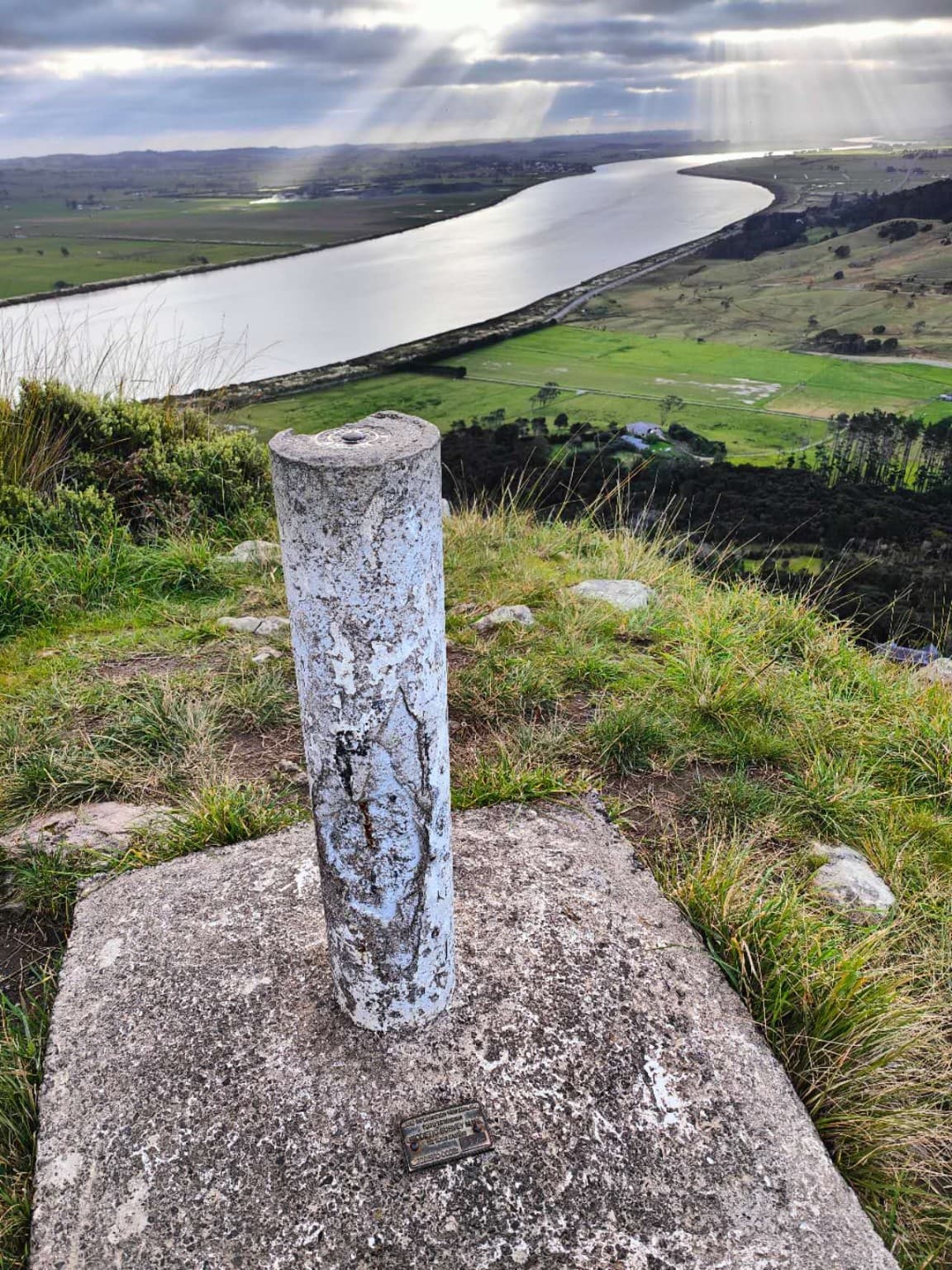
The wind hit me side-on and pressed my clothes against my body. There was only a weathered marker beside me. The land dropped away in every direction, with no trees and almost nothing to block the wind.
The road had become a thin line. Farmland spread out in broad patches, and the houses were reduced to tiny marks.
Below lay the Northern Wairoa River.
It ran through the green farmland and curved slowly in the distance. Heavy cloud covered most of the sky, but farther away a few shafts of light broke through.
The river suddenly turned bright.
A strip of silver across the land.
The wind was strong.
After looking at the river, I thought of the children below.
And the two donkeys.
I followed the road back with my eyes. The fences were little more than lines now, the houses only dots. I searched farther out.
I could see the paddocks.
I could see the roads.
I could see the river.
I just could not see the children.
Or the donkeys.
I did not stay long on the summit. The wind was too strong. I looked once more at the Northern Wairoa River and started down.
The final section that had required hands and feet on the way up was even more awkward in reverse. I lowered one foot until I found something solid, then loosened my grip and eased my weight down.
Once I was past the steepest part, the track became a track again.
I kept walking towards the bottom.
Before I reached the car, I saw the donkeys first.
Then the children.
They were still there.
One donkey had lowered its head.
A child’s hand was still resting on its forehead.
The wind moved through the grass and lifted the long hair of its coat.
The rings in the museum came back to me.
Then the clear resin.
READER NOTES