
This SeriesAbel Tasman
- 01Only Two in the Photograph
- 02The Tractor Pulled the Boat into the SeaCurrent
- 03There Was a Café Behind the Trees
- 04A Bird on the Bridge
“Three-thirty. Anchorage.”
“Don’t miss it. Otherwise you’ll have to walk back.”
The skipper said it from the boat, already backing away from Bark Bay.
A Few Hours Earlier, the Boat Was Still on the Road
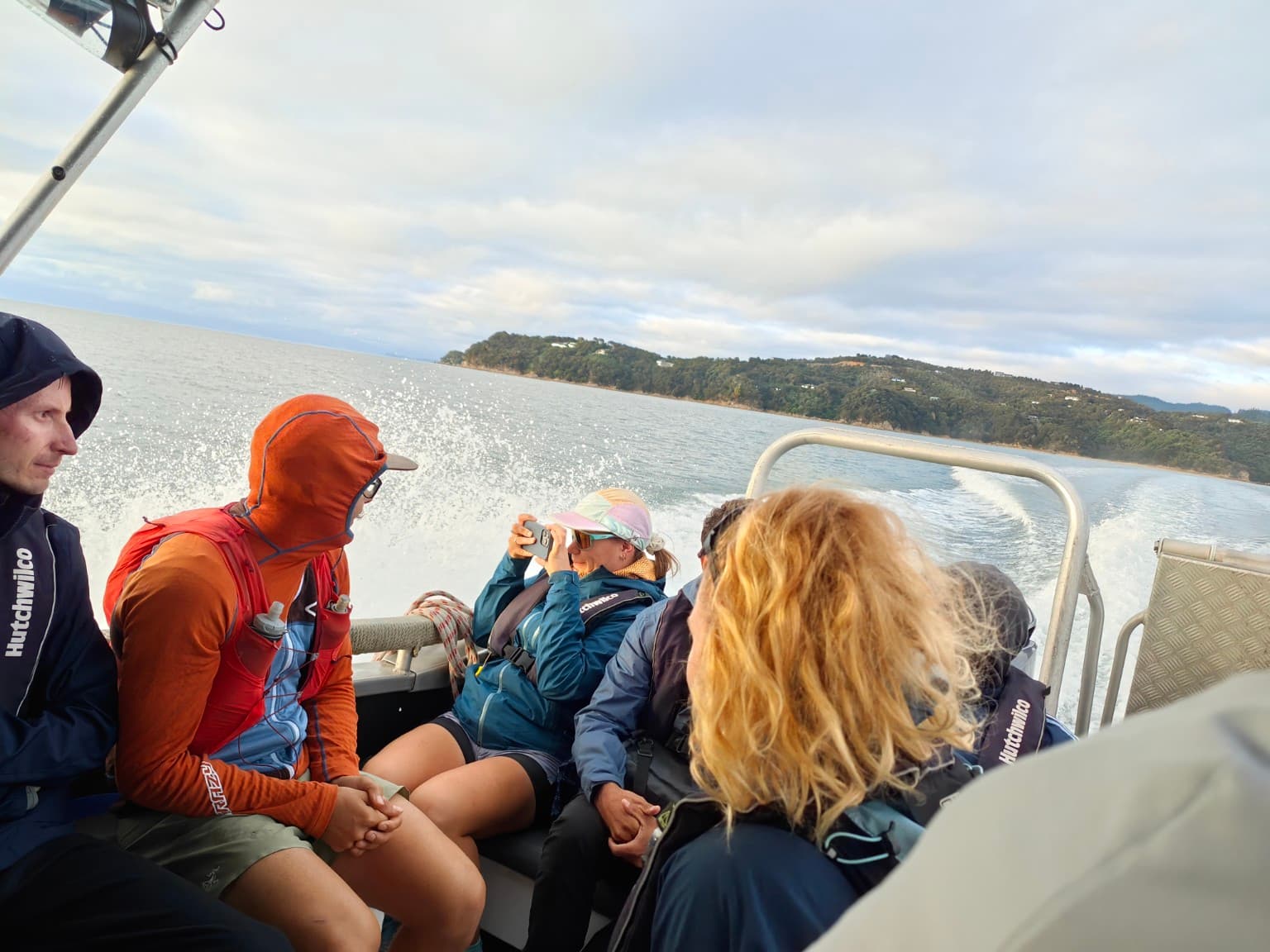
That morning at Mārahau, we were already wearing lifejackets and sitting in the water taxi.
My pack was at my feet.
The boat was nowhere near the water.
In front of us stood a tractor.
Its engine started and the whole boat began to move, trailer and all, along the road. We passed houses, parked cars and patches of grass. Looking only at the passengers, we appeared ready for sea. Looking over the side, we were still travelling through a village.
It was our first Great Walk.
We had chosen not to carry several days of gear or sleep in huts. Each morning we would take a water taxi into the national park, walk south for the day, and catch another boat back to Mārahau in the afternoon.
Day one was Bark Bay to Anchorage.
I looked down at myself: long trousers, jacket, walking shoes.
Around us were shorts, T-shirts and small daypacks.
Inside my pack was a thermos.
It contained hot water.
The tractor kept going.
The asphalt ended. The wheels rolled onto wet, shining sand.
At low tide, the sea at Mārahau retreats a long way from the road. The tractor simply followed it.
At first there was only a skin of water over the sand. Then the water climbed the tyres.
The tractor stopped.
Its diesel engine was still running when the outboard behind us came to life. The hull shifted. The trailer slipped away beneath us.
The sea took the weight.
There was no road ahead.
The Coast Unfolded from the Boat
Once the water taxi gathered speed, wind came hard across both sides.
Headland after headland passed.
Forest ran down the slopes almost to the rocks. Around one point, a strip of golden beach appeared below the trees; around the next, it vanished, replaced by blue-green water against the shore.
Some bays had no houses.
No road.
From the sea, it was difficult to tell whether anything existed behind the forest at all.
Now and then a piece of track showed between the trees and disappeared almost at once.
The water changed constantly: dark blue offshore, clear green over the shallows.
At Bark Bay, the boat nosed into the beach.
We stepped down into the sand. My pack was handed after me.
The skipper stayed aboard.
He pointed south.
“Three-thirty. Anchorage.”
I nodded.
The boat turned away. The sound of the engine diminished across the bay.
At the edge of the forest, a sign pointed north to Awaroa and south to Anchorage.
I took out my phone, checked the time, and put it back in my pocket.
We went south.
The Tide Chose the Route
At Rākauroa / Torrent Bay, the route changes with the tide.
At low water, walkers can cross the estuary. When the tide is wrong, the track climbs away from it and goes around.
That day, the short way belonged to the sea.
We took the all-tide track.
The path entered coastal forest almost immediately. Ferns leaned out from the slope, some close enough to brush a shoulder.
The sea did not remain beside us.
For long stretches there was only forest, hillside and the track underfoot. Then a bend would open, and the water would flash below again.
A kayak moved across one patch of blue-green sea.
Two people sat in it, no larger than dots.
A few steps later the trees closed and they were gone.
Falls River lay across the track.
A long suspension bridge hung between the forested banks.
A sign at the entrance said:
Maximum 10 people.
The bridge moved beneath each step.
Below, the river was dark under the trees. It was hard to see the bottom.
I stopped near the middle.
My hand went into my pocket.
The phone lit up.
I checked the time, switched the screen off, and kept walking.
Beyond the bridge, the path returned to the trees.
This coast does not run in a straight line. Bays cut deep into the land, and the track has to work around them: into a gully, up a slope, around a shoulder, then down again.
The sea appeared.
The sea vanished.
“Can We Stop for Some Water?”
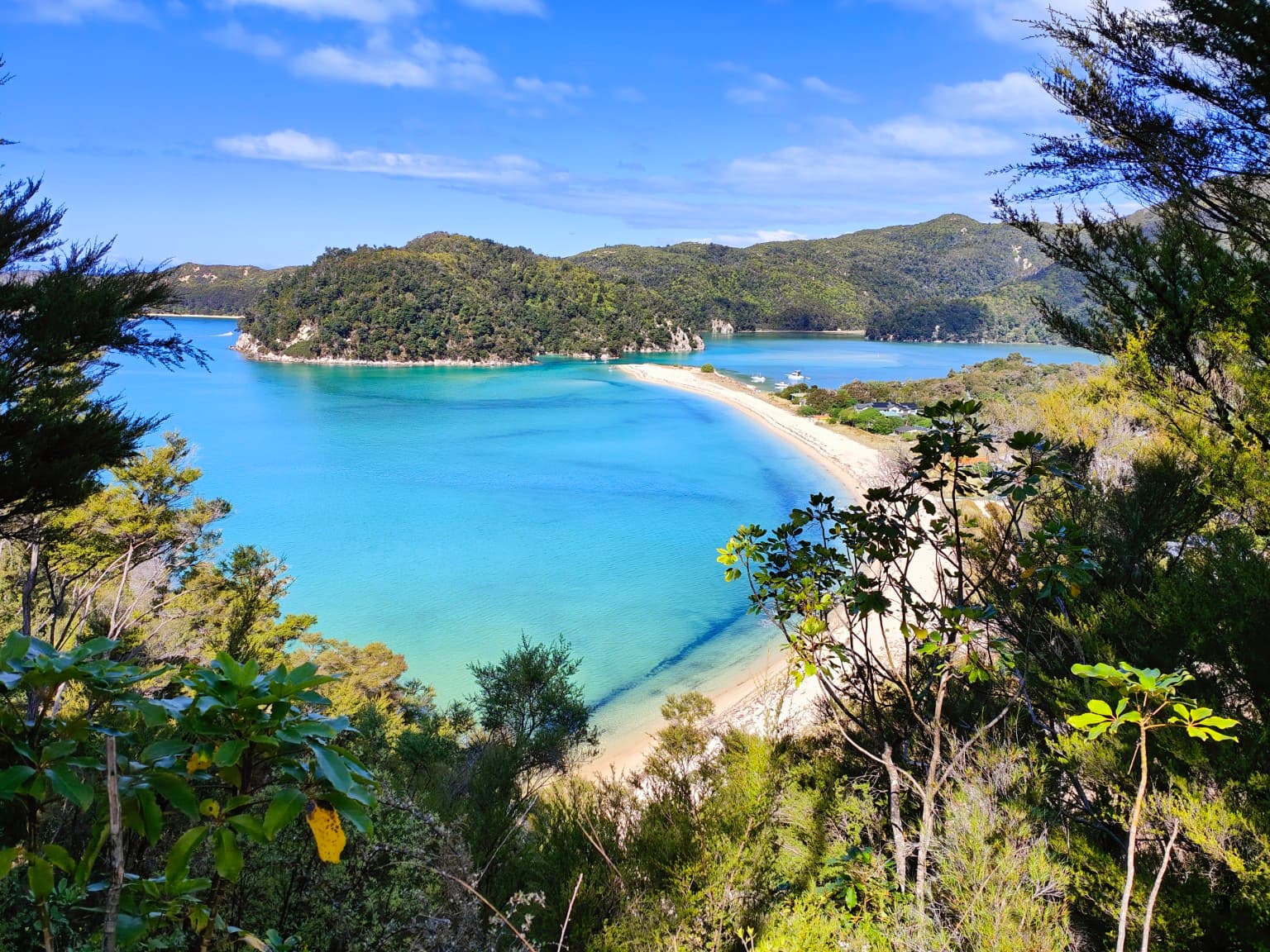
After several more ridges, Torrent Bay suddenly opened below us.
I stopped.
All morning the sea had appeared in fragments. Here it was spread out at once.
A pale sandbar lay across the bay. The water close to shore was almost green; farther out it deepened into blue. A few houses stood near the tidal flats. Boats rested close to the waterline.
From above, everything looked small.
I took out my phone.
A photograph.
A few steps sideways.
Another.
No angle seemed large enough for the whole bay.
“Can we stop for some water?”
Katherine’s voice came from behind me.
I turned.
She stood at the edge of the track with both hands on her knees. Her shoulders rose and fell with her breathing.
The phone went back into my pocket.
We sat beside the track.
I took the water and thermos from my pack. Katherine unscrewed her bottle and drank slowly. I poured some hot water.
It was still warm.
Below us lay the tidal flat we could have crossed at low tide.
After a while Katherine tightened the lid on her bottle, put both hands on her knees and pushed herself upright.
I shouldered the pack.
Within a few minutes the trees had hidden the bay again.
3:15
After that, the phone came out more often.
A stretch of track.
The screen.
Another climb.
The screen again.
At one point the sea appeared through the trees.
This time I did not take a photograph.
The phone lit up only long enough to show the numbers.
Katherine’s stride became shorter. On the climbs she sometimes pressed a hand against her thigh. At the bends she would stop, wait for her breathing to settle, then start again.
I began stopping at the bends ahead.
When she reached me, we turned into the next climb together.
Earlier in the day we had talked about visiting a waterfall.
A sign for the side track came up.
I checked the phone.
Katherine was already continuing along the main track.
The phone went back into my pocket.
So did the waterfall.
Near the end, more light began to appear between the trees.
Then sand.
Then sea.
We came out of the forest and Anchorage lay in front of us.
I took out my phone.
3:15 pm.
There was no boat.
I put my pack down on the sand.
Katherine found a piece of driftwood and sat. She took off one shoe and turned it upside down.
Several small stones dropped out.
She shook it.
A few more followed.
I sat beside her and stretched my legs.
Fifteen minutes.
In the forest, fifteen minutes had felt far too small.
On the beach, it suddenly seemed generous.
At three-thirty, a small shape appeared on the water.
It grew larger.
The water taxi had arrived.
Later that evening, my phone showed two numbers from the day:
15.94 kilometres.
25,048 steps.
After the Tide Went Out
Back in Mārahau, I stopped checking the time.
We had dinner at Hooked.
Only a road separated our table from the shore.
That morning the tractor had driven across the same ground towards the water. Now the tide had gone far out, leaving a broad sheet of wet sand marked by shallow channels.
Katherine ordered a local wine.
I had a beer.
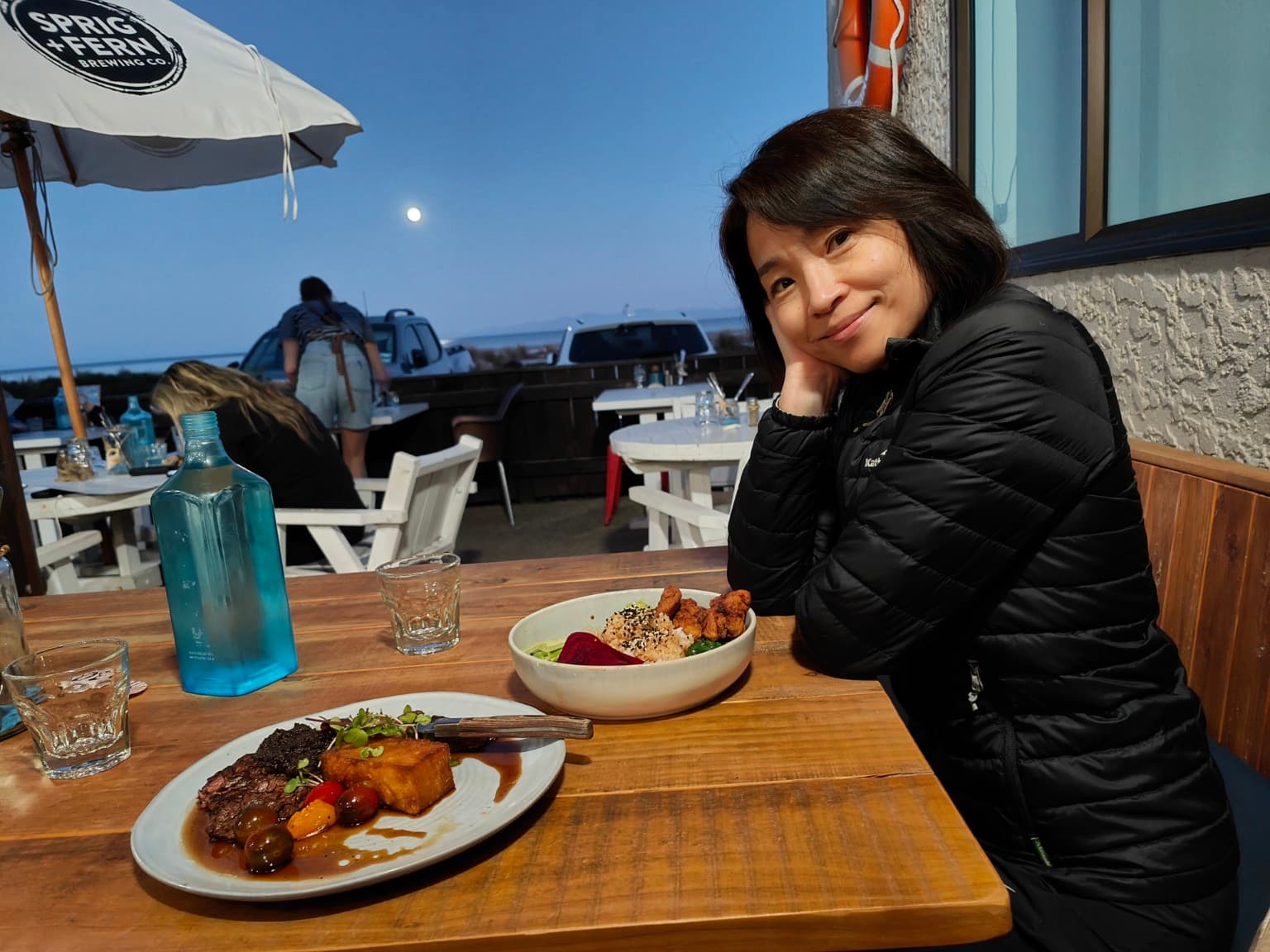
She ate for a while with her head down.
“How are you?”
She looked up.
“Okay.”
Then back to her plate.
A little later she slowly stretched both legs beneath the table.
“My thighs are so sore.”
By the time the glasses were half empty, the light was fading.
Katherine turned towards the tidal flats.
“I don’t know if I can walk tomorrow.”
The sky beyond the table had begun to change colour.
A pink moon rose above Mārahau.
Where the tractor had driven that morning, there was now only the wide, empty shore.
Neither glass was finished.
Tomorrow could wait until tomorrow.
READER NOTES